.JPG) |
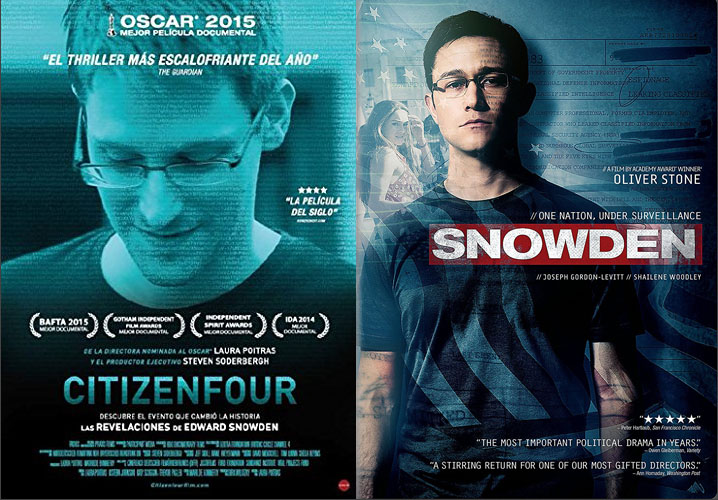
| Edward Snowden in "Citizenfour" |
I was watching the Academy Award-winning documentary “Citizenfour”about Edward Snowden. . . .
. . . I realize as I write that sentence there must, of course, be a lot of people be authoring essentially the same sentence, or its equivalent on computers these days, in emails or in phone texts or via other electronic devices. .
Having watched the film, I realize that the writing of such a sentence will, one must assume, attract attention, in all probability sooner, rather than later, something to take into account even though I eventually do plan to publish the sentence, at which time that publication, and any reaction to it, must be presumed to attract some greater level of additional attention.
This is my first National Notice article about libraries. I’ve written a great deal about what is happening to libraries in the city of New York where library real estate is being stalked by acquisitive developers, but I am writing here about this issue in National Notice because what I am about to address here it is an issue of national importance.
During the McCarthy era agents of the FBI showed up at the New York Public Library and said that wanted to know what books people were reading. The librarians were said to be aghast and briefly at a loss about what to do because they recognized the invasion of privacy that this represented. The solution to their plight, however, was apparently very simple: They took the FBI agents into a room where they showed the agents stacks of call slips for the books. The agents had no idea what to do with such an overwhelming amount of data, exited and never returned. This story was told to me by a long-term librarian.
During the McCarthy era there was also concern about what books were available in the libraries, how readily available certain books were and concern about the political leanings of librarians working in the libraries.
Times change and societies transform, often abruptly. Who would have thought that there would have been a time in the United States when freedom of thought was so perilously threatened? The Nazi era in Germany and the countries Germany occupied also provide examples of how completely countries could change faster than residents could recognize the dire threat they faced in time to flee and save their lives.
Much of the vastly expanded surveillance in the United States documented by Snowden came about abruptly after 9/11. There had been pendulum swings in both directions before. The paranoid abuses of government and Nixon’s enemies list during the Watergate era led to new check and balance protections that were gutted after 9/11.
And libraries? That’s what this article is about: Changes occurring at libraries mean that what you read there probably won’t be private anymore.
Author David Baldacci recently
commented to the New York Times:
Libraries are the mainstays of democracy. The first thing dictators do when taking over a country is close all the libraries, because libraries are full of ideas.
Indeed, the elimination of books is closely associated with
dictatorships and totalitarianism and totalitarian governments are likely interested in controlling thought will be interested choosing what is available to the public to read. Most recently, ISIS
reportedly ransacked Mosul's central library, destroying and burning 100,000 books and manuscripts, many of them reportedly
rare and ancient, that did not conform to their notion of what should serve their conception of Islam.
But the surveillance state is interested in something else: The surveillance state wants to know
what you think and for that reason the surveillance state believes that libraries should tell the government what you read.
Librarians in Connecticut were the first to successfully
challenge the PATRIOT Act when the FBI, along with an accompanying perpetual gag order to keep its actions secret, demanded broadly that the Connecticut librarians turn over to the bureau library records concerning what their patrons were reading and their computer use.
Secrecy was the name of the game. According to a report of the trial in
Mother Jones:
Among the evidence the government had tried to keep secret were quotes from previous Supreme Court cases; copies of New York Times articles; and the text of the Connecticut law that guarantees the confidentiality of library records.
Previously, librarians of the American Librarian Association had, relatively soon after the passage of the PATRIOT Act, fired a shot across the National Security Agency’s (NSA’s) bow, with passage of a
January 29, 2003 resolution by the ALA Council, criticizing aspects of the PATRIOT Act and urging librarians to be protective of the patrons' privacy. Librarians were recommended to adopt:
patron privacy and record retention policies that affirm that the collection of personally identifiable information should only be a matter of routine or policy when necessary for the fulfillment of the mission of the library"
Among other strong measures it was urged:
librarians everywhere to defend and support user privacy and free and open access to knowledge and information
The resolution cited among its premises that:
. . . Libraries are a critical force for promoting the free flow and unimpeded distribution of knowledge and information . . . that suppression of ideas undermines a democratic society, . . Privacy is essential to the exercise of free speech, free thought, and free association; and, in a library, the subject of users' interests should not be examined or scrutinized by others. . Certain provisions of the USA PATRIOT Act . . threaten civil rights and liberties guaranteed under the United States Constitution and Bill of Rights
And very important to the discussion here it cited:
the likelihood that the activities of library users, including their use of computers to browse the Web or access e-mail, may be under government surveillance without their knowledge.
End of story? Did the NSA, just pack up its bags and leave, tail between its legs? Back in the days of the swaggering Bush administration?
What do you think the NSA would do, especially after familiarizing yourself with Snowden’s disclosures concerning the NSA’s secret back doors into all things electronic?
One might suspect that the NSA’s opponents might become even much more of a target. That was probably likely, but remember that what the NSA does, it does not do out in the open.
Now consider this: Changes are being implemented at libraries, and the changes are particularly apparent in New York City, that would make the heroism of these librarians wanting to protect their patrons’ privacy virtually meaningless except for its symbolism. . As a practical matter the NSA is probably going to know what you read, just as it always wanted to.
The changes being implemented are twofold:
1. An elimination or significant curtailment of the availability of physical books at the libraries that is being pushed even though the public still craves its physical books.
2. To the extent that physical books can still be read at the library they must increasingly be requested by computer, often online, and this is more and more often being necessitated by keeping books off-site of the library premises.
Given its multitudinous back doors to technology the NSA will certainly be able to find out what you are reading from the library. It’s not just libraries: If you buy your books online from Amazon or Barnes and Noble the NSA is probably going to know that too.
When it comes to ebooks it is quite astounding what someone else at a remote location can easily know about your reading. The publishers of ebooks are not only able to know when you began reading your ebook and whether you ever finished it, they can also determine how long you lingered on each page, what you may have skipped over or chosen to read first. In other words,
“just what kind of reader you are.” See
BuzzFeedNews: Publishers Know You Didn't Finish "The Goldfinch" - Here's What That Means For The Future Of Books- The publishing industry's uneasy embrace of Netflix-style analytics, by Joseph Bernstein, January. 21, 2015.
As The Guardian in “
Big e-reader is watching you” (by Alison Flood, July 4, 2012) puts things
. . . Would Orwell have been amused or disturbed by the development that Big Brother now knows exactly how long it takes readers to finish his novel, which parts they might have highlighted, and what they went on to pick up next?
Because your ebook, as a recent article in the Wall Street Journal put it, is now reading you right back.
* * * *
Back to Orwell. Nineteen Eighty-Four, says Amazon, is the 608th most-highlighted book it sells. "'Who controls the past,' ran the Party slogan, 'controls the future: who controls the present controls the past'" has been marked by 349 Kindle users, while "If you want a picture of the future, imagine a boot stamping on a human face - for ever" has been highlighted by 195. What would George have said?
There is nothing an e-reader publisher is able to know that the NSA isn’t able to find out too.
Also, with digital reading, if the publisher decides retroactively that it doesn’t want you to be reading what it gave you to read, it can make it disappear. Amazon did exactly that in 2009 when it eliminated George Orwell's "1984" from its patrons' Kindles. Wrote the New York Times:
In George Orwell's "1984," government censors erase all traces of news articles embarrassing to Big Brother by sending them down an incineration chute called the "memory hole."
On Friday, it was "1984" and another Orwell book, "Animal Farm," that were dropped down the memory hole - by Amazon.com.
(See:
New York Times: Amazon Erases Orwell Books From Kindle, by Brad Stone, July 17, 2009.)
Amazon removed the books and others such as digital editions of the Harry Potter books and the novels of Ayn Rand as the most convenient to itself way of dealing with some licensing disputes. The precedent, however, is truly frightening. What’s worse is that there is no reason to believe that disappearance or deletions would always occur only in discrete book-size chunks. It might be just a paragraph or particular phrasing that disappears or is altered, just as it was the job of the Ministry of Information to do in
"1984."
The possibilities play out interestingly in a situation like the following. In 2010, Anthony Shaffer, a former military intelligence officer who was a military spy in Afghanistan and elsewhere, released a book,
“Operation Dark Heart,” after getting CIA clearance of its content. The book was already out and public when the CIA decided to rescind various aspects of its previously granted clearance. Unsold versions of the book (10,000 copies) were destroyed at government expense. This led to comically absurd outcomes. With
two versions of the book ultimately in release (review copies were out), exactly what the CIA had wanted redacted was highlighted by the contrast (including, for some reason, a reference to the actor Ned Beatty). Also, the CIA
would not release to Shaffer, a copy of the book that he, himself had authored and submitted to the CIA for review because it was classified.
Of course, we all know how this very same situation turns out in the digital, ebook world: The CIA instructs the publisher to make deletions whenever it decides on retroactive reclassification of previously cleared and public materials, and the readers, if they notice at all, get a feeling of vague disquiet that what they went back to read again is not what they read originally. If they linger over the particular passage trying to figure out their unease, somebody in a remote location can be taking note of it.
The idea of fluidly changing books is a reality. The industry is already releasing ebooks that are being re-edited based on reader feedback. It is a very small shift from this to books that perpetually and fluidly change for other less laudable reasons.
In the end, there is nothing to prevent ebooks from becoming the equivalent of an ever-changing web page. The old axiom that you can never step into the same river twice would similarly apply. Ever-changing web pages* may be beneficial in the context of Wikipedia, but where does this lead when it come to books?
(* When it comes to changing web pages there is actually some monitoring that currently occurs. Would that happen in the case of an e-publisher’s books?)
Government could be the culprit that ultimately makes our ready access to reliable information extremely tenuous, but the undermining of the availability can also come from the private sector.
Citizens Defending Libraries (of which I am a co-founder) has
testified at New York City Council hearings about the relationship of the privatizing sell-offs of library real estate to the threat of another form of privatization (excerpts below):
. . we must be wary that there are many who see the digitized future in terms of an increasingly privatized future where corporations pushing for various plans expect to make a lot of money by controlling digitized information, in many cases, by charging the public for what's already owned by the public in public collections that are being put out of reach.
* * *
Digital activist Aaron Swartz warned about this disturbing trend:
The world's entire scientific ... heritage ... is increasingly being digitized and locked up by a handful of private corporations....The Open Access Movement has fought valiantly to ensure that scientists do not sign their copyrights away but instead ensure their work is published on the Internet, under terms that allow anyone to access it.
In the future we may expect that after the libraries have contracted out to privatize content we will be charged exorbitantly high fees for what was once publicly owned. The further irony in all of this is that much of the transcription and other work to create digitally available content may have been crowd sourced so that the public will be charged for what it once freely owned and for the result of its own freely contributed work product and intensive labor creating privatized content.
Whether our slipping hold on the knowledge we are entitled to will come from the private sector or from government does not have to be an either/or proposition. Tim Wu, the Columbia Law School professor who is credited with coining the term
“internet neutrality,” has written in his book, “
The Master Switch: The Rise and Fall of Information Empires,” about how the government often colludes with private corporations. It’s particularly likely when those corporations are monopolies, the very companies the government is supposed to be regulating.
A section of Wu’s book describes how
at the same time that AT&T was assisting President Bush to violate federal law pursuant to a secret executive order by assisting the National Security Administration in the warrantless monitoring of telephone and Internet communications on a vast scale, the phone company's pending plans to reintegrate its monopoly were under review by the Bush administration. Congress then, in July of 2008, passed a law granting AT&T and Verizon full retroactive immunity for any violation of the laws against spying on Americans so the full extent of exactly happened has not been investigated and may never get adequate attention.
To put if frankly, it looks like there was a quid pro quo, a trade of rights, in this case, rights to competitive advantage, in exchange for aiding the surveillance state.
There are societal safeguards whenever monopolies are avoided to maintain a pluralistic society. Surveillance assistance was routinely provided with no objection raised to its illegality by any of the big telecom companies or other large companies, that provided by far the largest bulk of such surveillance. The first
challenge to such surveillance came instead from Nick Merrill, a CEO who ran a small Web-hosting company in New York named Calyx.
Had a few more mergers wiped out the smaller companies, we might never have heard that challenge.
Now let's leave the subject of
electronic books to discuss what is happening with respect to
physical books.
What is becoming knowable about the individual physical books that library patrons are reading is not quite as granular, but a great deal more is now knowable than ever before. Books are being checked out
electronically. If you renew your book, you will renew it
electronically. When you want your books you may even specify
electronically what library you consider it most convenient at which to pick up that book. There will be an
electronic, again web-based, record of exactly how long you kept your book.
Everything you do electronically can be tracked.
You might go to the library to select and read your book
privately, personally removing a copy from the shelves, but more and more under new management practices the number of
books kept on the shelves of New York City’s public libraries is dwindling. Fewer physical books overall and the escalating practice of keeping books off-site of the library premises diminish the chances that you can simply go to any library, or even a central library and expect to find the book on its shelves. If the book you want is the least bit esoteric or unusual its likely
not to be on the shelf. . . in the Brooklyn Public Library you
should not expect to find the books of Jane Jacobs without a a preparatory hunt, some not at all.
One thing you can do to adjust for this is to check library records before setting out for a particular library, but if you do, you will probably do so
electronically on the internet. At the library, you might want to figure out what particular section of book could be in. . . You might succumb and ask your phone (referred to these days as
'personal tracking devices'*) as the quickest possible shortcut.
(* These days they also include built-in fingerprint submission features.)
 |
| The NYPL's 42nd Street Central Reference Library- Famously guarded by the lions, Patience and Fortitude, and behind the statues of Truth and Beauty- Behind those symbols physical books are disappearing from the shelves. |
At the NYPL’s 42nd Street Central Reference Library, (
recently renamed after Stephen A Schwarzman of the Blackstone Group, among other things, the world’s largest real estate investment firm, who, without seeming to be that particularly an impressive fellow, just set a record collecting “the highest annual payout ever notched by a founder of a publicly traded private-equity firm”) any of its millions of reference books will now probably be requested electronically, because those books must be if they are off-site as the majority now are. Those are the books that used to be requested by the physical paper call slip system that once baffled the FBI.
Those research library books will probably be requested electronically whether they are amongst the minority of books still kept at the research library, or amongst the millions more that have been exiled to sites like Princeton, New Jersey. Only if you are already at the library and want to request a book that is actually there will you have the chance to circumvent a computer request with a paper call slip.
 |
| Reverend Billy in Princeton New Jersey where the NYPL sent its books. From his video. |
In August of 2014 the Reverend Billy
led a small band of fellow activists out to discover and visit the ReCAP facility site in New Jersey where the NYPL’s books are now entombed. His plan was to lead a ceremonial
“Stonehenge Circle” protest about the books’ removal. The protest was interrupted, its completion effectively prohibited, because it turned out that ReCAP shares an area of Princeton University with the nearby
Forrestal Campus, a complex which has stringent federal security requirements as a laboratory devoted to nuclear
fusion and plasma physics research.
Maybe it is unlikely that these books could become inaccessible to the public as the result of an accident or political change expanding federal controls over the area, but what is more frightening is considering the fate of the books that some library administration officials are now intent on bringing about by conscious design. That can be seen in this report on the ReCAP website:
ReCAP-Discovery to Delivery Project- April 1, 2012 through July 31, 2013, Final Report to the Andrew W. Mellon Foundation, October 2013.
When I first heard that million’s of the NYPL’s research books were being moved to, of all places, far away Princeton, New Jersey, I had an initial reaction of, Oh My God, is there some sort of plan where, in the end, the university is going to wind up owning all these books, a reaction I tamped down as paranoia on my part. . . Little did I think I’d eventually learn that this suspicion was not nearly so far off the mark as I’d thought.
 |
| From the report, speaking as of 2012, before the NYPL's transfer of even more of its research books |
This
“Final Report to the Andrew W. Mellon Foundation” speaks of the NYPL, Columbia University, and Princeton University as being partner institutions with ReCAP. It envisions that to `manage’ the books `efficiently’ the collection, effectively its ownership, would be “shared.” The sharing would extend to eliminating many books that were independently owned and identifiable as such in what is euphemistically phrased as a
“deduplication” of stock,
“deduping” for short. At the same time, books, now many of them made so much rarer through
“deduping,” would be put at risk by allowing them to be borrowed and circulated to
“authorized borrowers of any ReCAP partner.” That would typically be anyone from the universities, students or professors, as NYPL research collection books never circulated to NYPL patrons. They were considered too valuable.
 |
| Also from the report envisioning "deduping"of the shared books |
At the same time, the report also speaks of discouraging the reading of the physical books by encouraging that
“digital surrogates” of the books be electronically searched before any actual retrievals of books for use. That’s the
“discovery” of the report’s title. It would be done (are you listening, NSA?) through a
“cloud-based middleware system.” That system is spoken of as providing
“visibility” in
“real time status.” That’s
visibility to the users of the library. . Theoretically. The report envisions expansion of this
“cloud-based middleware system” system to all the libraries’ books.
 |
| From the report- "Search and Discover" has been slightly increased in size by National Notice to help emphasize its importance in the structure |
This scheme of locating the entire
“shared” collection books in New Jersey makes the books sound rather like the family portrait owned on a
“shared” basis by a group of siblings except that it is one sibling who keeps it hanging in her own home. It’s hard to ignore the fact that
“shared” books kept on the Princeton campus are most accessible there, especially when the NYPL concedes that transporting books to people who want them in New York is
interfered with by things like the Super Bowl.
The NYPL is contributing far more of the books to the
“shared” collection than the two universities. Princeton is contributing the fewest. According to the report the NYPL had the most books there already, 3.5 million in November of 2012, and noted that
“a significant number of additional materials” would come
“as part of the NYPL’s Central Library Plan.” In 2013 the NYPL emptied the research stacks under the Rose Reading Room with more transportations. Those stacks were historically understood to house another
3 million books, but NYPL president Anthony Marx recently asserted that the NYPL (presumably before any deduping) had determined that 3 million number to be somewhat overstated.
“Deduping” mankind’s knowledge into one central repository where it is intended to be shared may sound efficient, even altruistic, but it reflects a hubristic indifference to how knowledge survives the ages. Among other things it forgets that one of the benefits of a pluralistic society is the check and balance safeguards that inherently result. The conservative pro-tar-sands Harper government in Canada is apparently antagonistic to having evidentiary records in its libraries that document and further the understanding of climate science and climate change. Accordingly it’s engaged in a
wholesale destruction of the contents of its national libraries, including:
An irreplaceable, 50-volume collection of logs from HMS Challenger's 19th century expedition went to the landfill, taking with them the crucial observations of marine life, fish stocks and fisheries of the age.
In that particular case, however little the consolation, a copy of the logs was later found overseas. That is all we have that mitigates such tragedies when the occur.
The Great Library of Alexandria famously failed. The myth is that it met is demise in a single catastrophic fire. Actual fires may have seeded the myth, but the more encompassing explanation is that the library slowly degraded and fell apart in serial destructions over a prolonged period, lack of funding being one of its problems.
 |
| Image from Wikipedia: The Library of Alexandria- by O. Von Corven - Tolzmann, Don Heinrich, Alfred Hessel and Reuben Peiss. The Memory of Mankind. |
The Alexandrian library was intended to be a central repository of all of mankind’s knowledge, something it probably largely achieved. It built up its stock of books in a commandeering fashion. Whenever a ship came into the port of Alexandria all of its books had to be presented to the library for copying by the library’s scribes. But when the copies were made, books were returned to the ships. Reputedly some copies were so good that the ships may not have known whether they got back an original or a copy.
Although ultimately the Great Library of Alexandria wasted and then vanished, the copying that created duplicates meant that, at least as much of mankind’s knowledge survived as if the library had never been created, had never commandeered the knowledge into its collection. . . .
. . . It is the job of lawyers to envision the worst when drafting agreements (I am a lawyer), and the lawyers who drafted the book-sharing partnership agreement to which the NYPL was to become a party envisions that it is ultimately possible the consortium will unwind. At that time there will be a legal hell of ensuing complications and extra expenses. Even without a total unwinding, minor reversals or retrenchment of some of the decisions carried out could encounter bureaucratic obstacles such as if the NYPL wanted to, for the sake of increased convenience, return books contributed to the shared collection to stacks on its own premises because certain books (referred to sometimes in the report as the
“artifactual” original physical copies) were in frequent demand for retrieval.
 |
| The collapse of the NYPL's Central Library Plan was big news |
In May of 2014 the NYPL’s Central Library Plan
dramatically unraveled. In part because it was going to cost an astronomical amount for what was essentially a drastic shrinkage of library space and services, more than one half billion dollars. That half billion was
at least $200 million dollars more than the NYPL had previously publicized. As envisioned in the report, in 2013, before the plan fell apart, a significantly important part of the NYPL’s collection, an additional three million or so of what were probably the library’s most accessed books, had been transported off premises out of the stacks under the Rose Reading Room. . . .
. . . Notwithstanding the rather abject and embarrassing failure of the Central Library Plan the NYPL announced that it did not intend to return these books to the stacks from which they had been taken. The NYPL maintained that the 110+ year-old stacks that had always been the collection’s home were no longer suitable for their original purpose despite appropriate upgrades over the years. The cost of any further upgrade of the stacks to make them suitable for return to service was dismissed by the NYPL, ostensibly as prohibitive. While that was the reason given, there are many who think the NYPL simply wanted to continue to keep the books off premieres, and one must wonder to what extent the grip of these
“sharing” arrangements presented a force that countervailed against the collection’s return.
Legalities pull both ways, creating a sort of tug-of-war. The report, speaking before this additional major shift of the NYPL’s collection materials, noted that,
“The controversy over NYPL's Central Library Plan may affect planned transfers to ReCAP.” That escalating controversy ultimately became, among other things, three lawsuits that delayed and helped derail the plan, two of which I was involved in as a co-founder
Citizens Defending Libraries, one of the plaintiff parties. Similarly the report noted,
“a strict NYPL deaccession policy may complicate deduping.” Expressed more forthrightly, that second statement translates to an admission that getting rid of books that a library owns is likely to legally violate the duty of care impressed when possession of those books was
entrusted to the library. . .
entrusted to the library and its Board of
Trustees.
Although there are also the issues we have just just reviewed above of whether knowledge will be preserved and readily accessible with the NYPL sending its books off-site to ReCAP, the overarching concern of this article is the issue of
privacy of reading and thought when library collections become accessible only through computers. That concern increases exponentially when books are kept off-site.
The intermediation of computers to access books at the library is intruding into the libraries in another way. In the old days you could, and were likely to, speak to a reference librarian when you hunted for books that would serve your research and mental explorations. You were likely to speak to that reference librarian in person and that reference librarian was likely to have beliefs, per the 2003 ALA resolution quoted from near the beginning of this article, that your privacy using the library should be defended. Now there is a move afoot amongst library administration officials to
substitute off-site computer-based services for these formerly in-person services. These electronically managed services may be supported by running requests through analytical algorithms, possibly supplied by the likes of Amazon and may even, in the future, simply be handled largely by computer robots. . .
. . . Robots? (And Senator Joe McCarthy and his minions once worried about the political leanings of librarians?)
In New York City, the best
analysis and explanation for why libraries, more used and in demand and than ever, have been targeted for sale and shrinkage with the concomitant elimination of the books and the librarians used to occupy their space is that this serves the interests of developers looking to grab their real estate. It should be understood that plans respecting those library real estate ambitions began to emerge around 2005. Groundwork relating thereto may date back a tad earlier, perhaps a year or two. Although there is a decided convergence of interest between those who would like to grab library real estate and those who want the use of libraries to be less private, that does
not mean that there has been any effort by those with these interests to work together or cross-support each other.
In considering aligned interests one should also think about the increasingly monopolistic corporations providing content electronically with whom the NSA regularly gets entwined.
The sale and shrinkage of New York City libraries was initiated and handled largely by the NYPL's Chief Operating Officer, David Offensend, who came from Evercore, a spin-off from Schwarzman's Blackstone Group, until he was replaced by Iris Weinshall, Senator Charles Schumer's wife.* More or less contemporaneously with Offensend's efforts at the NYPL, Offensend's wife, Janet Offensend was involved in implementing similar plans at the Brooklyn Public Library.
(* Weinshall came to the NYPL from CUNY, the City University of New York, where she had handled some somewhat similar and related matters. The NYPL's Science, Industry and Business Library was designed to function on an integrated basis with CUNY's in the same building on 34th Street between Madison and Fifth Avenues.)
If one were to guess when the NSA might have wanted to mobilize to decrease the privacy of library use one might have guessed that it would have viewed the January 2003 American Library Association resolution calling for a defense of libraries as havens of privacy as a call to, instead, target these declared sanctuaries. 2006 was the year that the U.S. government backed off in its litigation with the Connecticut librarians, finally settling and allowing the librarians to speak about the FBI’s previous pursuit of library usage records under the PATRIOT Act.
There are those who feel secure, because they see no evidence to the contrary, that surveillance is benign so long as it is only used to prevent clearly illegal, bad acts such as terrorist attacks.
“Citizenfour,” the Snowden documentary, however, presents challenge to the notion that the NSA always acts in in such a restrained and circumscribe fashion. There a number of references to private companies collaborating with the NSA. For advantage? To avoid disadvantage? Or just because they feel legally compelled?
.JPG) |
| From "Citzenfour": Glenn Greenwald speaking to the Senate in Brazil |
In one scene of the documentary, Glenn Greenwald, one of the journalists who broke the Snowden story, subsequently addresses a Brazilian Senate hearing on NSA spying held in Brasília, Brazil. Speaking in Portugese, he says (the film’s translation below):
First of all, Americans’ justification for everything since the September 11 attacks is terrorism. Everything is in the name of the national security, to protect our population. In reality, it's the opposite. A lot of the documents have nothing to do with terrorism or national security, but with competition between countries, and with companies' industrial, financial, or economic issues.
* * * *
The US government has the ability to get not only metadata, but the actual content of your email, or what you say on the phone, the words you type into Google searches, the websites you visit, the documents your send to colleagues.
This system can track nearly everything that every individual is doing on line. So if you are a journalist investigating the American government, if you work for a company with American competitors, or if you work in human rights involving the American government or any other field, they can easily intercept your communication.
.JPG) |
| From "Citzenfour": Appelbaum before the European Parliament |
A little later in the film, Jacob Appelbaum, an encryption and security software developer, and journalist testifies at a September 2013 European Parliament hearing investigating NSA searches of of EU citizens and companies, telling the assembly:
There is this myth of the passive surveillance machine, but actually what is surveillance except control? This notion that the NSA are passive this is nonsense. What we see is that they actively attack European citizens, American citizens and, in fact, anyone that they can if they perceive an advantage.
Do we need to worry that the NSA puts its finger on the scale to control outcomes? If so, in which situations and how would we know?
 |
| Oscar night: Oscar to Laura Poitras, standing with Glenn Greenwald on the left for "Citizenfour" and Oscar to Graham Moore for "The Imitation Game" on right. |
Another film that took home an Oscar the same night as
“Citzenfour,” also about espionage, could provide some insight into the way NSA may be behaving. That was
“The Imitation Game,” that took home the Oscar for best adaptive
screenplay.
 |
| From left to right: Alan Turig, Benedict Cumberbatch playing Alan Turig and Julian Assange, and Julian Assange appearing in "Citizenfour." |
Spoiler Alert!: Several significant reveals in that film’s plot are key in giving that film a provocative depth and they apply to the questions we probably, if past is prologue, need to take into account when guessing what the NSA might being doing.
“The Imitation Game” is based on actual historical events concerning the breaking of Enigma, the Nazis’ encoded communications during World War II. It is a mostly, if not perfectly, accurate. (Humankind does exhibit a partiality for simplifying historical narratives. How that makes our race vulnerable to unfortunate manipulations will have to be saved for discussion another time.)
The first plot reveal of
“The Imitation Game,” not much of a reveal at all if you know the tales of the time, is how the Nazi code was broken.
After that, you learn in the film’s ensuing reveals:
1. After the Nazi codes were broken, the intelligence community (MI-6, the British Secret Intelligence Service) modulated their interventions into the war, intervening only selectively, sometimes intentionally not using available intelligence and allowing battles and military assets to be lost so that the Nazis wouldn’t perceive by any change in the pattern of outcomes, and would remain unable to detect the surveillance or any tell-tale interventions based thereon.
2. A main theme of the film was highlighted by the Oscar acceptance speech of screenwriter Graham Moore, who spoke of wanting to commit suicide as a 16-year-old: Those who are different, and out of the conventional mainstream who may seem weird or like misfits, even societal pariahs, often have very important gifts to offer. The unfortunate reveal is that even after such individuals may have proved in exemplary fashion how valuable the gifts they offer are, society’s prejudices and demands for conformity may ultimately destroy them nonetheless. The code-breaking protagonist of the film, Alan Turing, one of the fathers of the modern computer, played by Benedict Cumberbatch, is portrayed as socially awkward, somewhat along the Asperger’s spectrum, but more importantly, as a misfit, he is in the end tragically persecuted for his homosexuality. The British intelligence agency he helped stands by, not coming to his aid. Worse, even before that persecution, the intelligence agency manipulatively blackmailed Turig. (Interestingly, Benedict Cumberbatch played Julian Assange in 2013's “The Fifth Estate.”- Assange makes an appearance in “Citzenfour” working to assist Snowden get to a country of political asylum.)
3. The last reveal is that the intelligence community, able to operate in secret, is unaccountable. Those running the intelligence community decide that they know better than Churchill how to manage the sharing of information with the Soviets (allies during the war). Therefore they cut the British Prime Minster out of the picture in order to share more information.
Since World War II the Unite States and British intelligence agencies have been largely
cooperative and coordinated. These days that means the NSA and GCHQ.
Here would be as good a place as any to sum up with some questions. When you use your library these days, is your library use private, as was once intended? Or is your library yet one more place that you are being watched? It probably is. Also pertinent to ask: When you go to the library are the changes you may encounter changes that are being made because they are good for you, or because those changes are good for those wanting to watch you? In New York that means, for instance, you’ll probably ask about all those books that are getting increasingly hard to find. Asking these questions should get you around to asking another set: Is what is good for the NSA always good for the rest of us?. . .
. . . If it isn’t, what do we need to know about how and why it isn’t?
If you think these are questions well worth asking you might want to email or phone your friends that:
“There is an interesting article in National Notice asking interesting questions about the NSA and privacy in our libraries,” but, given the Snowden revelations, you’ll have to assume communicating such a sentence will attract attention.