Friday, January 20, 2017

Just Too Good A Distraction?: How Putin and Russia 24/7 Is Sidelining Another More Important Discussion- Government That Doesn’t Represent Us

On the Takeway, journalist Glenn Greenwald had some thoughts on the obsessive 24/7 thoughts the Democrats were having about Putin and Russia
Certainly you have noticed how distracted a whole bunch of people seem to be these days with whether Putin and Russia might have done something that makes Donald Trump an illegitimate president?

History of Distraction

If the main problem with American politics over the last decade is how thoroughly the public has been detracted from the real issues that might concern us, how little the our elected officials are truly representing the public to do the right thing by them, then what are we to make of the latest distractions?

Distractions?  Certainly, for more than a decade we have been relentlessly distracted by all the 9/11 stuff, the confused reporting on endless wars abroad that wind up almost impossible to understand, then there is all the junk food news, plus the silly and pervasive press release journalism, all the click bait on the web, the “infotainment.”  When it comes to “politics” we emphasize fascination with personalities as the perfect way to ignore issues- Not one question during the four “presidential” debates between Trump and Clinton about global warming and climate change?- . . .

. . .  Then, as Ralph Nader and others have pointed out, when it comes to focusing on any particular issues, the mainstream, corporately-owned media focuses on the issues that divide the American people and can be used to make Americans fear each other.

With all our distraction, what is the major story that goes unreported, swept under the rug?: It is the huge extent to which, when there is a consensus of the American public on many major issues (as there so often is*), the public is not being represented by its leaders who choose to act contrarily.  And then there are those additional issues, often closely related, where there would instantly be public consensus if there were proper and full factual reporting of the issues.**
(* Even with abortion, supposedly one of the most `divisive’ issues, when you do the analysis, there is much more overall agreement than the media would generally lead you to believe.)

(** Is there agreement about the over-spending of the military-industrial-surveillance complex? There probably is, but when the actual numbers are put before people that is almost certainly the case.)
Putin/Russia 24/7

Therefore, when it comes to distractions, I find myself suspicious of distractions that are just too damned perfect . . .

. . . . I find myself agreeing with journalist Drew Greenwald who, just the other day on the Takeway, said that the Democrats, obsessed 24/7 with Putin/Russia, are neglecting to speak of bad Trump policies that people truly care about.  Judged by the consensus of most of the nation Trump is doing some really bad things policy-wise. These things that people disagree with and don’t represent what they want (and we are not just talking about bringing some six Goldman Sachs guys into the White House even though he campaigned against exactly that), and the things people need to know and be hearing a lot more about.  (See: The Takeaway: Glenn Greenwald: Democrats Are Losing Again Amid Putin Frenzy, January 12, 2017)

Greewald said that very importantly “Donald Trump is doing a lot of bad things on a policy level that people care about, and Democrats are talking about almost none of that; they are obsessed with Vladimir Putin and Russia.  If you look at what they question Trump’s nominees on, it’s Russia 24/7.”

Certainly, the 24/7 talk about Putin, the Russians and how they supposedly hacked the American presidential election to “install” Trump is all part of the drumbeat (scary in some ways) to delegitimize Trump as president.  No doubt that’s something the Democrats are interested in doing . .

Russia The Evil Demon

. . . But let’s give this some thought . .

. . .  Even before we heard that the Russians were being blamed for hacking and changing the results of the election we were getting another drumbeat, a drumbeat about how bad the Russians are, bad just like the bad old days, and sounding like, when she was elected, Hillary Clinton herself wanted to go to war with them.

So this new drumbeat about Russians is sort of continuation of what was going on before.  I am not intending in this discussion to defend the Russians, an international power player in the world they (not us?) have done some bad things abroad, and they have a kleptocracy at home (a problem we also battle with here at home).  But is interesting, the facile turning on and off of this spigot of ill-will.

Journalist Matt Taibbi who lived in Russia for eleven years, including being there when Putin was elected president, said the other day:
As somebody who was there for such a long time it's so weird to see this all coming full circle and Russia now playing, once again, the familiar role of the evil demon that is going to require, of course, a massive investment in the military-industrial complex.  I think it’s all very convenient, you know, we have the `enemy’ again.
(See: The Leonard Lopate Show- Why Matt Taibbi Sees 2016 as the Year of the "Insane Clown President", January 18, 2017- at 29:00)

Played Again?

Mentioning my thoughts to an astute, politically observant friend the other day he said: “You’re right. I can’t help feeling we’re being played again.  But you know, pointing those things out puts liberals in a very delicate position.”   Played again, like those “weapons of mass destruction” tales?  We all know what it feels like to be played and we know how compliantly the New York Times can be the instrument for promulgating major falsehoods concerning our international security needs.

It’s not just “liberals” who find themselves in a delicate position if they announce that they suspect we are being “played” about these things: It’s also conservatives, libertarians, socialists, radicals, virtually anybody and loving your country patriotically doesn’t make it easier.

Personal Attacks Plus Avoidance of Issues Strengthening Trump

Those who want policy change (probably including most Democrats and many of those of the other political stripes listed above) also have to be careful about attacking Trump in ways that come across as too personal.  Because Trump's trademark is to traffic in personality, and got most of the votes he did based on personality, attacking him personally can actually serve to build him up, giving him political capital to pursue bad, unpopular policy veering even further off course from the desire of the American public than he might not otherwise have.

This is something else that Glenn Greenwald essentially said when John Hockenberry was interviewing him on the Takeaway.  Hockenberry, noting how right wing radio was describing all the attacks on Trump in terms of a “huge giant conspiracy” observed: “You’ve got this obsessive attention being paid to anything that‘s bad about Donald Trump; this story has become the sort of lefty, liberal version of the Kardashian story.”

To which Greenwald responded:
I couldn’t agree more, and this is really what concerns me the most, which is the only way someone like Donald Trump and his acolytes in right wing radio can convince people to dispense with their faith in established media institutions is if those institutions prove themselves unwarranting of that trust.  So if they constantly disseminate claims for political reasons such as harming Trump without regard to whether or not they are true, Trump can then seize on that and say these media outlets are producing fake news. . . . .That does end up helping the strategy of Trump and right wing radio. .
Delegitimizing Democracy?

But, forget about Russia for a moment:  let’s think domestically, in terms of our democracy and self governance.  Delegitimizing Trump while defending our broken election system delegitimizes democracy . .  It delegitimizes democracy unless you distract by blaming Russians as an excuse.  If we weren't distractedly blaming Russians/Putin 24/7 what questions would we be asking about how we got to where we are and why the electorate's interests are always being betrayed? 

In fact, if we don’t blame the Russians we’d have to ask questions about how we got here . . .  we would have to, instead, blame some of the very same democrats who are leading the fight to blame the Russians. . . Along with that it would be obvious how a number of our institutions have earned scrutiny as well.

. . . That’s, at least, what would have to be done by those of us who still steadfastly choose to continue to believe in democracy.  I’d like to count myself among them because, I for one, don’t believe that with the way things have been run recently we can say that true democracy has been fairly tested.

Our Plight: A "Divided" Electorate or Corrupt Systems?

Alternatively, if you don’t want to question the operation of our institutions, you could blame where we have landed on the people of the United States and say that our plight is because we have a frightfully “divided” country as Hillary Clinton did in her concession speech: “Our nation is more deeply divided than we thought.”

But the spectacle of gridlock as Obama, a Democratic president offering compromise and bipartisan effort, being thwarted by a Republican House of Representatives when the national vote for representatives in the house was overall Democratic (the outcomes changed because of gerrymandering) is not a “divided” nation; it is an artificial and superficial overlay of elected officials who are divided, not the public.  (There, are however, reasons why the fossil fuel industry wants government dysfunction and to attack healthcare.)  The problem would be readily solved if the elected officials were true leaders, or even just good at following, falling in line behind the public.   

To say that Trump has the lowest favorable ratings, only 40%, of any incoming president, is not to say that the country is “divided.”  (A CBA poll has him even lower at 32%, while, in comparison, Obama before his first inauguration was at 84%. In another poll, only 42% of voters approve of the job Trump is doing in his transition, compared to 47% who disapprove.)  It more likely says exactly the opposite, when taken in conjunction with the fact that, at the end two terms, Gallup says Obama is set to leave office with the highest favorability rating of any president in 24 years, 58% (18 points higher than Trump).  (Another poll says 53%.)

 That speaks of a certain kind of consensus.

The meme associated with the last election’s exit polls is (with much truth to it) that a frustrated American public is “hungry for change.”  What kind of change?: Most Americans, about three-fifths or more of the public, prefer progressive policies. Of all the voters, 17% said explicitly the change from Obama’s agenda should be to “more liberal policies,” and almost one of every four of them, 23%, however unwise their strategy might have been, voted for Trump.

That speaks of a certain kind of consensus too.

But if American’s are so overwhelmingly dissatisfied to have Trump as the incoming president, there are those who would steer us to believe that the fault lies with American people while asking us to assume that we’d be wrong to concern ourselves about whether and how our tools for pursuing democratic goals might have been sabotaged . . . One of them is the favorably rated President Obama.

In president Obama’s Chicago farewell speech, invoking quotes from George Washington, Obama pinned the blame for getting government that we are dissatisfied with on those deciding that corruption of the system is itself responsible for giving us bizarrely unsatisfactory outcomes (emphasis supplied):
In his own farewell address, George Washington wrote that self-government is the underpinning of our safety, prosperity, and liberty, but "from different causes and from different quarters much pains will be taken to weaken in your minds the conviction of this truth;" that we should preserve it with "jealous anxiety;" that we should reject "the first dawning of every attempt to alienate any portion of our country from the rest or to enfeeble the sacred ties" that make us one.

We weaken those ties when we allow our political dialogue to become so corrosive that people of good character are turned off from public service; so coarse with rancor that Americans with whom we disagree are not just misguided, but somehow malevolent.  We weaken those ties when we define some of us as more American than others; when we write off the whole system as inevitably corrupt, and blame the leaders we elect without examining our own role in electing them.
Perhaps the only saving grace in Obama’s words is the suggestion that  “whole systems” should not be written off, that there are at least some workable parts - probably true, and the suggestion that we should not be doing nothing- that’s true too.

The Clipboard is Mightier Than. . . .The Corrupt System

But what should we do?  What tools do we have?

Obama told us in his speech:
If something needs fixing, lace up your shoes and do some organizing.  If you're disappointed by your elected officials, grab a clipboard, get some signatures, and run for office yourself.  Show up.  Dive in.  Persevere.  Sometimes you'll win.  Sometimes you'll lose.
Well, as someone who has grabbed a clipboard and knows my way around well enough so that I generally prefer to wield and keep going three or four clipboards at a time in order to be even more efficient and effective in that regard (a small group of us collected about 600 signatures last Sunday), I can tell you that, even though this is an effective tactic, it doesn’t solve the problems we are facing. . .

It doesn’t prevent the way in which elected officials betray and ignore you after they are elected.  It doesn’t prevent the way in which elected officials routinely treat public hearings as sponges to sop up the frustrated energy of their complaining constituents while they, afterwards obliviously do what the money wants instead.  It doesn’t fix how when you succeed in deposing one sham politician another pops up to take their place immediately afterward.  It doesn’t prevent Donald Trump campaigning against Goldman Sachs and vowing to “drain the swamp” to nevertheless, immediately put six Goldman people in his White House.

. .  And Trump’s claim in his inaugural address that the time has finally come when the people will be represented doesn’t change the fact that this isn’t what is shaping up to be the case:
What truly matters is not what party controls our government but that this government is controlled by the people.

Today, January 20 2017 will be remembered as the day the people became the rulers of this nation again.
.  And it doesn’t make him sound any different from the many who have made the same sort of speeches before.

Conclusion With a Few Examples

That’s about all I have to say, except to suggest that if you consider what you are hearing in this framework, all the drumbeats to delegitimize Trump plus the distracting 24/7 focus on Putin and Russia may take on a new flavor.  Something else that may also get more of your attention along with that is the emerging meme questioning whether democracy and/or the rule of law has had its day, whether they are dying as public faith in them drains away.

We’ll depart with some examples of what we are talking about.


Weapons of M@@ss destruction?  New York Times Magazine- Cyberwar for Sale, By Mattathais Schwart, Januar. 4, 2017- Above two photos
 
Above and below: Donald Trump and the Tainted Presidency, by Charles M. Blow January 9, 2017- “Donald Trump’s victory and his imminent presidency are already tainted beyond redemption.. . .it is irrefutable that the integrity of our democratic process was injured when the sanctity of what we considered uncorrupted self-determination was assaulted. . . Donald Trump is Vladimir Putin's American `president’”

Above and below: America Becomes a Stan, Paul Krugman January 2, 2017. “Mr. Trump will be in violation of the spirit, and arguably the letter, of the Constitution's emoluments clause. . Everything we know suggests that we're entering an era of epic corruption and contempt for the rule of law, with no restraint whatsoever.. . How could this happen in a nation that has long prided itself as a role model for democracies everywhere?”

Covered before in National Notice: "Support for autocratic alternatives is rising, too. Drawing on data from the European and World Values Surveys, the researchers found that the share of Americans who say that army rule would be a “good” or “very good” thing had risen to 1 in 6 in 2014, compared with 1 in 16 in 1995."
 New York Times: A Threat to U.S. Democracy: Political Dysfunction, by  Eduardo Porter, January 3, 2017.
The United States resisted the temptations of Nazism, fascism and communism that beguiled Europe in the first half of the 20th century. . .  And yet, when the 21st century brought about a populist insurrection, the United States government was quick to cave.

* * *
- the political system itself has come to be seen by too many voters as illegitimate.

"There is persistent lack of confidence in U.S. political institutions which allows populists to make hay," said Pippa Norris, a political scientist at the Kennedy School of Government at Harvard and the University of Sydney in Australia. "And the institutions need a major overhaul because some, like elections, are badly broken."

This is not just about the Electoral College system. .

* * *

The Electoral Integrity Project, run by Professor Norris and colleagues from Harvard and the University of Sydney in Australia, surveys thousands of election experts to assess the quality of hundreds of elections around the world. . .

Based on the average evaluations of the elections in 2012 and 2014, the United States' electoral integrity was ranked 52nd among the 153 countries in the survey - behind all the rich Western democracies and also countries like Costa Rica and Uruguay, the Baltic states, and Cape Verde and Benin in Africa.

* * * *

Perceptions of weak electoral integrity matter. They depress voting turnout, according to Professor Norris's analysis of 2012 data from the American National Election Studies. Perhaps even more important, they can put into question the whole democratic enterprise.
New York Times: Donald Trump, This Is Not Normal! By Charles M. Blow December 19, 2016
The durability of our democracy is not destined. It is not impervious to harm or even destruction. The Constitution can't completely prevent that, nor can protocols and conventions. The most important safeguard against authoritarianism is an informed, engaged citizenry vigorously opposed to acquiescence and attrition.
New York Times: Will Democracy Survive Trump’s Populism? Latin America May Tell Us, by Carlos de la Torre December 15, 2016
The United States has a tradition of checks and balances to control political power. The Constitution divides power into three branches; elections are spaced; power is split between the states and the federal government; and there are two dominant parties. . . .

But, even if the institutional framework of democracy does not collapse under Mr. Trump, he has already damaged the democratic public sphere. . .

. . . Populist polarization, attacks on civil rights and the confrontation with the press could lead in the United States, as in Venezuela and Ecuador, to authoritarianism. Chávez and Mr. Correa did not eradicate democracy with a coup d'état. Rather, they slowly strangled democracy by attacking civil liberties, regulating the public sphere and using the legal system to silence critics.
New York Times: Trump's Threat to the Constitution, by Evan McMullin, December 5, 2016
As a C.I.A. officer, I saw firsthand authoritarians' use of these tactics around the world. Their profound appetite for absolute power drives their intolerance for any restraint - whether by people, organizations, the law, cultural norms, principles or even the expectation of consistency. For a despot, all of these checks on power must be ignored, undermined or destroyed so that he is all that matters.

The Planet’s Top Problems On a Single Page?

You can test yourself and see if you agree. . .

    (Something appropriate to put up on the first day of the Donald Trump administration?)

Are all the urgent problems of the world on the single page in the image above? . .

. .   Some sorts of problem are, of course, subcomponents of other ones.  Did we get the major categories to include everything? . ..

Comments are welcome.

And here is a game you can play. .  

. . . If you randomly pick any two of the problems, you can probably, without burning out too many brain cells, figure out how both are related. . . (. . .  for instance these two) What do you think?  You might want to extemporize about that in the form of a comment.

Or you might want to say what’s most important to you.

In order to let people find this page more efficiently when they Google, the list below was used to make the image above.
    List of Planet’s/World’s Top Problems
    •    Climate Change & Environment Degradation (including Ocean Acidification)
    •    Massive Species Extinction
    •    Monopoly, Oligopoly, Consolidated Ownership of Everything
    •    Corporate Controlled Media (purveying Government and Corporate Propaganda while censoring major stories)
    •    Economic Inequality (rapidly increasing)
    •    Endless Wars (fueled by massive U.S. Funding)
    •    Corrupt Government Officials + Government Lies
    •    Crony Capitalism (Government & Corporate collision)
    •    Money in Politics
    •    Lack of Democracy (including voter suppression, gerrymandering & unreliable elections)
    •    Rigged system and deals tilting playing field to 1%
    •    Privatization & Sell-off Public Realm (Parks, streets, libraries schools, etc.)
    •    Commodification of Everything including the Personal Realm
    •    Stealth takeover of Public Institutions and Advocacy Groups
    •    Government Control, Surveillance + Militarization of Police
    •    Racism and discrimination (including mass incarceration and unjust legal system in U.S.)
    •    Technological disruptions and threats in the wrong hands

Wednesday, January 18, 2017

Big Changes!: And The More Things Change, The More They Are Changing In the WRONG Direction- GLOBAL WARMING and INCREASING WEALTH INEQUALITY

The news didn’t wait to come out on the day of Mr. Trump’s inauguration (if that’s what you were expecting): Last year we got the news on January 20th.  This year we got the news today. . . .

Last year, on January 20th, we learned that 2015 had set the record for the world’s warmest year ever, eclipsing 2014, which, in turn, had been the world’s warmest year ever.

This year we learned today: 2016 is the world’s warmest year ever.  That makes it three years in succession that the temperature has set escalating records.

When this was announced last year, we were told that the odds were starkly against the phenomenon of "two back-to-back record years," that they were only 1 out of 1,500 unless. . .  climate change with the ever present prospect of continually increasing temperatures is undeniably here. -

. . . so what are the odds of THREE successive years of annual increase?  What’s worse is that the New York Times reports that record-setting figures of 2016 were “trouncing” those set a year earlier.

Last year, National Notice looked at this frightful record setting with respect to our climate and connected it to another dismal trend in setting records: News had come out that world wealth inequality had increased to the point that just 62 of the world’s richest were as wealthy as as half of world's population.  See: Hot News Connection: 62 Billionaires Now Own More Than Half The Planet's Population And 2015 Far Outpaced 2014 as Planet's Hottest Ever Year (January 23, 2016).
Well, this week similarly brought news that last year’s record of wealth inequality has been trounced by this year’s record as well.  Now just eight individuals have as much wealth as the poorest half of the world’s population:  World's 8 Richest Have as Much Wealth as Bottom Half, Oxfam Says, by Gerry Mullany, January 16, 2017

Eight individuals (including Michael Bloomberg, who was hardly even on the map of wealth before becoming NYC mayor)?. .

. . .  Only six years ago in 2010 this power of holding as much wealth as half the world's population was dispersed among 388 multi-billionaires.
Are these racing increases in wealth inequality related to the fast racing increases in climate change?  Yes, they are.  That was exactly what I wrote and explained when I wrote last year in National Notice about those records being broken.. . .  Consider this just an update about how increasingly out of hand the situation is getting.

BTW: In a related vein, if you want to read about how one of the world’s most bizarrely wealthy man is buying a central destination library from the New York Public Library, which will be snuffing out its major science library just when what we need to know about climate change is vanishing from the libraries, there is a Noticing New York article you should read.

Thursday, December 22, 2016

The Drumbeat To Delegitimize Trump And Why It’s Scary

Drumbeat headlines- Click to enlarge
First, before we proceed, let it be understood that nothing you are about to read here should be interpreted to mean that it was a good idea that Donald Trump should have been elected, nor endorse the idea that it's good that he should be taking office.  Further, what’s written here should not be interpreted to accede to the notion that we even know for sure that Trump actually won the election. . . .

. . .  Conversely, irrespective of whether Trump actually won the election, it's obvious that Hillary Clinton could have run a much stronger campaign in what should, after post mortem, have been an indisputably unlosable election for any Democrat running against Trump.  That's any Democrat, including Bernie Sanders who the polls always said would have done much better in a match against Trump.

That gotten out of the way, we note here that there is a drumbeat to delegitimize Trump as the president-elect and as the president if and when he probably takes office.  It is a surreal next act following a surreal election.  It is, for reasons we’ll discuss, scary. . . very scary.

How is Trump being delegitimized? Let’s count the ways:
    1.    The Popular Vote Gap.  At last count, Hillary Clinton was ahead of Trump in the popular vote count by about 2.9 million votes (2,864,978) or 2.1%, “which means that Donald Trump will be the president who has lost the popular vote by the widest margin in history,” and “one of the lowest percentages of the popular vote since Republicans and Democrats have been competing in the two-party system.”   The mathematics of how that is possible sidle up to another issue, how peculiarly interesting it is that Trump won by the very slimmest of margins (against expectations) the electoral votes of certain states like Michigan where he won by a mere 10,704 votes.  Overall, a thin critically placed spread of just 80,000 total Trump votes over three states, put Michigan, Pennsylvania and Wisconsin in Trump’s electoral column.

    2.     Highest Ever Negatives.  Gallup gives the president-elect such high negatives, a 55% unfavorable rating, it’s nigh on to double that of previous president-elects during what is typically a honeymoon period.  Just days before the election his unfavorability was even higher at 65%. And, “Even within his own party, Trump is the least popular president-elect in recent history.”

    3.    Conflicts of Interest as Constitutional Bar To Office.   Trump was still weeks away from office and people were already vigorously arguing that his conflicts of interest and the way he is expected to handle them (appointing family members in on his government dealings to oversee his continuing business operations and eschewing the use of a blind trust) will violate the Constitution’s emoluments clause.   Doubtless the problem is staggering in a probably insurmountable way, but what did people think they were ever going to do if multi-billionaire Michael Bloomberg had ever been elected president?

    4.    Russian Hackers Come Out of the Woodwork.   Now that the election is over we are being told with screaming headlines, one per day, appearing on the front page of the New York Times (with other media following suit) that we know that Russian hackers worked behind the scenes, `a foreign power interfering with the integrity of our U.S. election’ (like we can’t screw with the integrity of our elections well enough on our own) to give the election victory to Trump.  And Trump undermines himself, not looking like a good American when, during the election, he actually urged the Russians to hack Clinton.  New York Times and other coverage has quickly analogized this to Watergate (and we all know what happened to Richard Nixon as a result of Watergate) and to Pearl Harbor or quasi-close cousin to a cypber`Pearl Harbor'  the Russians stand ready to deliver.  The last time we were hearing comparisons to “Pearl Harbor” was with 9/11 and to complete that loop there were already those (like Frank Rich) who had compared America and its feelings of vulnerability on 11/9 to 9/11.  The level of certitude on the part of the New York Times and its copious flow of column inches turning into pages with suddenly available facts is frightening since there are reasons to believe (damn if Trump isn’t right about some things) that we don’t really know what we can for certain know about this and that it's still quite possible that whatever hacking was done was by people that only wanted it to look like “Russians.”  It’s worth remembering that, long before we actually voted, there was a steady drumbeat of anti-Russian stories with which Hillary was aligning herself.

    5.    Shuck the Electoral College?  Two moves have recently been afoot to bypass the Electoral College.  One was the campaign for Electoral College electors to defect, “go rogue,” be faithless and not vote to install Trump in the presidency in recognition of whatever reason you want to cite (fill in the bank- Russian Hackers, etc) of the unprecedented unsuitability of Trump for office.  The other (driven to a new fervor no doubt by the declaration of a Trump’s victory so out-of-whack with the popular vote) is the call for ending the Electoral College because, as a New York Times editorial calling for its demise says: “By overwhelming majorities, Americans would prefer to elect the president by direct popular vote.”   The drumbeat message: If the Electoral College shouldn’t be our system then Donald Trump should be our president.

    6.    Trump Already Envisioned Out of Office, Impeached?  Whether or not Trump, in all fairness, won the election, Michael Moore was acclaimed immediately after-the-fact for his skill at prognosticating that Trump would be declared the winner, together with a set of reasons he identified why.  So people have been doubling back to Moore to hear him prognosticate something quite remarkable: He predicted (we now know wrongly) that the Electoral College would not vote to install Trump.  Although not exactly consistent, this resonates with another new Moore prediction that could cause similar excitement: That Trump won’t finish his term, either resigning or being impeached.  This is remarkably akin to Trump in the last days running up to the election envisioning, his supporters calling for, Hillary being impeached if/when elected.   By that token, with a sort of weirdly brilliant conversness Trump seems to be somewhat inoculated from such premature crystal-balling of his impeachment by pundits such as Bill Maher reacting to the Trump camp Hillary statements, lecturing that `presidents can only be impeached for what they do after they take office.’   Trump also has an insurance policy against his impeachment (one the media was late in covering): The fact that by the reckoning of most of Trump’s adversaries, Mike Pence, the vice-president who would replace Trump, is far worse that Trump (as well as the “antithesis of everything” Trump told his supporters he was about.)

    7.    Trump Wasn’t Actually Elected- Count the Votes.  Hillary wasn’t raising it (because she feared Trump vengefully “putting her in prison”?), but independent Green Party Candidate Jill Stein did, and when she did, Hillary signed on: The votes should be recounted- Who says that Trump won at all?  Just before Thanksgiving Jill Stein started raising money to finance recounts in states where suspect slivers of counted votes consequently assigned those states electoral votes to Trump’s column and in just a few weeks raised over $7.3 Million from an army of small donors to support the effort.

It doesn’t help the optics for the Trump presidency that Trump defenders and Republican state officials were fighting tooth and nail against the recounts in Michigan, Wisconsin and Pennsylvania, making it seem certain there’s something they’re desperate to hide, some fatal change that could come from a recount of the votes.   Trump won the state of Michigan by fewer than 11,000 counted votes, but more than 75,000 votes there went uncounted mostly in “historically Democratic” Detroit and Flint, Michigan, majority-black cities.  That is reportedly, in part, the result of “ballot-destroying” voting machines discriminatorily sent to those areas.  Because of bankruptcy Republican state officials have “direct control of the government’s spending in Flint and Detroit.”  And, “in Wisconsin, where, for example, there were many, many votes, thousands of votes, lost in the Milwaukee area, another African-American-heavy area.”  In the words of reporter Greg Palast describing the Republican rush to shut down the recounts: “Wisconsin, Pennsylvania, here in Michigan-we may be way north of the Mason-Dixon Line, but the elections are still run by Jim Crow.”  The vote in Florida, with a Trump lead of counted votes of 112,911 has also been questioned. Meanwhile, for fifteen years Jonathan Simon, an expert in voting forensics, has been raising issues about the unreliability of our modern voting machines, their hackability, who owns and controls them and the increasing “red shift” between exit polls and the results counted by these machines that point to significant problems.  Results in North Carolina thus come into question too.  Further, according to Simon, the same sort of “red shift” was evident in the Democratic primaries (but not the Republican primaries), indicating another possible election flaw: Trump should have been running against Bernie.  Ironically, Trump is again somewhat inoculated against charges of election fraud with that same sort of bizarre jujitsu conversness whereby Trump’s allegations before the election that the election would likely be rigged were loudly refuted by pundits all around the mainstream media refusing to consider that our election could lack integrity. Even now, the same people worrying vociferously about the “integrity” of our elections when it comes to “Russian hackers” eschew this more fundamental “homeland” issue.

    8.    The Election, With Significant Voter Suppression, Just Wasn’t Fair.  Politics is dirty and rough and tumble, but no matter which way you slice it, this election, the first since the Supreme Court’s gutting of the Voting Rights Act, exemplified significant voter suppression and just wasn’t fair.  That voter suppression may also, to an extent,  help explain some of the exit poll discrepancies.   There was, among other suppression measures, a multi-state coordinated Republican-managed voter purge using a company called Crosscheck:  449,922 voters purged in Michigan, 589,393 purged in North Carolina, 270,824 purged in Arizona, in each case many multiples of the Trump margin of victory.  Those voters improperly purged had to resort to voting by provisional ballots, but even if they did so, their votes were not counted if they were actually purged, improperly or not.  If you had a black or Latino name that was similar to the name of someone else in your or another state you might have been one of the voters purged.  It isn’t just money in politics; the list of ways the scales were unfairly tipped when it comes to access to the polls or a fair election is long, too long to dwell upon here.  (And, no, we are not going to get into Facebook's changing of its algorithm during the last leg of the election to allow false news favorable to Trump or Trump's superior army of Twitter bots or helped to be launched.)

    9.    Donald Trump’s Willful Delegitimizing of Himself.   Once upon a time in a presidential election (1928) what was promised was “a chicken in every pot.”  Now, what the nation sees with the appointments Donald Trump is making is “a fox in every henhouse,” thus engendering the sinking feeling that there “ain’t gonna be no hens in anybody’s pot if this keeps up.”  His appointments are provocatively in-your-face to the point that he virtually dares the country not to take him seriously, or to trust him at all.  Scott Pruitt, a self-described “leading advocate” against the Environmental Protection Agency's policies, to head that agency?  Rick Perry, who couldn’t remember the Department of Energy as one of the Federal Agencies he wanted to do eliminate, will now be the head of that department?  Jeff Sessions, too racist to be a federal judge, as Attorney General? (And maybe Trump’s “unpresidented,” yes, Freudian slip, “unpresidented” tweets top off that challenge.)  It’s almost like Trump is joking.  Nor are these appointments consistent with what he promised his supporters during the campaign: “draining the swamp” by filling it with multiple alligators of Goldman Sachs pedigree?   And then there are Trump's military generals. .  Democracy Now points out that on the campaign trail Trump was dismissive of the generals (“I know more about ISIS than the generals do, believe me”).  But now, with the appointment of at least four military generals, Mr. Trump is appointing “more generals in his cabinet than any president since World War II.”  Maybe it’s not exactly “Seven Days in May” (courtesy of the Twilight Zone’s Rod Serling). .   But that would jump us ahead to another point.
“Don’t normalize this!”: After the election there was a widespread shock-and-awed sense of surreal disbelief and this was the mantra that sprang up.  The sentiment it expresses obviously aligns with all of what has already been covered above, and the mantra could, in itself, be yet another addition to the listed delegitimizing drumbeats despite how generally it’s accompanied by the acknowledgment that Trump is technically now the president-elect. . . .  Unfortunately, much of the mainstream media is quickly falling into the trap of doing exactly this normalizing with even the PBS NewsHour deciding `foggily’ that Trump is just not “traditional” rather than outright “abnormal” in a profoundly abject way (similarly, that Jeff Sessions euphemistically “has a `record’”).

There is now also, abroad in the land, a pervasive deep-seated dread we rarely associate with rulers expected to succeed.  Your dread could be related to science.  If you happen to believe in science, then you almost certainly believe that the planet faces an existential issue, climate change bringing us to the verge of a cataclysmic erasure of life as we have known it.  Rather than retrench and look for solutions, Trump with his appointments would step on the accelerator to speed us faster into this void.

Your dread could also pertain to the seeming disintegration of our basic relationships to each other as Americans.  “Not My President” became the chant of spontaneous demonstrations around the country.  And politicians have had to offer words to the very worried about “sanctuary cities,” islands to be safe from Trumpian policies, but how safe is that?: The federal government could retaliate by, for instance, cutting New York City’s budget by 7-8% (though not as much as NYC sends to the federal government in taxes), just the way that Republican-controlled state governments (in power through gerrymandering) are now shutting off funds to liberal cities until those cities change social policies the Republican don't like.

Conversely, with respect to the other end of the spectrum, we heard reports everywhere of extremists apparently emboldened to bigoted crimes against Jews, Latinos, Muslims, Gays and African-Americans, the posting of swastikas, etc by Trump’s election and hate-speech rhetoric.  Women also have cause to fear whether they will be harassed . . .

Frighteningly, we are told, (including by Hillary Clinton in her concession speech): “Our nation is more deeply divided than we thought.” And apparently 77% of Americans believe it.  That seems horribly unfair to say when Clinton herself got, according to the counted vote, such an unusually large percentage of the popular vote.  It also forgets the bizarre way we seemed to have found exactly the right two candidates to divide the public during this election.  Would this claim of “division” have been the epitaph of a Bernie Sanders/Donald Trump election?. .

. . . But now, not believing in our commonalities, we find ourselves almost expecting to be lawlessly at each other’s throats.  And that is what is scariest, because that kind of lawlessness is the formula for the introduction of martial law.  Even more frightening is to think how many people would be inclined to reason that martial law would be superior to letting the surveillance state we already have be Donald Trump's tool.

You can almost guarantee that any military cabal taking over the country would peddle itself as being more moderate, more centrist, kinder, gentler and more representative of the Unite State people than Trump.  (Probably less “kinder and gentler” with the Russians though.)  With fewer generals in evidence than Trump now has in place that might even have enticing believability.

You can imagine also that the military taking over might explain that it is too dangerous for the United States not to be mobilizing and protecting itself from the threat (including the military threats) of climate change.   That would be ironic since in all ways the U.S. Military is the worst polluter in the world.

Bill Maher recently said a couple of things that were pretty edgy even for him, a politically-commenting comedian who can back off from statements claiming them as `jokes.'   He said that he viewed an incoming Trump administration as lawless, capable of and inclined towards intentional harm to the American people.  He also, on another occasion, said that because the people of the USA are “stupid” (and we face apocalypse) that a despotic elite should simply anoint a technocrat as president.

Is the abandonment of democracy becoming an acceptable meme?   It’s being reported via the New York Times that in various countries around the world, countries that are now democracies, there have been startling drops in the percentage of people who say that `it is essential to live in a democracy.’  The drop gets much steeper with younger generations.  Perhaps the drop is not so hard to explain, especially for the younger generations, if you consider that fewer and fewer people might now consider that they are actually living in a true democracy and find, as they look around the world, that they don't see many countries with true democracies that they could and want to move to.
Maybe you missed you post-Thanksgiving reading: Above from the New York Times on November 29th- Percentage of people who say it is "essential" to live in a democracy

A report on this to be published in the January issue of the Journal of Democracy using data from Freedom House, a watchdog organization that measures democracy and freedom around the world, says that since 2005 there has been a decline in global freedom (perhaps actually dating since about 9/11?- the data says“the number of countries classified as `free' rose steadily from the mid-1970s to the early 2000s”).

According to the report, a critical indicator that a democracy is likely to fail is increased support for “`antisystem parties and movements' - political parties and other major players whose core message is that the current system is illegitimate.” . . . The drumbeats against Trump?

According to the New York Times on this:
Support for autocratic alternatives is rising, too. Drawing on data from the European and World Values Surveys, the researchers found that the share of Americans who say that army rule would be a “good” or “very good” thing had risen to 1 in 6 in 2014, compared with 1 in 16 in 1995.
Would our democracy be missed?  Would our mainstream press tell us its demise was `unfortunate'?  The mainstream press didn't care enough about our democracy to pay attention to the real issues in this election cycle.  There might be few to tell us we should note democracy's departure at all.  . . .  In the future, rather than celebrate how great a democracy our country has been, we could celebrate instead how great a military power our country is and has always been!

Deep breath. . .  let's pause a moment.  Whether or not you are yourself beating one of the drums delegitimizing Trump in these times that are so frightening (and we do not say such drums are not worth beating), before anyone else gets invited to take custody of our country, before anything like that happens, let's have some clear-eyed consideration of exactly what got us into this mess in the first place.  Maybe, by doing so, we can get back to a democracy that works.

Friday, November 18, 2016

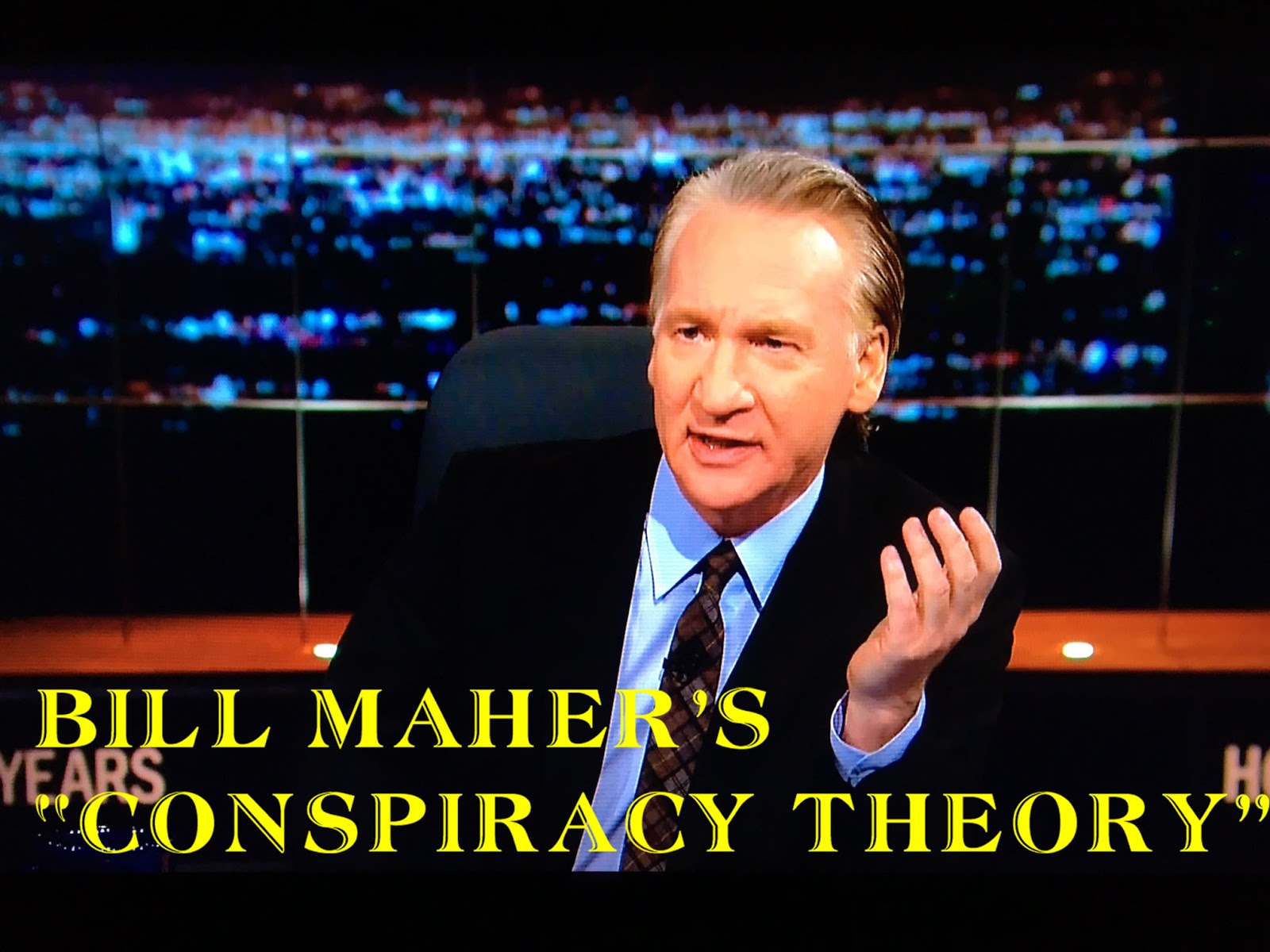
Bill Maher’s Conspiracy Theory- His Opinions About 9/11 Strongly Expressed, He Makes An Accusation of US Government Implementation of “False Flag” Attack On American Public- Weird?

With an election result that few except Michael Moore apparently expected there are quite a few people who may be in a weird place these days, but Bill Maher seemed to be coming from a rather weird place before the election.  He offered his viewers a conspiracy theory.

On his last Real Time With Bill Maher show broadcast before the election, Friday, November 4 (Season 14, Episode 37- It's the episode where Maher finally attains his long sought goal of interviewing President Obama), Maher spoke about a “slow moving right wing coup” telling us that: “This could fucking happen in this country.”

He wasn’t just speaking of the possible materialization of the election outcome prophesied by Michael Moore.  It went beyond.

Worriedly mentioning the recent rash of media reports about the `politicization' of the FBI, Maher said: “And of course in security law enforcement agencies it's usually right wing folks. The difference between fascism- And I know that's a strong word- that's what it is - and what we have enjoyed in this country for 240 years is that those types are under the rule of law. If Trump gets elected they're not: they ARE the rule of law.”

In criticizing the complacency of David Frum, one of the guests on his panel that night, he spoke about “old thinking”:
“Thinking in terms of someone who gets elected and is going to abide by the rule of law. That's not what these people will do. The reason why I use the word `fascism' is because of the cult of personality with the dictator, and they don't care about rule of law. It's going to be Donald Trump president, Chris Christie attorney general of the United States, and he's never been a vengeful guy-we know that from Bridgegate - and Rudy Giuliani the head of the FBI. You want to live in that country?”
Bill Maher then went so far as to suggest to his audience that, with the rule of law departed from by these individuals, we'd see our U.S. Government mount a false flag attack on our own county to seize even more power (he brought up the notorious German Reichstag fire after Hitler's election).

He said: “You know that Hitler was elected, And three months after he was elected, What did he do? He burned the Reichstag to create an `emergency' where he needed more powers. Don't you think that they would have that in their mind?”

FASCINATING: Bill Maher's “conspiracy theory” duplicates almost exactly the 9/11 “conspiracy theories” of others that Maher has vehemently castigated,* the only real difference being that Bill Maher is positing his conspiracy in the future and that he thinks that Bush, Cheney and Rumsfeld were characters more constrained by the “rule of law” than Trump, Christie and Guiliani would be.
 (* On  September 14, 2007 in the New Rules segment of his show Maher made fun of “crazy people” who thought the government brought down the two Twin Towers in a controlled explosion.  This was followed up, October 24, 2007, with the widely reported incident where Maher got tough with and insulted six heckling 9/11 Truther activist protestors who had infiltrated his audience and interrupted his show, shouting things like the question: “What about Building 7 " -i.e. the third tower that went down much later that day in a similar-looking fast and total collapse. The heckling incident does not appear to have been a faked one to make Maher look tough, because more about it, including the names of the protesters, and an interview, are available.  In 2011 Maher criticized those doubting that Osama Bin Laden was responsible for the attack.)
Interestingly weird on Bill Maher’s part. . . And, in another weirdness, just a few programs before this accusation against a possible incoming Trump administration he suggested (clip available) that because the people of the USA are “stupid” (and we face apocalypse) that a despotic elite should simply anoint technocrat Hillary Rodam Clinton as president. Merely another comicly based fantasy on his part?

On the show where Maher posited a “false flag” operation by the incoming Trump administration, he off-handedly quipped how, the election pending, the show could even be his very last.  Such speculation is not far-fetched.  Maher’s previous show, “Politically Incorrect” was canceled by ABC because in September of 2001 he controversially contradicted statements of President George W. Bush after the World Trade Center was destroyed.

Bush said (with the House of Representatives and Senate following suit to back him) that the World Trade Center had been destroyed by hijackers who were `cowards’ and “cowardly.”  Maher said that choosing to be in an “airplane when it hits the building, say what you want about it, . .   not cowardly.”  When the subject is `courage’ vs. `cowardice,’ not the despicability of attacks undertaken with the knowldge thousands of civilians will be killed, that seems correct: If you believe hijackers got on airplanes intending that they die by slamming into buildings it is hard to call them cowards.

Maher suggested something else even more controversial that, by comparison, it was “cowardly for the United States to launch cruise missiles on targets thousands of miles away,” a remark that, would today assuredly be updated to refer to overseas drone attacks conducted by operators not physically in any jeopardy as they remain in the United States.

What happened to Mr. Maher and his “Politically Incorrect” after 9/11?. .

Ari Fleischer, the White House press secretary, denounced Mr. Maher, saying the nation was in a time when ”people have to watch what they say and watch what they do.”  Mr. Maher lost his sponsors and his show was promptly off the air.

Last week, the week after the election, was Maher's last show of the season.  His conspiracy theory was out-of-sight and he was speaking more mildly of being in "uncharted waters."  His next show: He expects the first show of his next season will broadcast in January on Inauguration Day.  Here's expecting. . . . what?

Wednesday, November 9, 2016

How Much Do We Spend On Our Military-Industrial-Surveillance Complex? TRILLIONS (That's Millions of Millions Times Several), And We Are Headed To Spend TRILLIONS More!

The other day I was writing an article for Noticing New York and for background purposes I created a footnote about how much we spend on our Unites States Military-Industrial-Surveillance Complex.  It was a very long footnote, long enough to be an entire article unto itself so I thought I'd publish it as such here.

I was interested in how much we spent on the Military-Industrial-Surveillance Complex overall, with a particular interest in what we spend on surveillance, about which we know far too little.

Here, formatted a little differently for easier reading, is the footnote I included in that article. . .

* * * *

* If you want to consider this further, follow the money. . .  And there is a huge amount of money to follow.

The amount of money that flows through our military-industrial-surveillance complex, with all that implies, is mind boggling-especially if you consider that, statistically speaking, it is 82 times more likely for someone to be killed falling out of bed than by a terrorist.  The amounts and portions of our budgets that flow to the spy agencies is not transparent, with a significant amount of such spending in a so-called "black budget" component involving little oversight or check against potential waste.

Frontline’s "Top Secret America" while referring to the secret expenditure figures tells us: "Exactly how much money the NSA was spending in the years after 9/11 is one of the government's most closely guarded secrets. The agency's budget, like its work, is a state secret."  There are some sixteen or so different U.S. intelligence agencies.  The Guardian reported that, as of 2013, the government's "black budget" security agency spending had doubled over what was spent in 2001. But how precisely known these figures are has to be a guess as, for instance, the intricately related Pentagon's budget is very leaky and imprecise with trillions of dollars not properly accounted for on a recurring basis.

It is reported that the Pentagon controls 85% of the intelligence budget.  Budgets of other agencies, like the US Agency for International Development, are also leaky with amounts supposedly designated for other projects diverted to covert intelligence enterprises.  Then there have been the problems with off-budget spending with things like Iran-Contra arms sales or CIA drug trafficking generating unsupervised revenues. 

In May of 2011 after the U.S. announced that it had killed Osama Bin Laden in a secret CIA-led operation- about which there are disputed stories- The National Priorities Project calculated that, as of that time, "in all, the U.S. government has spent more than $7.6 trillion on defense and homeland security since the 9/11 attacks."  Point of reference: a "trillion" is one million millions.

Notably, there was a significant increase in this torrential spending right after 9/11.  The National Priorities Project calculated that as of that May 2011, in adjusted for inflation terms, the Pentagon base budget- exclusive of the $1.4 trillion spend on the Iraq and Afghan wars- increased 43%, spending on nuclear weapons increased 21% and spending on "Homeland Security" went up 301%.

Prior to 9/11 there had been appreciable decreases in our military-industrial-surveillance complex spending with there being talk of still further reductions due to the expected "peace dividend" flowing from the demise of the Soviet Union.  Total expenditure figures continue to escalate at a fast rate since those 2011 calculations were done: For instance, the $365.9 billion figure the National Priorities Project gave for Homeland Security spending then it now states to have surpassed a total of $708 billion since 9/11 and the total cost of the wars we have waged since 9/11, exclusive of what is spent on the Pentagon base budget now exceeds $1.721 trillion, and just in the year of 2016 we have already spent about $1.1 billion on Predator and Reaper drones.

Put this in perspective of the entire national budget.  Offering its own calculation, the Friends Committee on National Legislation calculates that of the $2.674 trillion “federal fund” budget, which is the spending supported by income taxes, estate taxes, and other general revenues- not the trust funds self-supported by dedicated revenue like Social Security- 37.5% is going to pay for the cost of current and past wars.  It's not clear whether their 37.5% figure includes surveillance expenditures.  The surveillance expenditures also flow through the economy in interesting ways.

Snowden revelations disclosed that security spending included the NSA's making huge payments to internet companies including Google, Yahoo, Microsoft and Facebook under the Prism program.  If properly calculated, these payments just reimbursed those companies for the cost of compliance with government surveillance requirements.  If not then. . .- Yahoo has recently been prominently in the news for the over-surveillance it did for the NSA.  Facebook, Instagram and Twitter were similarly in the news for such surveillance.  Thoughts on this? New York Magazine quips: "Facebook, Instagram and Twitter were shocked that law enforcement was using a company called Geofeedia to track their users. Only they're allowed to do that!"  As the main body of this piece will go on to make clear one thing that is key to remember about U.S. surveillance spending is that most of it is directed through what is officially the private sector.

*  *  *  *  

The article I wrote for Noticing New York?  It asks why the nation's largest private surveillance corporation was hired to overhaul New York City Libraries, starting with the dismantling of four of the most important in Manhattan (Donnell, Mid-Mahattan and SIBL libraries and the central research stacks of the 42nd Street Central Research Library):
If librarians were the first to successfully stand up and oppose the intelligence overreaching [of the PATRIOT Act] and if Booz Allen Hamilton "is really an arm of the intelligence community" involved with the federal government's "most controversial federal surveillance programs in recent years" then why was Booz Allen Hamilton hired to help reorganize the New York Public Library's most important libraries?
As noted above, with the U.S. spending trillions on the military-industrial-surveillance complex since 911,  70% of the nation's surveillance budget goes to private contractors.  Of this 80% is spent on just five private contractors, the “colossus” of which is Booz Allen Hamilton.

You can read the Noticing New York article here: Snowden, Booz and the Dismantling of Libraries As We Know Them: Why Was A Private Government Spy Agency Hired to Take Apart New York's Most Important Libraries And Turn Them Into Something Else? (Sunday, October 30, 2016).

If we weren't spending these trillions (these millions of millions times many) on the Military-Industrial-Surveillance Complex we could be spending on other things like schools- make your own list and don't feel constrained to keep it short.  . . .  How much do we spend on our libraries?  Another, Noticing New York article makes clear that we spend a relative pittance on highly valued NYC libraries, an immeasurably small amount by comparison, just "millions": What's Wrong With These Numbers?: The Baccarat Tower's $60M Penthouse and NYC's Library Budget (Tuesday, April 29, 2014)

Monday, October 31, 2016

Meta-Irony Of Trying To Mount A Social Network Campaign To Get People To See Oliver Stone’s Movie “Snowden” and To Pardon Snowden- How Efforts To Help Snowden Could Be Impeded

"Pardon Snowden": You are entreated to "follow the campaign."  Have You?  Can you?  Have you thought about. . . .
Concurrent with the September opening of Oliver Stone’s excellent new movie “Snowden” about the illegal surveillance whistleblower Edward Snowden, a campaign heavily supported by social media was launched to have Snowden pardoned.  The campaign has a website, and is using Facebook, Twitter, and YouTube.

There is a meta-irony in this in that, given the tools at the disposal of the National Security Agency, the agency that feels thwarted by Mr. Snowden concerning multiple issues about which they are at loggerheads, social media, may not be a dependable, or entirely serviceable tool.  That’s if you suspect that the NSA may be engaged in more than “passive” surveillance.

In the earlier Academy Ward winning documentary “Citizen Four” about Snowden, Jacob Appelbaum, an encryption and security software developer and journalist, testified at a September 2013 European Parliament hearing investigating NSA searches of EU citizens and companies, told the assembly:
There is this myth of the passive surveillance machine, but actually what is surveillance except control? This notion that the NSA are passive this is nonsense.  What we see is that they actively attack European citizens, American citizens and, in fact, anyone that they can if they perceive an advantage.
Do we need to worry that the NSA puts its finger on the scale to control outcomes?  If so, in which situations and how would we know?  Would the NSA or other U.S. security agencies only do so abroad, and, if so, in a world without borders, where communications, interactions and influence bounce back and forth across the world, does that matter? . . .

. . .  When it comes social media, don’t nearly all of us have foreign Facebook friends or follow people on Twitter who are not U.S. Citizens?

Here is why, when it comes to political dissent or anything that the NSA thinks threatens it, social media may not be a dependable level playing field.  (What might government and the NSA feel threatened by?: Perhaps anything that is not sufficiently normative in their opinion, like believing that Edward Snowden deserves a pardon for his self-sacrificing heroism.)

Laura K. Donohue is a Professor of Law at Georgetown Law, Director of Georgetown's Center on National Security and the Law, and Director of the Center on Privacy and Technology. She writes on constitutional law, legal history, emerging technologies, and national security law.

Ms. Donohue was a panelist at a New York County Lawyers Association conference, "Government Surveillance and Privacy Have We Reached a Tipping Point," held June 11, 2015.

Those attending learned some frightening things from Ms. Donohue about how readily social networks monitored by the government can also be manipulated by the government:
If you look at the fields of social network analytics, for instance, it has just rapidly expanded. So, in the academic literature there are hundreds of new books, in physics and mathematics and new technologies in computer science about how to do these social network analytics.

. . .  you can look at . . . a person in society, right, any of us, and see what our relationships are with other people, how strong those relationships are by what is called bandwidth, how powerful that individual is, and how to pressure that person by those power relationships. So if, for instance, you are the Democratic administration and you had the Republican-- the RNC mapped out-- their Social networks, you could see who the important nodes were in that network and look at different ways to neutralize them. So you could bring charges, for instance, against them, you could find pressure points and get other individuals to pressure them, you could find ways to isolate them. And that would interrupt the communication network. So you could also use their power to accomplish things in the network.
Does this actually happen?  Donohue continued:
Now this isn't science fiction: The USAID [US Agency for International Development] tried [secretly] to do this in Cuba, I'm not sure how many of you are up on ZunZuneo [slang for a Cuban hummingbird's tweet]. This was a Cuban Twitter website that the USAID set up in order to build a social network to overthrow the Cuban government. And the idea was that they would start out with innocuous content like weather reports, soccer, music; they would build a social network, figure out where the powerful nodes were in that network and then pressure those nodes to basically bring on a Cuban spring.
Donahue qualified this tale by offering her estimation that, “in the end” USAID’s ultimately failed scheme “was up there with exploding cigars and the Bay of Pigs . . . for good ideas in Cuba,” but stressed that “the idea was” this agency of the US Government was “trying to use the social networks to bring about political change.”

And, she said, these tools are very powerful for bringing about such change over time:
And this is an insight from the literature, which is the reason why social network analytics are so powerful is because networks aren't static: they change over time, people’s actions change over time and their perceptions and beliefs are influenced by others in that network. And so that's one of the reasons why the social network analytics are so concerning.
Notwithstanding that power, Donahue said, “there is a certain irony” that researchers have found these tools are not particularly effective to do what has been set up as the justification for the government’s collection of massive troves of information (“metadata” about people and their relationships): preventing terrorist organizations that have organized along cell systems.

She explained what she referred to as “the snowballing effect”:
If you are looking at a social network, the denser that network is the more you can tell about it, but in a cell structure where they are communicating very rarely and you are dealing with peripheries it's very hard to tell where those important nodes are in a sparsely populated communication network.

So, ironically, it turns out to be an incredibly powerful tool to head off potential social, economic, political opposition and not as an effective way to head off concerted terrorist cell structure activity.
Donahue emphasized that exactly what social network manipulation is effective at, targeting “social, political and economic opposition,” is a major concern.  She further pointed out how worries about such governmental abuse by the founding fathers were also certainly a concern behind the fourth amendment’s protection against unreasonable search and seizure at the time of the amendment’s adoption. She cited the attention that had been given back then to a customs officer who had used information obtained through his position “to go after political rivals in Boston.”  . .  Ms. Donohue has a new book coming out where it is to be hoped we can learn a lot more.

A less than perfectly informed United States citizenry is struggling with what it thinks about Snowden.  What it thinks is already quite subtle, complex and perhaps incongruous.  The intricacies involved in informing oneself and understanding the issues are formidable.

There are polls showing that a majority of Americans think that what Snowden did was beneficial for the country while at the same time a majority feel he should be prosecuted:  See: Time Magazine- Support for Snowden-and His Prosecution- 54% of respondents said the leaker, Edward Snowden, did a "good thing" in releasing information about the government programs, by Zeke J Miller, June 13, 2013 and USA Today- Poll: Snowden should be prosecuted for NSA leaks, by Susan Page, June 18, 2013 ("In a USA TODAY/Pew Research Center Poll, most Americans say the NSA leaker should be prosecuted, but two-thirds don't like the idea the U.S. government is collecting their own communication records.")

With such a delicate balance, what if the NSA castigating Snowden publicly with the help of Obama and Hillary Clinton and much of the major corporate media, also, behind the scenes, puts its thumb secretly on the social media scales?

In theory we have a system of voter elections so that the American populace controls the government and not vice versa. . .

 . . .  There is, on the other hand, a long list of ways in which one may say that elections have been "rigged."  They run the gamut, some more obvious and hard ball than others . . .  the Supreme Court, with a partisan split, saying that Bush should be president without Florida's votes being counted in the 2000 election where, when the votes were after-the-fact counted, Gore was apparently the actual victor . . . discriminatory purges of the voter rolls as happened in that same Florida election, and as apparently went uninvestigated in the New York Democratic primary this year . . . there's the age-old practice of gerrymandering voting districts which when newer technology like the program "Maptitude" is stirred into the brew becomes exponentially more pernicious . . . . voter suppression and disenfranchisement . . there is the problem of hacking and unreliable voting machines, like with Florida voting machines running backward in 2000 . . . deploying polling place resources inequitably so that some polling sites will get extra speeding-up assistance (like special election laptops in Florida 2000) and others will frustrate potential voters with very long lines. . .  money in politics buying elections and, if that fails, the elected officials afterwards. .  there are the efforts by our two major parties to ensure that the rules of election process skew towards perpetuation of a duopoly. . . then there is the imbalance of a corporately owned press.

Suffice it to say that history shows a longstanding interest in, and efforts at, the manipulation of elections by the powerful and, nearly just as frequently, by those in government wielding government's extra powers.  Some of those efforts because they seem harsh and heavy-handed generate resistance as their reward, but now add to that traditional arsenal the potential soft power of behind-the-scenes social media manipulation that you might not even sense is there.  If effective enough, harsher methods need never be taken out of the cupboard unless they are known to be needed.

With these new technologies it is not just social media that can unobtrusively, subtly manipulate your vote: One of the top under-reported stories of this year is about experiments showing that, using biased search engine rankings, a search engine like Google could shift the voting preferences of undecided voters by 20% or more. . .
 
. . . It is one thing for Google to target you and send you health related advertisements even before you, yourself, suspect you have issues.  It is another for Google to know how you are to vote before you ever get to consider that matter and make the decision on your own.

Finally, what about Snowden?  Are you curious about whether he will actually get his pardon, whether the social media campaign mobilized toward that result could be impeded?  One thing you can do is experiment: You could share this article and the recommendations being made for pardon via the social media platforms you use . .  and then see if you think what you've shared gets as much traction as you would expect.