Showing posts with label Occupy Wall Street. Show all posts

Saturday, October 12, 2013

The Other Government Shutdown Now In The Works (One You Are Not Hearing About): A Corporate Replacement Of Government Via The Trans-Pacific Partnership Treaty

It sounds like a science fiction vision of a futuristic dystopia, the kind of story whose horrific elements have been slathered on thickly to emphasize the “cautionary tale” a creative writer has dreamed up, one of those, not now, not here, not just yet, but “could be” essays commenting on what might go wrong in the future given the seeds we can observe in today’s society:
A select army of coordinating and elite-trained corporatist operatives, 600 strong, deploy around the world planning to replace government control of corporations with corporate control of governments.   Having found their more nefarious goals stymied by democracy and public debate, the corporations plan a secretive end-run around public process to supplant government with corporate supremacy and, in one fell swoop, enact, unfettered, their long wish list of desires, even at the cost of public health, welfare and the environment.  In the end, even the earth itself may be doomed as a result of this power grab.
The only problem is that this is not science fiction.  It is actually happening.  What I have just described is the move toward passage of something called Trans-Pacific Partnership treaty (“TPP”) and though it may sound like pure paranoia, the fact that political adversaries Mayor Michael Bloomberg and Occupy Wall Street are both among those very concerned about its effects should be a pretty good indication that the nightmare threats are very real.

The TPP gives corporations the right to tell governments to stand down from their functions of protecting the public.  That’s because, in the corporatist view, governments should not be allowed to interfere with the expectations that corporations and their investors have of receiving profits.  It has been described as giving corporations a new “corporate bill of rights” to make profits notwithstanding public detriment.

So, for example, in August New York’s Mayor Bloomberg wrote an Op-Ed published in the New York Times fearful that one result of the TPP’s passage would be that New York City could no longer regulate smoking the way it does because doing so would interfere with the profits the tobacco companies want to make.  The NYC Bloomberg era ban on smoking is considered a signature and, in retrospect, very popular (82% approval) achievement of the mayor’s administration, copied elsewhere around the world.

The TPP’s provisions are actually secret from those who are not among the 600 corporatists working on it, a problem we will get to in a moment.  Mr. Bloomberg, who apparently knew something about what was actually in the TPP about regulating smoking at various times, commented:
The early drafts of the agreement included a “safe harbor” provision protecting nations that have adopted regulations on tobacco — like package warnings and advertising and marketing restrictions — because of “the unique status of tobacco products from a health and regulatory perspective.” This provision would have prevented the tobacco industry from interfering with governments’ sovereign right to protect public health through tobacco control laws. 
(See: Op-Ed Contributor: Why Is Obama Caving on Tobacco? By Michael R. Bloomberg, August 22, 2013.)

Unfortunately, as Mr. Bloomberg was also aware, the tobacco industry successfully lobbied to have the provision removed.  Mr. Bloomberg complained about the agreement's alternative:
weak half-measures at best that will not protect American law — and the laws of other countries — from being usurped by the tobacco industry, which is increasingly using trade and investment agreements to challenge domestic tobacco control measures. 

    . . .  not only will cigarettes be cheaper for the 800 million people in the countries affected by the trade pact, but multinational tobacco corporations will be able to challenge those governments — including America’s — for implementing lifesaving public health policies. This would not only put our tobacco-control regulations in peril, but also create a chilling effect that would prevent further action, which is desperately needed.
There is actually something wrong with this picture of Bloomberg championing protection of the public health: It is Mr. Bloomberg’s very narrow focus about what is wrong with the TPP.  Tobacco is certainly an addictive poison the use of which governments would do well to curtail, but under the TPP it is not just anti-smoking measures, but virtually all public health protections that would be sacrificed or in jeopardy if they conflicted with a desire for corporate profit.

Elsewhere in his Op-Ed Mr. Bloomberg commends that (in his view):
The pact is intended to lower tariffs and other barriers to commerce, a vitally important economic goal.
And later he says:
I could not be more strongly in favor of trade agreements that expand economic opportunity here and around the globe.
In actuality, most of the TPP does not concern itself with these issues of trade.  The current version of the TPP has 29 chapters.  Of these, only five reportedly have to do with trade. The other 24 chapters involve a wide range of grabs by the corporations. Days ago Naked Capitalism commented that the TPP has been mis-branded as a “trade deal”:
The reason the label is misleading is that trade is already substantially liberalized; the real point of the TPP and its cousin, the pending EU-US trade agreement, is to weaken the power of nations to regulate, which will allow multinationals to lead a race to the bottom on product and environmental safety.
(See: Thursday, October 10, 2013, Will China’s Gambit to Undermine the Trans-Pacific Partnership Succeed?)

In this race to the bottom, what else would the TPP override in terms of public protections?  That’s where the problem of secrecy comes in.  Discussion of the treaty’s provisions is very difficult because the provisions under negotiation are being treated as "classified."  The army of 600 corporatist soldiers working on the document may be intimately familiar with the wish list items they are inserting, but the public is not allowed to know anything about them.  A good starter guess though is that anything that has to be secret is not good news for the public.

Said Senator Elizabeth Warren in September:
For big corporations, trade agreement time is like Christmas morning. They can get special gifts they could never pass through Congress out in public. Because it's a trade deal, the negotiations are secret and the big corporations can do their work behind closed doors. We've seen what happens here at home when our trading partners around the world are allowed to ignore workers rights, wages, and environmental rules. From what I hear, Wall Street, pharmaceuticals, telecom, big polluters, and outsourcers are all salivating at the chance to rig the upcoming trade deals in their favor.

Why are trade deals secret?  I've heard people actually say that they have to be secret because if the American people knew what was going on, they would be opposed.  Think about that.  I believe that if people would be opposed to a particular trade agreement, then that trade agreement should not happen.
Congress, which has exclusive authority to approve treaties (in this case both houses), is being asked to “Fast Track” the approval of this treaty  “But until this June, they were not even allowed to see the draft text,” according to Lori Wallach, director of Public Citizen’s Global Trade Watch, who explained that, after 150 members of Congress made a tremendous fuss, the situation now is that:
    . . members of Congress, upon request for the particular chapter, can have a government administration official bring them a chapter. Their staff is thrown out of the room. They can’t take detailed notes. They’re not supposed to talk about what they saw. And they can, without staff to help them figure out what the technical language is, look at a chapter.  This is in contrast to, say, even what the Bush administration did. The last time we had one of these mega-NAFTA expansion attempts was the Free Trade Area of the Americas. And in that instance, in 2001, that whole draft text was released to the public by the U.S. government on the official government websites. So, this is extraordinary secrecy, and members of Congress aren’t supposed to tell anyone what they’ve read. So, for instance, you know, Alan Grayson, who was one of the guys who helped to get the text released, Alan Grayson said, "I can tell you it’s very bad for the future of America. I just can’t tell you why." That’s obscene. 
(See: "A Corporate Trojan Horse": Obama Pushes Secretive TPP Trade Pact, Would Rewrite Swath of U.S. Laws, Democracy Now October 4, 2013.  A full Democracy Now transcript of the video below is available.)


The Obama administration reportedly wants to push through the “Fast Track” authority that would delegate Congressional authority for the treaty review to get it adopted by the end of this year-. . . That’s just months, practically a matter of weeks away, and yet the public knows virtually nothing about what that would mean.  “Fast Track” authority would limit the congressional lawmakers to an up-or-down vote on the TPP.  BTW: The current government shutdown may be a distraction from what is going on but it reportedly isn't slowing down the efforts to bring about this other envisioned shutting down of government functions via the TPP.

What kinds of things are crammed into the TPP?  TPP has been referred to as “son of SOPA” because it contains most of the intellectual property rights restrictions that corporations tried, and ultimately failed, to lobby through as part of “SOPA,” the “Stop Online Piracy Act.”  Remember that fight?  That was when Wikipedia and other internet sites shut down for a day to call attention to that law's proposed Draconian provisions (See: Wikipedia Blackout: 11 Huge Sites Protest SOPA, PIPA On January 18.)

The hotly debated SOPA amounts to 38 pages coming out of my printer.  Think of that as just one of the 25 non-trade related chapters of the TPP!  The money and the corporatists wanted to see that law passed but the public was against it.  Listed on Wikipedia 125 organizations supported the law while 222 opposed it and many others refused to support it: List of organizations with official stances on the SOPA and PIPA.

Here is a list of the corporate end-runs presently understood to be in the TPP that will give you an idea of why the TPP is often referred to as “NAFTA on steroids.”  Note that although there are 25 chapters full of non-trade related provisions, the list below doesn’t approach that number:
    1.    Limitations on food quality and food safety regulation.
    2.    Limitations on regulation of agriculture and forestry practices.
    3.    Limitations on environmental standards, and environmental protections (including provisions whereby corporations expect to be able to avoid having to pay for environmental damage).
    4.    Limitations on the regulation of toxins and poisons.
    5.    Limitations on climate policy measures.
    6.    Limitations on regulating energy markets.
    7.    Establishment of corporate rights to seize natural resources, including for such things as mining.
    8.    Protections for corporations to charge high and unregulated prices for such things as water, gas, energy, transportation and other utilities (unless government provides them to the public entirely without a fee).
    9.    Limitations on regulation of banks and the financial industry, including back doors for those institutions to get around what presently exists.
    10.    Restrictions on taxes such as a ban on the proposed “Robin Hood” tax on speculative Wall Street investments.
    11.    Restricting measures governments undertake to make medication affordable, including limiting generics and affordable medicines.
    12.    Limitations on other consumer health laws like those that deal with cigarettes. (Prevention of gun control regulation Mr. Bloomberg?)
    13.    Restrictions on internet freedoms and intellectual property rights (The “son of SOPA” provisions).
    14.    Effects on labor unions (see discussion below).
    15.    Give corporation new rights to sue governments that try to regulate them and entitle corporations to taxpayer-funded damages for such unpermitted regulation.
    16.    Elevate rights of corporations to a higher level equating them with governments.  It looks as if foreign corporations would thereby wind up empowered with greater rights than U.S. companies in the United States. 
    17.    Turn adjudication and resolution of these corporate rights matters over to new pro-corporate international foreign courts outside of and not bound by the existing legal systems.  The idea is that the those representing corporations seeking to assert their rights would rotate through taking their turn as the adjudicating judges.
Full-fledged world-wide dystopia as was described at the outset?  The twelve countries negotiating to put the TPP into effect (Australia, Brunei, Chile, Canada, Japan, Malaysia, Mexico, New Zealand, Peru, Singapore, the United States, and Vietnam) comprise about 26 percent to 30 percent of world GDP), but that overall reach can be expanded, partly, as Naked Capitalism points out, with the implementation of other parallel treaties.   The exploits of the James Bond super-villains, most of whom all had their own super-corporation empires, once seemed satisfyingly fantastical in scale, but most of them would have picked more sparingly from the above menu in concocting their world-domineering schemes. (In 2008's “Quantum of Solace,” my candidate for the most disappointing of the Bond franchise films, you had a fairly exact match for just one of the schemes above: The villain was a counterfeit environmentalist named “Greene,” whose goal was to monopolistically corner the market for water in Bolivia so as to be able to charge the populace higher prices.)

The above list, generically covering all the bases, manages to be automatically comprehensive about protecting all the worst possible corporate behaviors.  So, for example, those who perceive hydro-fracking to be a threat to our health, water, and with climate change the survival of much of the life on this planet, would lose all possible tools to address the practice.  The hard-fought fight to prevent fracking in New York State?: The industry would have achieved an end-run around it.

When I and others write to say that the TPP contains such disturbing provisions, are we wrong?  If they’d only make the TPP provisions public we’d know exactly what to worry about with accuracy and specificity.  Otherwise we just leave it to those working for Halliburton and Monsanto to assure us that the unpublished provisions they are stuffing into the bill will be as good for us as they will be for them!

Would foreign corporations doing business in the U.S. gain greater rights than domestic corporations?  Days ago, without bring up the advent of the TPP as a possible contributing reason, the New York Times was reporting:
From New York to Silicon Valley, more and more large American corporations are reducing their tax bill by buying a foreign company and effectively renouncing their United States citizenship.
(See: New Corporate Tax Shelter: A Merger Abroad, by David Gelles, October 8, 2013.)

The effect of TPP on jobs and labor unions in the United States under the TPP is not a simple discussion.  Many blame NAFTA for draining jobs out of the U.S.  It is true that when jobs go overseas other jobs can be created here in ways that are complicated and not easy to measure.  Many economists believe a liberal approach to free trade usually results in a net plus.  However, when our domestic labor unions compete with workers in other countries where workers rights are not enforced or don’t exist there is a serious race to the bottom problem.  The subject is too long and complex to debate in this short article, but that complexity too is another example of why passage of this secretly formulated corporate wish list cannot be rushed through without due and proper discussion and airing.

What then might the concerned citizen want to do about the TPP?    Contact your senators and congressmen.  Tell them you are concerned and that, at a minimum, the TPP should not be "Fast Tracked."

Here are sites at which to further educate yourself:
 •        Expose the TPP

 •        Public Citizen’s TPP Trade Watch site

 •        Sierra Club TPP page

 •        Occupy Wall Street TPP page

 •        Citizens Trade Campaign TPP page

 •        Amnesty International TTP information
 •        Public Knowledge TPP page 
 •        Electronic Frontier Foundation TPP webpage and petition
 •        Infojustice.org
 •        Food and Water Watch TPP page
There is a MoveOn Petition you can sign calling for no "Fast Tracking" of the the TPP:

  •        MoveOn Petition: Congress: Don't renew "fast track" authority

Here is a short, simple video to send around through social media: "Why you should care about the TPP."


Tuesday, January 29, 2013

Tsk, Tsk: Criticism of Beyoncé’s Lip Syncing . . A Distraction From More Serious Issues And Moral Choices

President Barack Obama’s second inaugural speech last week had a lot in it that ought to have commanded serious attention, like the fact that he said, “We will respond to the threat of climate change” and his calls for equality with his alliterative allusions to “Seneca Falls, and Selma, and Stonewall.”  He spoke of protecting the young and future generations including those of Newtown.  There was his proclamation that a “rising middle class” is imperative and that the “patriots of 1776 did not fight to replace the tyranny of a king with the privileges of a few or the rule of a mob.” Significantly, he spoke out against believing that in America “freedom is reserved for the lucky, or happiness for the few” while asserting that the commitments Americans make to each other through “Medicare, and Medicaid, and Social Security” do not “make us a nation of takers” but strengthen and free us “to take the risks that make this country great.”

It’s unfortunate then that so many people want to come away just talking about whether Beyoncé lip-synced her singing of the National Anthem.  Admittedly, comment on the subject is hard to resist. . .  Right after Ms. Knowles concluded the soaring notes of her rendition Gwen Ifill, moderating PBS’s coverage, said: “As we have seen many, many times in the past, that is a tough song nail and Beyoncé managed to find a way to do it today.”

Yes, indeed, but little did Ms. Ifill know that the way that Beyoncé had managed to find to deliver her otherwise pitch perfect performance was for what was piped out to the national audience to be a prerecorded version.

With wealth of around $775 million Beyoncé and Jay-Z are the richest celebrity couple in the world, which adds to the feeling that they ought to really deliver when they perform (the way that Kelly Clarkson did when she performed “My Country, 'Tis of Thee” moments before Beyoncé performed.) 

As it turns out, even though the national audience only heard Beyoncé’s prerecorded version Beyoncé was probably not lip syncing in the truest sense but singing along live to the prerecorded tape people were hearing over the speakers.  That’s the verdict of a British sound engineer after listening to an alternative feed and he opines that her actual live performance “was every bit as good as the `safety’ pre-record – in fact it was so close that it’s hard to tell them apart” (See- and hear: 'She DID sing live': Now sound expert delivers verdict on the curious case of Beyoncé's national anthem... as new audio of her performance emerges, by Chris Johnson, 24 January 2013.)

People like Jon Stewart on the Daily Show have taken humorous advantage of the distraction of this faux scandal concerning Beyoncé’s performance ethics to make serious points.

One of the quips making the rounds gets expressed thus: “As if Beyoncé were the only person in Washington to move their lips and say nothing.”
Bill Maher opened his HBO program last week with a more pointedly appropriate variation on the above, telling the cheering audience that greeted his arrival on stage:
I know why you're happy this week: Obama got reinaugurated.  That was a big thing for liberals.  But I have to say, the Republicans were right . . . He's been in office less than a week now in the second term and already the administration's rocked by scandal . . .  Beyoncé lip syncing!

    * * * *

Let that be a lesson: If you are in Washington, D.C. and you open your mouth and another voice comes out it better be the NRA, an oil company, or a bank.
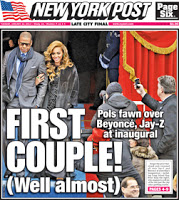
Maher may have been more on target than he knew.  The attendance of Beyoncé and Jay-Z at the inauguration provided a ready-made distraction for those who were looking for one and there were, indeed many, like Rupert Murdoch, owner of the media empire that includes Fox New and the New York Post, who would prefer that Obama’s message on the historic day not get through.  So, for example, the Post ran a full front page on its edition covering the inauguration that was nothing but a photo of  Beyoncé and Jay-Z with a tabloid-size headline proclaiming these two to be the real first couple.

What makes the distraction the celebrity couple was conveniently providing less funny and also makes the misguided fixation on Beyoncé lip syncing as `scandal’ less innocuous are the much more serious distractions that Beyoncé and Jay-Z provide, obstructing the messages Obama needs to get across.  No, I don’t refer to the fact that Beyoncé has been chastised for the promotion of sugary soda because it conflicts with Michelle Obama’s efforts to encourage healthy diets for American children as she seeks to combat the obesity epidemic.  There are other moral indicators and choices that concern me more, things that do greater damage to and greatly confuse the message Obama seeks to get out. . .

. . . Beyoncé's high-paid special performance for Libya’s Gaddafi family. .

 . . Jay-Z saying that he doesn’t understand what Occupy Wall Street is about while he himself buys into a system that perpetuates unfair privilege . .

. .    And yes, my concerns involve the moral laxity Bill Maher chided in his joke of people opening their mouths to give voice to words a disreputable organization has paid them to say. .  This extends to Jay-Z and Beyoncé, hiring out as fronts for a monopolisticly predatory real estate developer and public subsidy collector looking to neuter the rights of a community and the effectiveness of their community organizers mustering a defense.  (For more on all of this see: Tuesday, January 8, 2013, Tsk, Tsk: More Criticism of Beyoncé’s Moral Choices In a New York Times Op-Ed Piece.)

Thursday, November 8, 2012

Lesson Of Election: The Big Money Lost! . . . Or Maybe That's Pretty Far From Perfectly True

Which Times article to believe?  No effect from money or a shift to the right?
People still haven’t got it sorted out: One way you know . . . conflicting headlines in the same edition of the New York Times!  Everybody’s busy proclaiming victory or trying to deny actual defeat.  Fact is, they're both right.

One perfectly good take on this election is that the big money unleashed by the Supreme Court’s Citizens United decision lost.  Upper left hand of its front page the Times today chose to run a story making exactly this point: Little to Show for Cash Flood by Big Donors, by Nicholas Confessore and Jess Bidgood, November 7, 2012.

After what the Times notes was the “most expensive election in American history drew to a close this week with a price tag estimated at more than $6 billion” it comments that “the nation’s megadonors returned home with lighter wallets and few victories.”  Indeed, just as the Times observes, “President Obama will return to the White House in January, and the Democrats have strengthened their lock on the Senate.”

But contrast that with the message conveyed by other articles the Times featured in the same edition.  One picture is worth a thousand words and the message bolstered by Times data graphics proclaimed “most counties shifted toward the Republican side in Tuesdays’s vote, partly reversing large steps to the left in the 2008 election” and “Counties Blue and Red Move to the Right.”   See: Over the Decades, How States Have Shifted, How Obama Won Re-election, Obama Was Not as Strong as in 2008, but Strong Enough.

The Times supplies the above, illustrating a shift to the right, in the form of an animation at their site
And let’s not forget that the House of Representatives, seized by the Republicans in 2010, remained in Republican control.  So Karl Rove’s perspective reported in that first mentioned front page Times article is very important: Without the huge amount of spending by the megadonors, “the race would not have been as close as it was.” *  Among other things the Democrats might have taken back the House.  And this doesn’t even begin to consider what the effect of big money might have been in smaller, more easily bought local elections.
(* Notwithstanding, this philosophical point of view, Rove reportedly melted down on the Fox News set the night of the election unwilling to admit Obama had won Ohio.)
So if there is solace to be taken that the influence of big money can be fought and counteracted, that isn’t to say that its influence isn’t mightily felt.

With big money in play this election was fought very strategically on both sides.  It’s already been mentioned that Republicans “have lost the popular vote in five of the last six presidential elections.”  That Republicans have won presidential elections while losing the vote is an indication that money was spent strategically with the most important goal being the winning of the election, not the winning of the hearts and minds of the populace.  But Obama was also willing to play strategically and for a while it was viewed as possible that Obama might have won the all-important electoral college without winning the popular vote.

Perhaps the biggest surprise is that with a little campaigning in North Carolina, a state the Obama campaign apparently wrote off due to importance of electoral collage math, Obama probably would have shifted a lot of voters in his favor, adding to his popular vote and electoral collage tallies.

Big money also probably forced the Democrats to play a strategic game concentrating on keeping a balance of power with majority in the Senate rather than devote resources to taking back the House.

How did big money assert itself in this election?  The best analysis will come in time.  Since much of the money invested in political candidates now stays secret, utilizing 501(c)(4) organizations, organizations that are ostensibly formed for charitable and public purposes but these days are abused for political purposes, it may take a long time to figure out whose money was going where, notwithstanding that there are some donors, like Sheldon Adelson, who actually seem to like to attract attention to the money they are giving as well as to whom it's going.

Before we discount the influence of big money too quickly let’s remember that Romney was the Republican candidate because he was the product of the big money.  In the Whac-a-Mole Republican primaries it was the powerful effect of Romney money that was whacking down that long string of anyone-but-Romney alternative candidates.  Speaking of "anybody but Romney," the phrase can be inverted and turned to say that analysts keeping their eye on the money never gave anybody but Romney a chance of being the Republican candidate, consistently and for more than a full year in advance.

The irony is that the other potential candidates taking on Romney were those favored by those in the populace stirred up by the Tea Party.  Consider that the Tea Party, while it masquerades as grass roots, is actually a top-down movement.  It is top-down and well-funded because it is largely the creation of big money.  It served to siphon off and engage a lot of the national anger coming to the surface about privileged elites that would have been channeled more rationally in a direction like the Occupy Wall Street movement.  While most of the establishment's big money wanted Romney, the big money funding the Tea Party couldn’t and didn’t tightly control the free-for-all preferences emerging for for candidates like Herman Cain, Michele Bachmann and Newt Gingrich.

What the donors behind the Tea Party have been buying with their focus on extremism and their picking off of moderates is an intransigent resistance to compromise, leftward movement, and any sort or rational debate and discussion about issues.  Gridlock is acceptable, likely desirable, to them.  Their strategies of creating new out-lying poles of "political" thought parallel the strategies of those spending heavily to create doubt about climate change and to remove from office politicians willing to take steps to deal with it.  This is not surprising because a lot of the money to fund the Tea Party and to fund creation of doubt concerning the scientific conclusions on climate change is actually coming from the same places.

I recently offered a teaser which I will offer here again: This may be the last presidential election where the fossil fuel industry will ever be able to spend this kind of money to buy politicians.  Why?  I’ll have to set that aside and deal with it in a future National Notice article.

Provided that big money is disabled in the future the shift to red that money bought in this election is likely to be counteracted by the changing demographic that favor Democrats in future years.  That's provided that the money, being done with this election, doesn't figure out how to buy new set of voters in the future.

Was big money also spent on the Democratic side of the election?  Of course.  There was some balancing out.  Big money on the Democratic side helped defeat big money of the Republican side, but there was much more of it on the Republican side.  Big money unleashed in politics was exactly what Republican strategists wanted when they pursued the Citizens United case.

There are those who will correctly point out that because there was big money spent on the Democratic side we should expect Obama will inevitably behave with a certain deference to the establishment entities where the money came from as a result.  True, but by virtue of that analysis we can also expect Obama to be less beholden to the Wall Streeters who abandoned him this time around and less beholden to fossil fuel industry that threw so much support to Romney.

Another set of data maps in today's Times showing a shift to red
Did the big money win?  Yes, in part: The House is still Republican.  The Republican’s are proclaiming that the results of the election mean that the people of the United State don’t want higher taxes on the rich.  If that is believed or treated as true that's a win for them.  Also, as mentioned in the last National Notice article, it’s the Republicans in the House of Representatives who won’t even talk about their positions about climate change.

Yes, big money is having a lot of influence.

Friday, December 23, 2011

Why Someone Else Being Wealthier Actually Makes Me Poorer: Debunking a Suspect Claim

I found that the assertion stayed naggingly with me after I heard it expressed by one of the conservative talking heads appearing one night on Bill Maher’s Real Time HBO program: “Just because someone else is wealthier than I am doesn’t mean that it makes me poorer.”

I didn’t believe the statement when I heard it expressed but the way it seems to relinquish any envy gives it an attractive quality, making it sound admirably virtuous, as if it bespeaks a magnanimity of spirit even though it’s a statement wielded by the sort of spokespersons who also espouse such theories as “trickle down” economics. Somewhat inconsistently, “trickle down” economics proposes a world where another man’s accumulation of wealth can indeed be counted upon to affect your own but, optimistically, only for the better: Those who have less are expected to be satisfied by all the extra crumbs that will spill off the table with overflowing wealth. (The math behind this involves a prediction that the overall pie will always be bigger by more than the amount the wealthy themselves take.) These are the same sort of folk who now speak about the 1% Club as munificent “job creators.” Those espousing such theories can be counted upon to argue against measures such as a progressive income tax structure in order to to reduce the gap between the rich and the poor by having the wealthy pay higher income taxes.

“Just because someone else is richer doesn’t make me poorer”: Does this kind of statement really need debunking? Isn’t it just obviously wrong when you think about it? Maybe only to some and what might not be so obvious is just how many ways the statement is wrong. Let me count some ways:
1. Compensation to top executives in the United States is now paid at absurd multiples of other employees’ salaries. Ben and Jerry’s may no longer limit compensation of its highest paid employees to seven times that of entry level employees but the fact that it once did puts in perspective the kind of huge differentials now prevalent. Exact reliable figures about the ratio of top executive pay to bottom level employee pay or average employee pay level for given years is not easy to come by and the figures depend upon which group of companies one is selecting to derive one’s statistics, but whether one is looking at a ratio of 531 average employees’ salaries to1 highly compensated CEO’s, 525 or 263 to 1, 185 to 1, or 325-to-1 (the last ratio involving executives getting paid an average of $10.8 million each), each of those multiples represent corporate resources that could be redirected into hiring more employees or paying other lower-paid employees more. And isn’t it reasonable to expect that in the face of a more progressive income tax system we would likely see that kind of redistribution as the attraction of high salaries waned just as was the case when taxes were once more progressive?

2. Further, as focus shifts away from jobs being chased and held just for the sake of very high salaries mightn’t the quality of corporate management improve as a result? This is something we’d perhaps be more apt to believe if, along with Warren Buffett, we believe that executive compensation for U.S. executives is too often “ridiculously out of line with performance” and that a cooperation’s board’s ability to rein in such excessive compensation is a critical test of proper corporate governance. These then are two ways in which wealth lavished excessively on select individuals means the impoverishment others.

3. After another man is paid so many multiples more than his fellows the amount he is likely to invest should predictably be much greater than the rest of the populace and that investment will, in turn, spin off even more income. A fair amount of his wealth will probably be invested where so many of us inevitably think to invest: in stocks. Much of the nation’s wealth is owned through corporations. Ownership and control over a corporation is represented by its stock. The wealth of all of the nation’s investors intermingles in its ownership of the stock of those corporations but the intermingling is not equal in terms of ownership of the decision-making process because when it comes to corporate governance majority rules, the preferences of the minority must bend to the decisions of the majority. That majority is not added up in terms of stockholders as individuals; majority is counted up in terms of the majority of individual shares of stock. Which is to say the calculation involved is sheerly a measure of total wealth. As so much of the nation’s wealth is owned through corporations much of the nation’s policy is consequently set by the demands of those corporations but in the setting of such policy the voice of any minority ownership is lost as the corporate governance structure acts as a lens to focus the corporation’s influence behind the interests of aggregating wealth, much like a magnifying glass can bend the diffuse rays of the sun to focus on one concentrated incinerating point. Maybe I want my local environment kept clean and pure but maybe the corporations don’t, and maybe the wealthy will fly away to vacation in remote spots beyond my means where devastations to the environment will matter less to them.

4. When we think of influencing policy in the United States we think about appealing to our politicians and electing those we think will represent our interests, but every politician thinks of him or herself as having two constituencies: a.) Those individuals capable of voting for them, and b.) Their money constituency. The first is a finite constituency tied to a locality. In the United States every individual must decide where he will vote and there he will get to vote only once in each election. The monied constituency is free to cross lines. Those wealthy enough can support candidates anywhere no matter whether they live or vote where a candidate is running. They can even support candidates running against each other in the same election, and do. The amount of support supplied this way is limited only by one’s wealth and the will to deploy it. In the United States political spending in the form of contributions to political candidates is almost entirely the provenance of the very wealthy. Most of the money for the nation's political campaigns comes from .5% of the population,which means that it is really the .5% vs. the 99.5% that Occupy Wall Street ought to be talking about and 1 percent of the 1 percent account for almost a quarter of all individual campaign contributions to federal political campaigns in 2010. That means we have a government where it is going to be very difficult for ordinary citizens to get the attention of their political representatives because those representatives will spend most of their time preoccupied thinking about the donating elite. Unequal access to those entrusted with governing the nation leads, quite justifiably, to distrust of the system by those without access.

5. One reason that distrust of the system may now be very sensibly coming to the fore is that, as argued by Glenn Greenwald, the author of “With Liberty and Justice for Some: How the Law Is Used to Destroy Equality and Protect the Powerful,” we have seen a two-tier justice system emerge, one for the nation’s uppermost class, another for the less politically powerful. Normatively, the idea that the same rules apply to all ought to supply a check and balance against draconian abuses in the legal system and against violations of the law. With a two-tier system liberties are no longer protected by this check and balance. So yes, when others become a lot wealthier than the rest of us we poorer souls all become still poorer because even our life and liberty are put in jeopardy.

6. Others being wealthier also makes us poorer when we are competing in the market for the same limited resources. This is really classic supply and demand economics. More money chasing a limited supply drives prices up. Since real estate is unique and can’t be duplicated it is very easy to see how the rules apply. In 2004 when apartment prices in New York were rapidly rising the New York Times ran an article about “gazumping” which, technically, is the acceptance of higher offer from a different buyer after a handshake deal on a lower apartment price was reached. With the market awash in new cash, offers significantly trumping already accepted offers for which contracts weren't yet executed were becoming commonplace. It created a lot of pressure to close deals rapidly. A “gazumping” buyer can be particularly effective in persuading a seller to accept an offer (in the bidding practice that is considered less than entirely ethical) if they offer cash and a substantial deferential in price. Sellers may appreciate the higher prices the wealthy pay but say, for instance, you have a property that has been in a family for many years: Members of the extended family who want to buy it and keep it in the extended family (essentially maintain the status quo) may be “gazumped” out of their opportunity to do so by those who have become disproportionally wealthy. Another example involving real estate would be a neighborhood townhouse providing homes to perhaps nine renting families which is then purchased by a bet-winning hedge fund entrepreneur who, with his newly minted wealth intends to occupy the entire building after he evicts all the long-term tenants. Those tenants will have to move elsewhere. Shifting wealth will subtract from their other choices and the prices they will pay will accordingly be higher. These examples involve real estate but the same rules apply whenever there is competition for commodities that are limited.

7. Others having wealth substantially exceeding my own makes life more expensive in other ways. Sometimes the cost of living gets established as a community package. Say I live in co-op or condominium building where the expense of maintenance and operation are handled communally. If everyone in the building has resources similar to mine we are all apt to have similar notions about the value of certain expenditures and the need to make careful resource-conserving choices. But if others in the building become far wealthier than I am then they may want to hire extra doormen and porters, multiplying expenses. They may also care less about close oversight of the the wisdom with which each community dollar is spent. They may be more inclined to delegate such oversight to hired professionals at extra expense. In their view the lobby might need to be grander. The wintertime heat in the building might be ratcheted up profligately allowing windows to be flung open. The building may become unaffordable to the less affluent but because the expenditures are communally undertaken and enforced those expenses must be paid by all who stay. Those who need to move as a result will bear an extra expense but those who don’t, won’t.

8. The community-determined expenses discussed above which are enforced are presented conceptually with the example of a residential co-op or condo, but the very same sort of situation can occur when government in a locality decides to provide a higher level of more expensive services, better roads, more frequent trash pick-ups, a more ostentatious Town Hall, etc. Or it can work similarly but in reverse: As an area fills with wealthier residents there may be fewer among them who feel the need for the services of a good public library open at convenient hours throughout the week. As a result these services may be cut back.

9. Besides communally undertaken and enforced expenses there are expenses associated with living alongside wealthier people that are not enforced but nevertheless hard to avoid. Those with fewer resources appreciate some of the changes that come with a gentrifying neighborhood (renovations, cleanliness, policing may improve and some new stores may be appreciated) but one of the complaints such residents often have is that many of the stores selling merchandise at price points geared to their own incomes disappear and are replaced by stores selling merchandise at price points they can’t afford. A Starbucks may have a certain novel cachet but the Starbucks coffee can be a lot more expensive than the alternatives.

10. Looking for a new home one might also find one’s choices of apartments circumscribed by the wealth and more affluent life style of others when one encounters apartments that are available only if one pays unaffordable “amenity fees.” The amenity fees may boost the cost of renting more for those looking to save money by doubling up when they are required to be paid on a per person basis. Developers have been packing new New York City buildings with amenities like swimming pools, party and entertainment rooms, screening rooms, roof decks, etc. - There is no free lunch (although amenities sometimes include ostensibly-free regularly-served breakfasts) so these would be paid for in increased prices somehow but now developers make a practice of charging overtly for these amenities by required fees imposed in addition to the rent.

11. The very best schools, particularly colleges, are also likely to exceed the reach of the less wealthy for a variety of cumulative reasons: a.) tuition b.) higher SAT scores by virtue of hired tutors and prep c.) preference for legacy admissions based on prior family member attendance d.) Attendance at better feeder schools, and e.) donations from the family to the school. Whether or not one succeeds in sending one’s children to the nation’s select set of very top schools would not be such an significant issue (many schools are very good and more than sufficient for providing excellent educations) were it not for the fact that attendance and socializing at premier schools significantly eases the entry of the next generation into a privileged club whereby they can expect better opportunities in terms of earning wealth. Ultimately it becomes a self-perpetuating system.
The above list can no doubt easily be expanded. I invite readers to suggest additions by commenting on this post. I know the list is not all-inclusive.

I originally thought to write this article months ago back when I first mused about what had been said on Bill Maher’s show. Since that time there was an influential article in the May 2011 edition of Vanity Fair by Joseph E. Stiglitz that makes similar and related points even if its theme is not exactly the same. On point Stiglitz makes that could be added to the above list is that the nation’s decisions with respect to war are affected when there is a class wealthy enough not to send any of its children to war. Surely we are poorer when another disinvolved individual makes a decision to send our children to war. I strongly suggest that if you have appreciated this National Notice article and haven’t yet read Mr. Stiglitz’s, you read it: Of the 1%, by the 1%, for the 1%.

A final point to mention: After acknowledging that another man’s wealth can, indeed, make me poorer in all the ways mentioned, there is another economic truism to remember. . . The value of a dollar is greater to a poor person than it is to a rich person. Ergo, when a wealthy man’s wealth makes a less wealthy man poorer, the significance in the shift is greater to the poorer individual. To the extent that the shift reflects an injustice, that injustice is consequently greater.

Tuesday, November 29, 2011

Times Editorial Page Quandary: After He’s Dubbed Free Speech Champion Bloomberg’s Police Suppress Press During Occupy Wall Street Eviction

This weekend the Times ran an editorial that must have posed a fascinating challenge to write. It criticized the suppression of the press when the police executed Mayor Bloomberg’s orders to evict the Occupy Wall Street protesters from Zucotti Park. (See: Editorial, Police and the Press, November 25, 2011.)

Off On the Wrong Track: Reporting That Mayor Bloomberg is Backer of Free Speech
How exactly does the New York Times editorial page get out of a bind like this- The Times in writing about Occupy Wall Street had just dubbed Mayor Bloomberg a champion of the First Amendment and backer of free speech, including running an article that conveyed this assessment in its front page headline. Almost immediately thereafter, and this is what the editorial was dealing with, the editorial page was confronted with a letter written by one of its own attorneys, a vice president and assistant general counsel, that said that the police actions in executing Bloomberg’s orders to evict the Occupy Wall Street protesters were “more hostile to the press than any other event in recent memory.” That letter gained a high profile in that it was signed not just by the Times itself but also by almost every news organization of importance in the city that was conceivably available to sign it.

This article follows up from another angle on others I have already posted here about how off course it has been to promulgate the notion that Mayor Bloomberg is a free speech protector . . .

. . . I have previously written about how the Times suddenly christened Bloomberg a champion of the First amendment and defender of free speech in its Occupy Wall Street coverage. (In fact, I noted that part of this strange behavior included an editorial page buy-in to the notion that Bloomberg was defender of free speech.) The Times was apparently succumbing to recent PR management emanating from Bloomberg’s City Hall since, as I documented, the Times prior coverage of Bloomberg’s attitudes about protesters was strictly at odds with such a characterization. (See: Sunday, November 20, 2011, Question of Truth For The Times: The Meme of Bloomberg as Champion of the First Amendment & Free Speech, Firmly Planted Before OWS Eviction.)

. . . I also wrote about how Bloomberg’s biographer, Joyce Purnick, discussing the OWS protesters (before their removal) proclaimed Bloomberg to be “a firm supporter of the First Amendment,” probably having been influenced by the recent stories in the Times; what appears in her biography is directly contrary to that notion. (See: Tuesday, November 22, 2011, Orwellian Purnick Purge: Bloomberg Biographer Rewrites Billionaire Mayor’s Record On First Amendment Free Speech Rights.) The documentary about the New York Times, “Page One: Inside the New York Times” describes something it terms “The Times Effect” which is that the Times can make something virtually true by reporting it, setting the agenda, and then afterwards everyone imitatingly follows suit, reporting similar things. Perhaps this is an example of that effect.

Bloomberg’s “Free Speech Zones”

The previous articles dealt principally with Bloomberg’s attitude and treatment of protesters wanting to exercise their right to free speech and freedom of assembly. As captured in what the Times and Ms. Purnick had historically written, Bloomberg’s attitude was always one of disrespect for-- at best ‘brusque’ impatience with-- the principles of the rights being exercised. Bloomberg was even impatient with those who might merely wander near to such protesters, to him a stupid mistake. His `pragmatic’ preference was to circumscribe and impede the exercise of these rights to the best of his abilities, particularly so when ideas being expressed were in opposition to ideas he was supporting, as in the case of the 2004 Republican National Convention. One Bloombergian tactic standing out prominently as a symbol for how Bloomberg believed he could regulate protesters’ speech so as to minimize its effectiveness was his creation of “free speech zones” set up as far as possible from the object of the demonstrators’ protest. In other words: “You can speak, but if we can set it up that you are far enough away, maybe you just won’t be heard.”

Bloomberg’s “Freedom of the Press Zone”

The Times editorial, although it dealt with the suppression of the press rather than the suppression of the protesters’ speech itself, dealt with something quite analogous. The Times weekend editorial and the letter signed by the press organizations to which it referred both wrote about how with chilling calculation the police set up a freedom of the press zone to keep reporters far enough away from the Occupy Wall Street demonstrators so that the press would not be able to see what happened as the police moved in to evict the protesters. According to the Times editorial, “Before clearing tents and other structures from Zuccotti Park, for example, a police representative asked journalists in the area for press credentials.” Why? The letter describes the next step complained about by the press organizations:
credentialed media were identified, segregated and kept away from viewing, reporting on and photographing vital matters of public concern. A press pen was set up blocks away and those kept there were further prevented from seeing what was occurring by the strategic placement of police buses around the perimeter.
The Times editorial makes the point that this was a violation of the Police Department’s own policy expressed in a “1999 reforms and policy statement”: “under no circumstances should the press be provided less access than that afforded the general public.” There is a good reason why that is the official policy that has to bind the police. It has to be there because of what is in that First Amendment of the Constitution of which Bloomberg is supposedly a champion. The First Amendment, binding upon New York’s mayor and his police department, says that the government shall make no law abridging the freedom of the press. That is why the Times editorial objected to the use of press credentials as a mechanism to regulate and prevent reporters from witnessing what was going on, saying: “Reporters and photographers do not need credentials to be in a public area. The passes are supposed to give them better access. .”

Suppression of the Press During the OWS Eviction: A Litany

A Gothmist blog headline addressed the gist of what was going on, and the penning in of the credentialed reporters blocks away from the scene of the eviction was only part of a bigger picture: “The NYPD Didn’t Want You To See Occupy Wall Street Get Evicted.”

Other ways the police prevented the press from being witness to the events:
• As noted in the Gothamist article, “Airspace in Lower Manhattan was closed to CBS and NBC news choppers by the NYPD”. Really? Was this done for any other reason except to block images of police routing the demonstrators? Did the police believe that Occupy Wall Street protesters were going to call in air support they had at the ready to resist eviction?

• Credentials were peremptorily and illegally seized from credentialed reporters.

• Police did not want reporters admitted to the interior private space of nearby office buildings to watch the eviction from behind the glass of those buildings from where other members of the public could witness events.

• Reporters were ordered off the streets and kept as far as three blocks away.

• When a photographer close to Zucotti Park raised his camera to photograph police carrying a protester covered with blood two police officers shoved a barricade into the photographer, “screaming” (according to the Times editorial) “that he was not permitted to take pictures even though he was on the sidewalk.”

• Journalists who were clearly journalists were “roughed up” by the police, held in choke-holds, thrown to the ground, pushed to the ground, sent to the hospital for injuries from being thrown and dragged around, and reporters (and in at least on case also that reporter’s camera) were struck with police batons. One chief police spokesman, Paul J. Browne, dismissed what was reported, officially denying that he had personally witnessed any of the multiple incidents of roughing up reported.

• Over 25 Journalists were arrested though never formally charged and many more were threatened with arrest for being in public places.
“Free Speech Zones” and “Free Press Zones” - Never The Twain Should Meet?

The evident Bloomberg philosophy is to suppress the protest and to suppress the coverage of the protest. The cumulative effect is a monumental suppression of free speech. There is undoubtedly a reason the First Amendment nestles its protection for freedom of the press in between its protection of “freedom of speech” and “the right of the people peaceably to assemble.” If you have the other two freedoms but the press can’t report it, it’s like the proverbial tree falling in the forest with no one to hear. In fact, a large part of what the Occupy Wall Street protesters are attempting to communicate in their protests is about exactly what the police actions were attempting to suppress, the response by the “Government” [and those like Bloomberg representing Wall Street and the 1%] to their request via protest “for a redress of grievances” (to employ yet one more phrase in that First Amendment).

There may be times when the protesters’ absolute right to engage in specific demonstration tactics may be questionable: Remember that one judge (Lucy Billings) issued a court order that said the protesters had a right to remain in Zucotti Park, a court order which the Bloomberg administration blatantly defied for the half day it was in effect, and then a more administration-friendly judge, Michael D. Stallman, was pulled into the fracas to rule the other way. But even when the protesters are with careful calculation choosing civil disobedience such as setting up the preplanned November 17th arrest of a symbolic 99 volunteers to be arrested on the Brooklyn Bridge (in a prearranged and orderly staging) to commemorate the Saturday, October 1st arrest of 700 Occupy Wall Street protesters as they crossed the Brooklyn Bridge with police in the lead, they are doing so as a free speech communication to be noticed and reported upon. Among other things, intentional civil disobedience is a comment that not all laws are good laws. Sometimes it is the way that all those laws converge in their affect that makes them unjust. The press needs to be able to cover such events as part of our public dialogue.

Reconciling Bloomberg Administration Suppression of Press With Characterization of Bloomberg as First Amendment Champion

How did the New York Times editorial page manage to reconcile its complaint about the “numerous inappropriate, if not unconstitutional actions” by police officers during the eviction with the Times’ recent proclamations that Mayor Bloomberg is a defender of free speech and champion of the First Amendment? It concluded with the stern admonition:
It is time that Commissioner Kelly made a serious effort to enforce the department’s own code.
In other words, as serious as the subject was, the editorial never mentioned Bloomberg once, directly or by implication.

Does this mean that despite how the police actions reflected Bloomberg’s trademark traditions Bloomberg might not have been involved? That seems unlikely: The Times reported on the day that Bloomberg evicted the Occupy Wall Street protesters that the police raid was planned in advance, carefully, minutely and in secrecy at the very highest levels with the intention that it be a surprise. (See: After an Earlier Misstep, a Minutely Planned Raid/Operation to Clear Zucotti Park, Carefully Planned, Unfolded Without Warning- the second headline is the Times print edition’s, by Al Baker and Joseph Goldstein, Published: November 15, 2011.)

In fact, there seemed to be coordination between New York City and other similarly timed Occupy Wall Street evictions elsewhere in the country. Then there is the fact that Diana Taylor, Bloomberg’s live-in girlfriend and companion, is on the board of Brookfield Office properties, the company that technically owns the public Zucotti Park space and whose security guards were involved in the police actions the day of the evictions.

If Bloomberg was going for plausible deniablity with respect to the actions taken by his police the question is how could he be doing so and still maintain that he was doing his job, especially after so many years of receiving criticism, including from the New York Times, for the way that he has dealt with protesters in years prior. In 2005, the Times editorial page addressed itself directly to Bloomberg as mayor, in criticizing his administration’s use of agent provocateurs in a “a deliberate effort to incite violence that would in turn justify a tough police response” when dealing with protesters.

LinkBloomberg’s Endorsement of Keeping the Press Away

That being the record how could it be appropriate for the mayor to refrain from the involvement necessary to ensure that similar things not happen again. And that being the record you can see how important it was for the press to be there and observe if similar things were, indeed, happening again.

What most damns the Times editorial’s failure to admonish Bloomberg alongside of his admonished police commissioner is that Bloomberg has already connected himself with the police tactics and endorsed their intent to keep the media away. In essence the Times editorial page was either ignoring or disavowing coverage in two of the paper’s own stories, the first covering the media blackout that day and the other covering the subsequent press complaints about it, each of which ran practically identical versions of the paragraph below:
At a news conference after the park was cleared that day, Mayor Michael R. Bloomberg defended the police behavior, saying that the media were kept away “to prevent a situation from getting worse and to protect members of the press.”
(See: November 15, 2011, Reporters Say Police Denied Access to Protest Site, by Brian Stelter and Al Baker and November 21, 2011, News Organizations Complain About Treatment During Protests, by Brian Stelter.)

New York Magazine reported the mayor’s endorsement of the police tactics, following up with a terse comment) this way:
Mayor Bloomberg previously defended the NYPD's actions. "The police department routinely keeps members of the press off to the side when they're in the middle of a police action," he said last week. "It's to prevent the situation from getting worse, and it's to protect the members of the press."

That's all nice and good, but there's a difference between keeping people "off to the side" and launching them into pavement.
(See: 11/21/11, Journalists Protest Police Treatment During Occupy Wall Street Eviction, By Brett Smiley.)

Addressing Unaddressed Complaints

The letter of complaint signed by the news media was addressed to Bloomberg’s Police Department (its full text is here: New York media organizations demand meeting with Kelly, Browne about Zuccotti Park 'abuses' of the press, by Joe Pompeo, Nov. 21, 2011- I can't find the full letter on the Times’ own web site). A second similar letter sent by the New York Civil Liberties Union was addressed first to “Honorable Michael R. Bloomberg, Mayor” and secondly to Raymond Kelly as commissioner of the Police Department. That letter expresses concern about the “media backout” imposed by the NYPD effectively blocking first-hand reporting, details physical abuses and mentions the closing of the airspace over Zucotti Park to prevent news helicopters from documenting the police actions. It goes on to say that it is:
clear to us that the NYPD is aggressively blocking journalists from doing their constitutionally protected work and in some instances is even targeting journalists for mistreatment. That this has happened during a nationally important protest is all the more disturbing.
A copy of that letter is available here.

Who Signed News Organization Complaint Letter? And One Organization That Didn’t

The letter of complaint by the news organizations that the Times addressed in its editorial this weekend was signed, in addition to the Times, by more than a dozen of the most important news organizations and associations in New York, a veritably complete BINGO of everyone conceivably of importance available to sign. It includes the following:
1. The Associated Press
2. The New York Post
3. The Daily News
4. Thomson Reuters
5. Dow Jones & Company
6. The Associated Press,
7. WABC
8. WCBS
9. WNBC (NBC Universal and WNBC-TV)
10. National Press Photographers Association
11. New York Press Photographers Association
12. Reporters Committee for Freedom of the Press
13. New York Press Club
14. Deadline Club
Although it includes one organization, Rupert Murdoch’s Dow Jones & Company, owner of the Wall Street Journal, that famously reports on Wall Street, it does not include another major company reporting on Wall Street, Bloomberg, L.P. whose “Bloomberg TV” was given a prominent spot on the NYC Time Warner dial by City Hall (Bloomberg) and which publishes BusinessWeek. It seems that if you own the press you might no longer need to worry that it will criticize you.

Owning One’s Journalistic Principles

The Times editorial this weekend doesn’t say so but you should probably infer from it that a press that is free to go where it wants and report what stories it wants is important and a good thing. That, however, is something that the Bloomberg administration and apparently Mayor Michael Bloomberg himself doesn’t want. But if you fight for these rights in principle, what difference does it make to win them if, in the end, you are only going to report things as the administration would like them reported? Isn't that what the Times has done by compliantly passing along the administration’s recent PR that Mayor Bloomberg is defender of free speech and a champion of the first amendment. And it furthers that misguided notion by failing to chastise the mayor for the blatant suppression of the press when the Occupy Wall Street protesters were evicted. Michael Bloomberg may own Bloomberg, L.P. and that may be one of the many ways that he, with various forms of paid speech, ensures that messages he wants promulgated get out (or, alternatively are ignored), but what hold does Michael Bloomberg have on the editorial page of the New York Times that it should be guilty of such a gross lapse in not holding Bloomberg himself accountable?

Friday, November 25, 2011

Pepper Spraying Cop Gets Around: National Notice Found Him Spraying Mayor Bloomberg’s Dogs Bonnie and Clyde at Zucotti Park

If you are at all exposed to the contagions that rage through the social media then you have already been exposed to the ubiquitous meme of the “casually pepper spraying cop.” The image plays off and derives from police Lt. John Pike pepper spraying a line of seated Occupy protesters at the University of California, Davis that was also captured in a video that went viral. The protesters and those witnessing the incident responded by chanting “Shame on you” and “Who do you protect?” (Video below).


One of my more frequent encounters with the CPSC was seeing on people’s Facebook pages an altered version of George Seurat’s “A Sunday Afternoon on the Island of La Grande Jatte” below. Another favorite is Christana of Andrew Wyeth’s “Christina’s World” getting a facefull.

Images are collecting at this Tumblr site: Pepper Spraying Cop.

The list goes on, Peanuts characters, Cindy Loo Who, Muppets, Gandhi, an appearance in Picasso’s Guernica, or flipping things, CPSC becomes part of the "Clockwork Orange" gang.

The phenomena has been covered by National Public radio’s “All Things Considered” ('Casually Pepper Spraying Cop' Meme Takes Off: Categories: Technology, National News, by Mark Memmott, November 21, 2011) and in an article of surprising thoughtfulness in the New York Times (Pepper Spray’s Fallout, From Crowd Control to Mocking Images, By Katherine Q. Seelye).

I thought it was time for National Notice to contribute images to the furiously compiling flurry of images. My immediate instinct was to build upon a Photoshop theme I have played with before although it makes for multi-step mental process to appreciate the product rather than what might be achieved by riffing off an immediately recognizable icon: Mayor Bloomberg’s dogs, bizarrely named after Bonnie and Clyde, two bank robbers who, via folklore and a movie directed by Arthur Penn, have become imbued with a certain Robin Hood reputation, robbing from those who have too much.

The dogs are not as quintessentially helpless, nonthreatening, or carefree as some of the images others have composited. Nor are they classic pacifists as in other compositions that involve Jesus and Gandhi. They don’t epitomize American liberty as do the iconic images pressed into service by others.

Originally I Photoshopped the dogs joining the Occupy Wall Street protesters because it seemed that if they were named after Arthur Penn’s Bonnie and Clyde the dogs, having more in common with the protesters, ought to be joining them. It also seemed especially absurd that, the way things were originally going to happen, the New York Times was going to run a `Mayor loves (or tolerates) his dogs story’ on the same morning he was going to evict the Occupy Wall Street protesters from Zucotti Park, although it didn’t finally happen that day.

Anyway, I figured that these days the mayor’s dogs, if they could, would still be hanging out with the Occupy Wall Street protesters and that means that the “casually pepper spraying cop” would naturally want to show up to spritz the placid animals.

For more about Bloomberg’s Bonnie and Clyde including pictures see:
• Saturday, October 22, 2011
Occupy Wall Street and the Banks- Messages From Bonnie & Clyde, “They’ve Got Too Much Money”: Ownership of the Public Forum by the Wealthy?

• Monday, October 24, 2011
On NPR, Echo of Coinciding Principles Noticed: What the Tea Party and Occupy Wall Street Ought To Agree On