Showing posts with label gun control. Show all posts

Sunday, April 1, 2018

Setting Back Any Setbacks, The NRA Once More Succeeds In Further Advancing Its Policies In The Wake of The Parkland Student-Led Protests (or Mr. Novak Gets His Gun!)

Just as the NRA wanted it: Mr. Novak gets his gun
Things looked bad for the NRA (National Rifle Association) after the Parkland Marjory Stoneman Douglas High School shootings: 17 people in six minutes of AR-15 assault rifle gunfire mayhem, the majority, 14 of them, students between the ages of 14 and 18.

This time the school shooting was followed by students organizing themselves in eloquent protest.  The very conservative Republican Florida state legislature and governor even responded by passing some new limitations on gun ownership in the state.  On March 9, Republican Governor Rick Scott signed legislation sent to him by the legislature raising the minimum age for buying rifles in Florida to 21, establishing waiting periods and background checks, banning bump stocks and barring some potentially violent or mentally unstable people from possessing guns.  At the urging of the NRA the bill also provided for the arming of teachers with guns.

Originally the Republican legislators were working to pass legislation to require that teachers be armed in every school.  Not giving the NRA exactly what it wanted with respect to its long-standing hope to arm teachers, the bill, as passed, funded (with $67 million*) a voluntary, not a mandatory a “marshal” program that schools could opt into to equip and train certain teachers, including counselors, coaches and librarians, but not full-time classroom teachers.
(*  These funds will be rerouted from school library expenditures.)
A setback for the NRA?  The NRA doesn’t get scared in such situations; they just get their agenda advanced.  If all it takes is a few extra weeks of waiting, in the end they get what they want, and then some.
The Florida legislature is revisiting the legislation that was passed in order to eliminate the recently enacted gun restrictions while significantly beefing up and making mandatory the program to arm teachers.  As revised, almost every teacher in every Florida school will now be required to carry a firearm while on duty.

“The commotion and hubbub about these things just needed to die down a bit for people to think clearly,” said NRA spokesperson Jennifer Baker.  “Those protests are now so last week,” she added.   But while the NRA was biding time waiting for things to die down, they were working to bring the press to heel, while feeding it a negative view of the opposition.

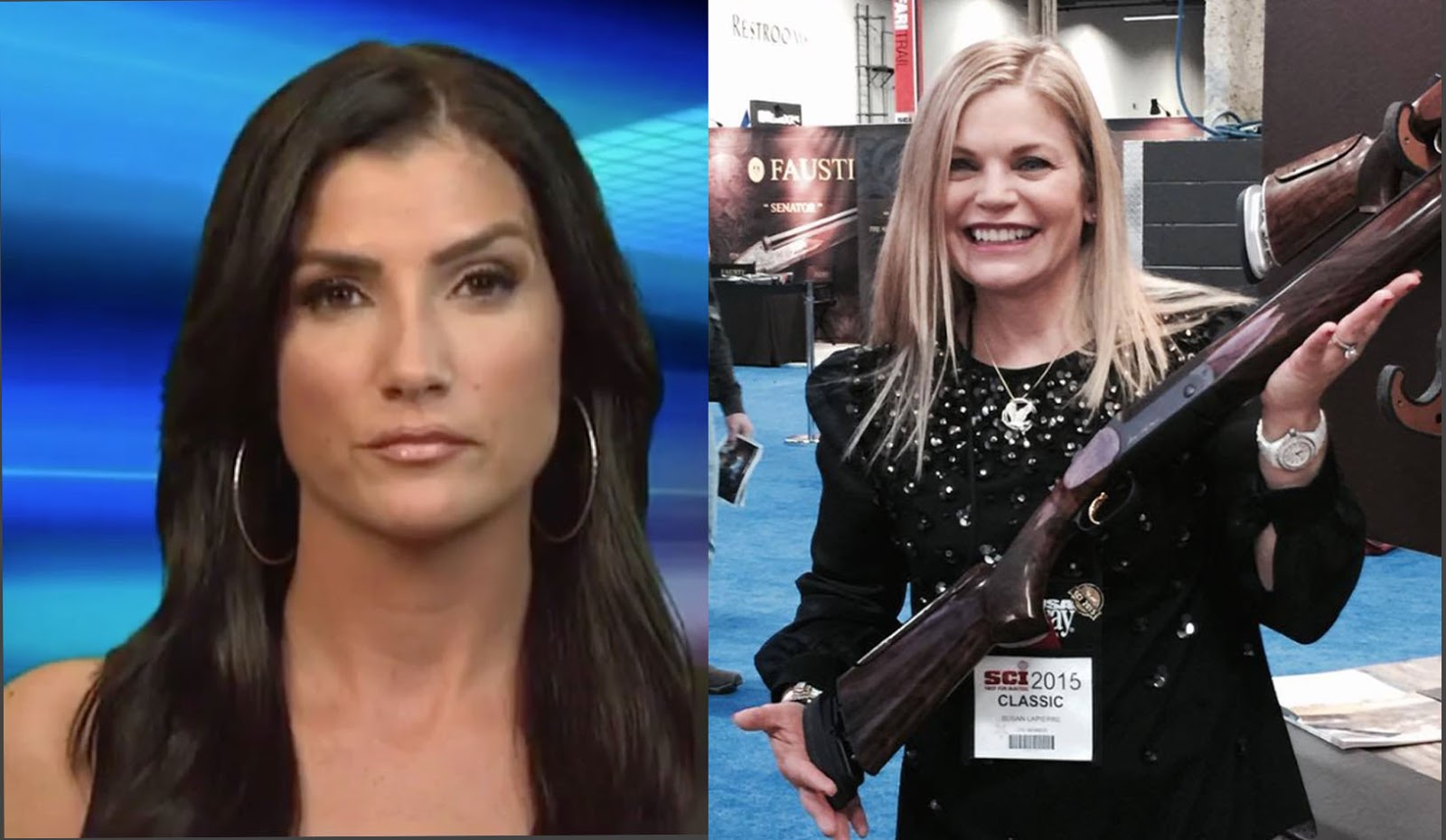
Women who speak for the NRA: Dana Loesch and Susan LaPierre
NRA spokesperson Dana Loesch, like Ms. Baker, not only vilified the media for reporting the Parkland school shooting and others just for the sake of ratings, she said that the Parkland students, as young as they were, were not qualified to make anti-gun statements.  “These students are mere babies,” she said, “and when they criticize guns and the right to bear arms just because of a few dead friends, they are being cry babies.  At that age, unless you, yourself already own a gun, know how to use it and understand our interpretation of the Second Amendment, you are not qualified to speak on the subject.” 

Click to enlarge
Perhaps even more effective than portraying the opposition negatively, the NRA swung Florida legislators’ votes by unveiling a new PR campaign with which they promise to soon be flooding the airwaves.  The NRA bought the rights to the likeness of James Franciscus from the estate of the dead actor.  From 1963 to 1965 the chiseled James Franciscus made a splash (many TV Guide covers) playing the title character “Mr. Novak” in a Peabody Award-winning TV series about an idealized role model of a sensitive English teacher who “who helped his high school students with their problems.”  The new NRA campaign, “Mr. Novak Gets Armed,” will again promote the Novak character as an ideal teacher, this time slinging a gun.

Click to enlarge
Jennifer Baker said that the NRA was quite pleased to have acquired the James Franciscus rights.  “We are thinking effective time line here,” she said.  “Prior to his incarnation as the gentle Mr. Novak, Franciscus did a lot for our American culture wielding guns during the cowboy era of television on programs such as, `Gunsmoke,’ `Have Gun Will Travel,’ `Tales of Wells Fargo,’ `The Rifleman,’ `Death Valley Days,’ `Black Saddle,” `Rawhide,’ `The Deputy.’”  Said Ms. Baker, “those shows were marvelous, everybody carried a gun and justice always prevailed.”

Talk about starting out one’s career propitiously as a future NRA icon for younger minds, Franciscus was one of the featured actors in the wonderfully named 1957 film, “Four Boys and a Gun.”  And as for maximum firepower gloriously unleashed from all sides, think of WWII: Franciscus played the explosive Pfc. Charles Harris in an episode of the  “Combat!” TV series.  In a more contemporary modern dress format Franciscus was also involved in investigating detective gunplay in the “Naked City” and “The Investigators.”   He was in “The Investigators.” immediately preceding his assumption his Mr. Novak role.

“After having done so much to advance American culture and our vital understanding that you keep the bad guys, whoever they are, in check with fire power, the pencil pushing Mr. Novak, was an enormous disappointment,” explained Ms. Baker, “but owning the Franciscus image and having available all of the pictures of him with guns we now get to invert that time line.”  Obviously triumphant, she went on to say, “We get to invert the time line and take it forward to a new action-packed super attractive future where Mr. Novak will henceforth represent what an ideal teacher should be as he helps students survive tense shootouts in his school.”

Donald Trump has agreed to appear along side the gun-toting Mr. Novak of the future in an NRA web-produced reboot of the Novak character series.  How will this even be possible?  “Mr. Novak will be CGI,” said Ms. Baker and titillating tidbits leaked to Variety say that the NRA is reaching out to famed CGI character actor Andy Sirtis or, alternatively, Guy Henry to play Novak.  Henry memorably mimicked Peter Cushing in a CGI skin version of that actor playing Grand Moff Governor Tarkin in the recent last “Rogue One” Star Wars film.

“We’d actually prefer to have Andy in the role though,” said Ms. Baker, “because of the `Planet of the Apes’ tie-in.”   (Sirtis, in CGI skin, played Ceaser, the ape revolution-leading, sometimes gun-grabbing Ceaser in the “Planet of the Apes” reboot films.  Franciscus had a central role in the original `Planet of the Apes’ series as an  astronaut arriving to rescue the earlier arriving astronaut George Taylor played by Charlton Heston.  That was in the second film of the original series with its climactic scenes in front of a destroyed NYPL 42nd Street Central Reference library ending- spoiler alert- in the human civilization destroying nuclear war of the future revealed by the previous film being topped by an even bigger Trumpian-scale nuclear planetary destruction.

“The Franciscus image thus provides a felicitous echo,” asserts Ms. Baker, because people will recall that Charlton Heston was once, himself, another iconic spokesperson for the NRA, speaking as its president when with thespian skill he viscerally infused deathly intensity into the NRA/Citizens Committee for the Right to Keep and Bear Arms slogan “I Will Give Up My Gun When They Peel My Cold Dead Fingers From Around It.”  (Are negotiations also underway with Heston’s estate? Time may tell, but there is many a slip between the cup and the lip- The tobacco industry had also attempted to buy rights to control Franciscus’ image.)
On the precipice of nuclear planetary destruction, NRA President Charlton Heston vies with Franciscus for domination.
According to what was leaked to Variety, being talked about is a 15 minute “Mr. Novak Gets Armed” web crossover episode with Trump’s “Apprentice” where a candidate (for a national security post?) disgruntled and drawing a gun when they are fired” by President Trump while competing with Novak will be dispatched by a faster-on-the-draw Novak.

The Florida legislation requiring nearly all teachers to be armed will further require that teachers enter their class rooms with their guns drawn.   “Otherwise, students can get the drop on them,” said Ms. Baker.  The Franciscus/Novak campaign will deploy plenty of images of Novak thus entering the classroom to normalize this so students will be accustomed to such sights even before they experience them in real life.

Alex Wind, a student speaking at the junior at  March 24 Saturday student-led day \March for Our Lives
“The student protests have actually helped inspire us,” says Ms. Baker.  Here’s how.  At the March 24 Saturday student-led day of action March for Our Lives in which 800,000 took part in more than 800 protests, Alex Wind, a junior at Marjory Stoneman Douglas High School made a speech in which he said:
Together, we will use our voices to make sure that our schools, churches, movie theaters and concerts, and our streets become safer, without having them feel like prisons. If teachers start packing heat, are they going to arm our pastors, ministers and rabbis? Are they going to arm the guy scanning tickets at the movie theater? Are they going to arm the person wearing the Mickey Mouse costume at Disney? This is what the National Rifle Association wants, and we will not stand for it!
Ms. Baker’s answer is simple: “Yes, we also have legislation we are ginning up to require that pastors, ministers and rabbis and the costume characters at Disney all be armed along with the ticket takers at the entrances of all entertainment venues.”
  
As Longstreet in 1971
That’s legislation for the future.  Under the legislation currently being enacted, teachers who refuse to carry guns as required or refuse to enter classrooms with guns drawn will be subject to penalties.  Persistent and flagrant ongoing violations can, according to the new legislation, even include the death penalty.

The new NRA-drafted law also contains a fix for Florida’s death penalty.  The death penalty is legal in Florida (and at one point there was a fraternal competition between two of the Bush brothers as respective governors of Florida and Texas to see which state could legally execute the most people.)   “But there have been challenges to humanness of the death penalty and the methods of execution used,” Ms. Baker, “and our legislation fixes that, requiring that all future deaths be by firing squad using absolutely assuredly lethal AR-15 assault rifles.  If our students can tolerate being killed this way, there is no way to say that it is not a humane way to kill people we think committed crimes.”
 
Quite sensibly, not all teachers will be required to carry guns and some may even be prevented. Noting that in his last significant television series Franciscus played “Longstreet,” a disabled  insurance investigator who was blind and thus didn’t carry a gun (he sometimes defended himself with Bruce Lee Jeet Kun Do or his seeing eye dog named “Pax,” i.e. “Peace”), Baker explained that teachers who are blind will not be required to carry guns if they don’t want to, but they will be allowed to.

There is another category of teacher who might not be bearing arms.  “We are not extremists,” said Ms. Baker, going on to elaborate:
Gun control legislation has some legitimate origins, and to the extent there may be something at the core in terms of common sense that needs to be recognized we ought to be flexible.  We recognize southern traditions.  Ronald Reagan tenaciously continued to oppose gun control even after he himself was shot in a presidential assassination attempt, but he started out on the other side of the fence as a governor who fought to curtail gun ownership when it was feared that guns would be used by organizing black people like the Black Panthers.
Accordingly, teachers who are black, will not be automatically required to carry guns.  To the contrary, teachers who are black will have to apply to go through a vetting process if they wish to carry guns like the other Florida teachers.  Asked about what might happen if a gun armed blind teacher encounters a black teacher without a gun and what the blind teacher might assume about that other teacher following (or not) the new law and requirements, Ms. Baker said she was sure whatever the outcome it would be colorblind.

The NRA is hoping the effective date of the new legislation will be today, April 1st.

Wednesday, January 9, 2013

A Teachable Moment: Bloomberg Veers Off Course In Gun Violence Prevention Debate

From the New York section of Monday's New York Times
Just as the discussion concerning gun violence prevention was receiving crucial national focus in the wake of the Sandy Hook school killings, gun control advocate New York Mayor Michael Bloomberg has cheapened the debate by likening New York City’s United Federation of Teachers to the National Rifle Association.  (See: Teachers Irate as Bloomberg Likens Union to the N.R.A., by Al Baker, January 7, 2013.)

Yes, that’s the NRA that in response to school shootings has suggested that the solution to too many guns is more guns, including lots of guns sent into schools so that problem of too many guns can be mediated via shoot-outs on school terrain between the good guys and the bad guys.  May the purchaser of the biggest, most recently purchased technological marvel in firepower win!  (See: Monday, December 31, 2012, Guns As The Solution To Guns? A Meditation on Corporate Solutions In General.)

True, Bloomberg in maligning the teacher’s union was wanting to make the point that the NRA doesn’t represent its rank and file members and true, that same point was made by me in the article I just linked to above.  In that article I went on to observe that the policy positions of the NRA leadership objecting to multiple very sensible proposals to prevent gun violence, while they may be attuned to the manufacturer’s interest of selling a maximum number of guns, diverge from what most Americans want.  In the end the policy positions of the NRA leadership actually represent the views of a very small fragment of the population found only at the extreme ends of the spectrum.

All of that, while true, does not make it appropriate for Bloomberg to make his point by suggesting that the teachers union leadership cares as little for the children in our schools or for protecting general welfare as the NRA.  Notwithstanding such inappropriateness, Deputy Mayor Howard Wolfson dug in, defending the mayor with a statement reiterative of this exact theme just two days later:
“As the mayor has said before, the union is a special-interest group focused on advancing its agenda, whether it’s in the public interest or not. . . Their refusal to agree to a fair evaluation deal is just the latest example of this.” 
It's really not fair to suggest the teachers union doesn’t care about our public interest in teaching our children, to set it up oppositionally, virtually as if it were a dichotomy.  Even if the teachers union does have its own special interests to advance which likely creep up in the priorities they set forth in their agenda:, the fact is that if the children of New York are well taught and enthusiastic about their education it strengthens the teachers union by making the union look good and giving it allies amongst the parents.  It also means that much more often teachers will enjoy the kind of meaningful experiences in the classroom that most of them probably factored in as compensation when they chose a profession that is not very financially rewarding.

By the same token it would hardly be fair to say that Bloomberg cares nothing about the welfare of New York’s schoolchildren or how well the city school system works to teach them because, similarly, when the system actually works to give children good educations it helps Bloomberg look good.  But to acknowledge this is not to say that Bloomberg doesn’t have his own special interests prevailing in his agenda for the school system.  Bloomberg is notorious for favoring the marshaling of statistical numbers that can make him look good as mayor irrespective of underlying substance.  Also, of course, he would like to spend less on education than the teachers union would advocate.

Bloomberg has introduced into the school system a destructive focus on teaching to the tests when, in actuality, education is about having an enthusiasm for learning. . . . . .  Most of the facts we learn in school when we drill to take tests of debatable relevance wind up being forgotten.  What can stick with well-taught students is something less measurable, the enthusiasm for learning with which they can become imbued and the self-motivation they develop to keep building upon their skills.

Bloomberg’s pursuit of a shift to charter schools to privatize and profitize education also does not speak well of a commitment to public education on his part.  One can easily argue the abstract merit of creating new schools and allowing them to compete with each other in a quasi-marketplace structure that embraces consumer choices that informed parents can make, but with charter schools the devil is in the details and if charter schools can cherry pick the best students out of the system, determine their optimal class size when public schools can’t, and procure superior funding and facilities, then they are a discriminatory drain on the rest of the system.  They are also, of course, an ill-concealed effort to sidestep the teachers union.

It is disconcerting that when Joel Klein, Bloomberg’s long-term Chancellor of Education, left his post he went to work for Rupert Murdoch.  Murdoch (whose vast empire includes the “fair and balanced” Fox News) promotes charter schools and Murdoch hired Klien, a champion of charter schools, to oversee Murdoch’s branching out investments into education (according to the Times, he was being “charged with pursuing `entrepreneurial ventures` that cater to the educational marketplace”).  More recently, 2012, Klein’s work for Murdoch has consisted of efforts to soothe the Murdoch’s wire-tapped and politician manipulation scandal.

There was compounding confoundment when Klein’s departure was followed up by Bloomberg’s appointment of  Cathie Black, whose very brief 95-day tenure ended with a forced resignation.  Whatever Bloomberg’s intent was when he hired Ms. Black for her private sector media-company salesmanship expertise, she was not up to the job of running an education system.

I could argue that the teachers union, whatever its special interest concerns, still has a deeper and broader commitment to the core values of public education than Bloomberg, given the mayor’s inclination to get distracted with the competing matters he makes his priority.  Instead, I will just say that, whether or not such an argument would carry the day, it is good that we have the teachers union as a counterweight to Michael Bloomberg considering the inevitable pitfalls of self-interest on both sides.

I do not question Bloomberg’s commitment to quelling gun violence.  Unlike other issues (like protecting the environment) where he has acted inconsistently and swung with the polls, Bloomberg has been consistent from the very first about regulating guns.  However committed he may be to making a strong case for this cause, dragging in the subject of public education and the teachers union for such careless pot-calling-the-kettle-black mud-slinging has undermined his efforts.

Monday, December 31, 2012

Guns As The Solution To Guns? A Meditation on Corporate Solutions In General

Brilliant!  In quintessential arms-industry fashion the gun lobby as embodied in the National Rifle Association (NRA) has offered to supply both sides in an escalating arms race: More guns is the industry’s proposed answer to too many guns!

American crazies can obtain and walk the streets toting arsenals unimpeded by any legal challenge or rules and the gun lobby’s proposed remedy is that our response should be to expend taxpayer money to publicly equip and position sentries with the industry’s newest designs and latest ideas in terms of achieving superior force so that both fabulously equipped sides can shoot it out Wild West style with rapid fire multiple bullet high capacity magazines spraying large caliber armor-piercing bullets through our schools, movie theaters, shopping malls and churches . . .

Who wins such a shooting match?  Let’s send an award out to the fastest to draw . . .  the obvious conclusion: The only sure winner of such a plan is the gun manufacturing industry.

We all know the debate can get rather silly when people struggle to assert that guns are not the problem when you don’t responsibly regulate guns. . .  Remember the discussion of assault gun violence during the last presidential debate?: Republican candidate Romney came up with the idea that the solution to gun violence was for government to get involved in ensuring that the nation is populated by two-parent households.  No kidding: He did!  That was his version of how to cling to the notion that “Guns don’t kill people, people kill people,” although the statistics make it perfectly clear that people kill people (with guns as it turns out) much more frequently when they have guns.

The gun industry’s plan for America comes across a little like the proverbial vacuum cleaner salesman who elbows his way through your front door to spread dirt on your carpet so the salesman can endeavor to show you how well the machine they want to sell you will clean it up; the only thing is that this isn’t like the real version of that rigged sales pitch where the fluffy mix spilled on the customer’s floor is especially easy to suck up with the machine. . .  The gun manufacturers gambit works out more like an spectacular unfunny version of those spoofing burlesque skits where the mud stains leave a very real and very uncleanable mess.

The absurdity of the NRA’s sell more guns to address the gun problem is understandable when you realize who the NRA represents when it is promoting gun policy.  The evidence is that it doesn’t represent its own membership: It instead represents the industry selling the guns.  A New York Times editorial on the subject makes the point:
 . .  surveys that show a majority of N.R.A. members and a majority of American gun owners often support restrictions on gun sales and ownership that the N.R.A. has bitterly fought.

For instance, a 2009 poll commissioned by Mayors Against Illegal Guns found that 69 percent of N.R.A. members would support requiring all sellers at gun shows to conduct background checks of prospective buyers, which they do not have to do now and which the N.R.A. has steadfastly argued against.
Whatever reputedly huge amount of spending the NRA puts into political campaigns its actual membership is relatively small.  In our country of 315 million people the NRA with its low dues rate claims membership of only 4.3 million.  According to YouGov survey statistics recently reported in the Washington Post about 35 percent of Americans had a gun in their household (either owning a gun or living with a gun owner).  NRA membership among gun owners (mostly men) was 24 percent.  Obviously, surveys depend on the questions you ask (i.e. The Times cited survey above about background checks for gun shows NRA members favoring stricter law) but of the very much more substantial majority of gun owners who are not NRA members 25 percent supported stricter laws and 45 percent want no change.  Of the smaller 24 percent group of gun owners who are NRA members 54 percent wanted to make gun laws less strict.   Interestingly, a plurality of those who did not own a gun but lived with a gun owner (40 percent) want to make gun laws “more strict.”

While it may come as a surprise that the NRA membership is more supportive of gun restrictions than the NRA itself (despite NRA supported policies almost everyone is in favor of keeping guns out of the hands of the mentally ill and half of the NRA members supported requiring a five-day waiting period for gun purchases), consider that particular surprise against the background of how much more conservative NRA membership is compared to the rest of the American public.  The New York Times recently published survey information that not only are Republicans more likely to own guns than Democrats, but:
Whether someone owns a gun is a more powerful predictor of a person’s political party than her gender, whether she identifies as gay or lesbian, whether she is Hispanic, whether she lives in the South or a number of other demographic characteristics.
The NRA membership as opposed to gun owners in general is likely not just to be Republican but conservative as well: According to the survey figures in the Washington Post story:
70 percent of [that small percent of] gun owners who were NRA members called themselves “conservative” or “very conservative.”  Only 44 percent of gun owners who weren’t NRA members said that. 
In other words, the NRA being more extreme than its relatively small membership does not just mean it is more extreme than typical gun-owning Republicans; it means that it is also more extreme than a much smaller segment of the population (actually outnumbered by the rest of the gun-owning population) that self-identifies as especially conservative.

Here are a couple of things I found surprising to learn: First, the NRA’s stance on gun control was originally diametrically different, until relatively recently (1920s and 30s) it pushed for gun control legislation and, secondly, those positions now advanced by the NRA when it says it represents its highly conservative membership are positions it derived from the country’s radical left.  We may tend to associate guns more with the South than the North but the NRA was started right after the Civil War by two former Union soldiers. The change to the current politics of the NRA came with a May 1997 coup that changed its leadership.  More on this background is available via a WNYC On The Media interview with UCLA law professor Adam Winkler, here: The Untold Story of Guns, Friday, December 21, 2012.

While we may strongly associate the NRA’s current views with right-wing  conservatives Winkler suggests that the heritage of the NRA’s current views, including demonization of the government as a threat (used as a justification to incapacitate government’s ability to regulate the industry), hearkens back to a precipitating NRA endorsement of and alliance in support of the radical left Black Panthers view that gun ownership is a critical protection against hostile government that can be  “tyrannical and disrespectful of people’s rights.”   Winkler has written a 2011 book on the subject (Gunfight: The Battle over the Right to Bear Arms in America) extracts of which became an article in the Atlantic: “The Secret History of Guns,” September 2011.   Another interesting tidbit therein: Ronald Reagan, who tenaciously continued to oppose gun control even after he himself was shot in an assassination attempt, started out on the other side of the fence as a governor who fought to curtail gun ownership.

When it comes to gun control I consider myself to be somewhere in the middle, recognizing that there is a very big middle to be in.  Living in New York City I see little reason to want to own a gun and plenty of reason I don’t want lots of them floating around the city, but having had family in Montana where they reported being stalked by cougars (who I was told are especially attracted to child-size human beings) I can see why one might want to take a gun for a walk in that area of the country.  Still, I can’t readily imagine how a concealed carry permit would assist in warding off the big cats. On the other side of the equation, my father’s cousin wound up owning his own World War II Howitzer for a while, you know those artillery field guns that are so big they travel on their own two wheels pulled around behind jeeps?  This gun was one of the smaller of such species.  If you have your own mountainside devoid of humans in the winter as my father’s cousin did you might actually be able discharge such a gun without too much mayhem but do we really want average citizens deciding where they want to point guns of such caliber and just when they want to set them off?

What do I think should be done in terms of gun control?  There is a lot that could be easily done that I would view as relatively middle of the road:
    •    I am hardly the first to wonder why guns whose primary purpose is to be deadly shouldn’t be at least as well regulated as automobiles which are only deadly if not used with the proper care.  The U.S. Constitution actually speaks in terms of regulating guns (the Second Amendment addressing guns speaks of a “well regulated Militia”) but the Constitution’s other direct mentions of possible government regulation (regulation of federal military forces, ports and commerce, currency, the federal courts, the manner of federal elections) doesn’t immediately bring to mind measures to ensure that other potentially deadly things like automobiles, chemicals or drugs be responsibly handled.

    •    Not only are car drivers required to have licenses but the cars they drive around also display license plates so that their improper use can be accountably traced back.  (The minimal cost to this system of licensing cars is far less than the alternative.)  I rather like the proposals that have been put forth to make bullets traceable in various ways so that law enforcement can identify where bullets were bought as well as the gun used to fire them.  A national registry to make the all of the tracking jobs a lot easier makes sense.  (See: Lawmakers Consider Stamps on Bullets, Published August 03, 2005, FoxNews.com, The Year in Ideas; Traceable Bullets, By Margaret Talbot, December 15, 2002, US Needs Traceable Bullets - Not More Marketable Guns, By Josh Sugarmann. Josh Sugarmann is executive director of the Violence Policy Center. / December 13, 1993, Make Bullets Traceable To Affect Accountability, July 17, 1999, Mon Jul 12, 2010, How to track Gun Crimes, 'Tags' to Help Catch Bombers, May 30, 1995.)

    •    I was stunned when I learned in 1999 that it was possible to trace back half of all the crime guns to just 1 percent of federally licensed firearms dealers and that, with most crime guns being guns that were legally bought, all of the legally bought crime guns were sold by only 20 percent of the dealers.  From this you can infer that a lot of repetition of consciously intended bad acts.  We know that straw buyers make repeated purchases for organized rings of gun traffickers.  It hardly seems that, unfettered by the gun lobby, that this would be hard to stop.

    •    The list of possible sensible restrictions can easily be lengthened.  I don’t think that there is reason that most people should be permitted to own either a Howitzer or the assault weapons designed for mass mayhem even if I am not the sort to dismiss out of hand the notion endorsed by the Black Panthers that government can be tyrannically disrespectful of individual rights (Disquietingly, gun control advocate Michael Bloomberg, mayor of New York City, is one of the ones who must be watched in terms of the potentials for government abuse). 
But what is the logic of fighting the plethora of guns with an escalating investment in more guns to keep pace?

What is this predilection we seem to have developed in this new era now dubbed the Anthropocene* for attacking all our manmade problems (I should say masculinely manufactured problems) with an escalating piling on of the same?
(* the new epoch where human beings are changing the planet)
I find myself thinking of the disappearance of bees around the world due to colony collapse disorder.  One reason colony collapse disorder is likely occurring is because genetically modified crops are producing a new class of neonicotinoid pesticides (produced by companies like Monsanto). How are companies like Monsanto dealing with the fact that the world is dependent upon bees for fertilization of most of the world’s crops, about 40% of what we eat? Not by eliminating the genetically modified crops threatening the bees. Like Zeus when he decided he needed no female partner and could masculinely give birth to Athena without Hera, these companies are prepared to go it alone without any partnering or balance with nature: They are hard at work genetically reengineering almond and soy crops so they won’t require fertilization by bees.  How parthenogenetically pathological: To banish forever the utility of flowers!

Similarly, the same companies that sell powerful herbicides (like Monsanto’s Roundup) and pesticides are patenting new crops that they are genetically modifying to be resistant to increasingly high doses of such chemicals.  As weeds found in the fields naturally evolve to become herbicide tolerant and insect pests likewise evolve the companies escalate the strength of their poisons and the artificially created GMO crops that can co-exist with them.  It’s the rest of nature that can’t keep pace to stay in balance.  Those who think that the horror GMO “Frankenfoods”is their mere unfamiliarity probably have it wrong: What we really have to fear most is likely this kind out-of-balance arms race of man inventing alterations to the natural environment to stay ahead of man-made alterations to the natural environment.

We could be cutting back on the greenhouse gases we pour into the air that cause global warming and climate change but instead it is likely that we are going to be more content simply to take extraordinary measures to deal with its effects.  The center of the country (62 percent of the continental United States) is drying out.  The Colorado River, supplying seven states including Arizona and California and 25 million people with water, is drying up so the Federal Government is looking at a new pipeline to annually divert 600,000 acre-feet of water from the Missouri River.  But the Missouri River feeds the Mississippi River and right now because of the unprecedentedly severe drought the Mississippi is becoming increasingly less navigable.  If the river is shut down as a navigation waterway it will necessitate a huge reconfiguration of the nation’s existing infrastructure, including the relocation of towns and population or their reassignment to new industries and livelihoods.

Meanwhile, the Ogallala Aquifer, instrumental in keeping a return of 1930s Dust Bowl conditions in the region at bay, is is being drained at an unsustainable rate.  At the same time, the acquirer which supplies drinking water to 82% of the populace in the region is threatened by the proposed new Keystone pipeline which, probably more importantly, will lead to a significant increase in greenhouse gasses, global warming and thus, full circle, the aquifer’s replenishment problem.

Other things we are looking at doing to adapt to climate change: moving infrastructure, homes and industry away from the changing coastlines, rebuilding coastline structures to make them less vulnerable to storms, rebuilding subways and waste management systems, pumping sand to the beaches, building surge barriers in our harbors and paying for storm recovery.  As sea levels rise, substantial amounts of potable water sources near the coastlines need to be replaced.  We are even considering more extreme schemes to reverse the climate change like spewing iron into the oceans to spur algae production to recapture carbon and spewing reflective dusts into the sky to repel the heat.  With dust above our heads the skies might no longer be blue and solar power installations might be less effective but it would be consistent with piling on to take active measures to try to stay ahead of ourselves.

Why is the silliness of these compounding races to keep pace with our own unbalancing reinventions of the environment accepted by any of us as making sense when they get proposed?  Maybe they don’t actually make sense to us, at least not as we inhabit the world as human beings, citizens of the world or parents of future generations.  Maybe these ideas only make sense to the corporations that propose them in order to continue making profits.  Is acceptance of these ideas, such as that acceptance may be, only just the way that corporate thought pervades into the general culture at large?

My respect for former New York Governor Eliot Spitzer has been somewhat circumscribed at times, but maybe Mr. Spitzer has the right answer about how to address the problem with government’s spinelessness in taking on the proliferation of guns and their irresponsible use.  Spitzer found good answers in tackling Wall Street before.  Now he is suggesting that we need to take the profit out of the gun industry’s promotion of irresponsibility. 

He says it is time to bring pressure to bear on the owners of the gun companies, time to look at major union pension fund and university endowments investing in the industry because they sure don’t want to be;
tarred as a passive owner of the company that sells semi-automatic weapons with no background checks or concern for the use of the weapons. Those investors have enormous leverage over the [companies that own the gun manufacturers]
He suggests they “could wield vast power” if they spoke with one voice.  (See: It’s Time To Target Cerberus, the Private-Equity Firm That Dominates the Gun Industry, by Eliot Spitzer, Monday, Dec. 17, 2012 and December 22, 2012, Public pressure and guns, by Eliot Spitzer.)

It’s an idea worth expanding upon.  The world could be made better in a lot of ways if we took the profit out of a lot of things.  It would be a nice way to clean the slate for the New Year.

Happy New Year.

Tuesday, October 23, 2012

Did Romney Access His Credentials As Mormon Bishop To Answer Gun Control Question In Second Presidential Debate?

Romney answering question about controlling AK-47 assault weapons during second presidential debate- Was his answer "heaven-sent"?
There was a moment in the second presidential debate that struck me as most odd.  I think I have finally managed to explain it by referring back to the time that Romney served as a Mormon Bishop. . .

. . .  How do we get from here to there?

Well that was more or less my question when I was listening to the debate: What kind of leap was Romney making when he answered an audience member’s question about gun control?

The Gun Control Question

Nina Gonzales asked the gun control question first of President Obama, whose turn it was to take the next question.  When Obama finished answering moderator Candy Crowley restated it to put it before Mr. Romney.

Ms. Gonzales’ question and Ms. Crowley restatement were as follows:
Ms. Gonzales: President Obama, during the Democratic National Convention in 2008, you stated you wanted to keep AK-47s out of the hands of criminals. What has your administration done or plan to do to limit the availability of assault weapons?

Ms. Crowley: Governor Romney, the question is about assault weapons, AK-47s.
The Answer?

Now admittedly we’ve had a number of issues that people would just as soon dance around or avoid entirely in this election if they can: Global weather change, Guantanamo detentions, drug legalization (See Brian McFadden’s October 21, 2012 “The Strip”).  Given the strength and inflexibility of the gun lobby, gun control is no doubt another of these.

But where did Romney go in his dance?  He went to the importance of two-parent households and not having babies before getting married!  (Presumably that translates into not having sex or only having very careful sex before getting married given Romney’s stance against a woman's free choice when it comes to abortion rights.  Presumably it also means government encouragement of the forgoing, given that Romney was answering the gun control question in the context of explaining why he should be president.)

Government encouragement of two-parent households to limit the availability of AK-47 assault weapons?

Obama danced a little in his response but not that much.  He referred implicitly to being governed by the Supreme Court’s recent rulings by saying that: “we're a nation that believes in the Second Amendment.”   That’s pretty direct.

Romney actually cited back to part of Obama’s response when he went off on his tangent about having babies when you are not married.  Indeed, Obama had spoken of having “a broader conversation” about reducing impulses to violence in the culture (and he even mentioned “faith groups” in this regard) even as he spoke about taking guns out of the hands of criminals and the mentally ill:
And so what I'm trying to do is to get a broader conversation about how do we reduce the violence generally. Part of it is seeing if we can get an assault weapons ban reintroduced, but part of it is also looking at other sources of the violence, because frankly, in my hometown of Chicago, there's an awful lot of violence, and they're not using AK-47s, they're using cheap handguns.

And so what can we do to intervene to make sure that young people have opportunity, that our schools are working, that if there's violence on the streets, that working with faith groups and law enforcement, we can catch it before it gets out of control?

And so what I want is a — is a comprehensive strategy. Part of it is seeing if we can get automatic weapons that kill folks in amazing numbers out of the hands of criminals and the mentally ill. But part of it is also going deeper and seeing if we can get into these communities and making sure we catch violent impulses before they occur.
But consider where Romney went with it when invited to participate in that broader question.

First he referred back to President Obama’s concept of being attuned to the culture of communities to catch violent impulses before they manifest:
What I believe is we have to do as the president mentioned towards the end of his remarks there, which is to make enormous efforts to enforce the gun laws that we have and to change the culture of violence we have. And you ask, how are we going to do that? And there are a number of things.
The “number of things”?

Obama had mentioned (in conjunction with the need for opportunity) the nation's schools should be working and Romney quickly endorsed having good schools (We were able to drive our schools to be number one in the nation in my state” - Fact checking: Romney didn't do that `driving') saying:
    . .  we'll give people the — the hope and opportunity they deserve, and perhaps less violence from that. 
But it was where Romney went quickly after that and the depth and amount of time he spent with the idea indicated it might all have been heartfelt even as he tried to cover multiple bases (two-parent households are “not always possible):
But let me mention another thing, and that is parents. We need moms and dads helping raise kids. Wherever possible, the — the benefit of having two parents in the home — and that's not always possible. A lot of great single moms, single dads. But gosh, to tell our kids that before they have babies, they ought to think about getting married to someone — that's a great idea because if there's a two-parent family, the prospect of living in poverty goes down dramatically. The opportunities that the child will — will be able to achieve increase dramatically.

So we can make changes in the way our culture works to help bring people away from violence and give them opportunity and bring them in the American system.
Where did this come from?  Obama wants to pay attention to how people are behaving in their “communities” but Romney wants to have a conversation with us all about having babies and what kind of families we are forming that . .  (is he really saying this?). .  may or may not (depending on the number of parents?) be part of the “American system”?

A Heaven-Sent Answer?

I believe I found my answer the other day.  I was about halfway through watching PBS Frontline’s “The Choice 2012,” a two hour documentary (Frontline does one every four years) interweaving the biographies of the two presidential candidates.

What I believe is my answer came when the documentary covered Romeny’s being ordained as a Mormon bishop.  (He served four years.) Here is what I heard:
NARRATOR: He would spend 20 to 30 hours each week helping other Mormons handle their most personal problems;— debt, sickness, unwanted pregnancies, and failing marriages.

CLAYTON CHRISTENSEN, [Romney's] Friend: The responsibility to helping them resolve their difficulties and recommit to each other falls on the shoulders of the bishop.

NARRATOR: At first, Bishop Romney was viewed by some as inflexible, what Mormons call an “iron rodder.”

SCOTT HELMAN [The Boston Globe- Co-Author, The Real Romney]: Some people describe him as being very much out of that hidebound tradition, where you know, he’s telling women that they cannot have an abortion. He’s telling single women to give up their children for adoption because the Mormon church does not encourage single parenthood, that he’s resistant to calls for changes within the church for more liberal policies, especially towards women.
The documentary suggested that Romney, confronted with real world family problems ultimately “thawed a bit” but that idea that “single women” should “give up their children for adoption because the Mormon church does not encourage single parenthood” sounds an awful like the idea Romney accessed on the stage of the second presidential debate when he told the nation how we should address the availability of AK-47 assault weapons on the streets.  I am not comfortable with the “broader conversations” Romney seems a little too eager to have.