Showing posts with label Obama. Show all posts

Monday, January 30, 2017

How Big Was Women’s March On Washington (Just in DC Alone)? Here Are A Few Clues (Including That It Was Much, Much Bigger Than The Trump Inaugural And Magnitudes Greater Than The Biggest Tea Party March)

(Click to enlarge- if you dare.) Was D.C. Women's March crowd "over million" marchers by a healthy margin? Probably!  Images of D.C. Metro, eventually too crowed to us from NY1reporting.  See below for aerial comparison views.  Two crowd pictures upper right from avenues north of National Mall.
How big was the Women’s March on Washington?  There were crowds marching everywhere, all over the world and all over the U.S.A.  But how big was the Women’s March on Washington, just the people who were in D.C.?
Click through to see sweeping video of a portion f the Women's March crowds flowing through Washington DC
We know it was really big, bigger by far than the gathering for Donald Trump’s inaugural, but let’s obsess a bit about exactly how much bigger and how big, because it’s fun: The more we obsess, the more fumed DT gets. You know how Trump wants to insist that he had a really big inaugural crowd (asking the Parks Department to scour for pictures as proof) . . . It’s with something of the same urgency that he wanted to tell us he had “big hands.” . .

. . . O.K. Donald: tell us how “big” your hands are: We enjoy all your “alternative facts.”

How big was the Woman’s March crowd?  It’s true that very large crowds like this are hard to count.  A company called Digital Design & Imaging Service, is trying to make an estimate of attendance at the Women’s March and says it will put its data up for others to assess when it is done.
Washington DC.  Washington Monument in distant background.
Meanwhile, some clues:
(click to enlarge) Hard to get a perfect three-way overlay (its best to use the available interactive sliders to do two comparisons at a time), but here are three event overlaid: The Woman's March on right, On left the Trump inaugural with an upper middle square patch showing the much more populous Obama inaugural.
The First Obama Inauguration in 2009 Estimated To Have 1.8 Million People.- Trump Had a Fraction of That and Women’s March Had Multiple of Trump Crowd.  The figure that has long been widely given and accepted for the number of people who attended Obama’s first inaugural address is 1.8 million. Perhaps 460,000 of them were back on the National Mall rather than closer up (it is believed to have been the largest ever crowd in D.C.).  The New York Time recently reiterated this as it made comparisons (via pictures and graphing on a map) of that crowd to the relatively scant groupings of people at the 2017 Trump inaugural.  See: Trump's Inauguration vs. Obama's: Comparing the Crowds, by Tim Wallace, Karen Yourish and Troy Griggs, January 20, 2017.

(One estimate of the size of Obama’s 2013 crowd is about 1 million.)

Professor Keith Still, of Manchester Metropolitan University in England, a crowd safety consultant providing his assessment to the Times, estimated the Trump inaugural at “about one-third the size of Mr. Obama's,” although looking at the side-by-side pictures of the number of people on the mall those days the estimate seems generous to Mr. Trump.
New York Times article: Crowd Scientists Say Women's March in Washington Had 3 Times as Many People as Trump's Inauguration,
In another article (two days later), with more sets of side-by-side pictures and graphs on maps, the New York Times published that the “women's march in Washington was roughly three times the size of the audience at President Trump's inauguration, crowd counting experts said Saturday.”  (The experts: Professor Still again, this time with his colleague, Marcel Altenburg also at Manchester Metropolitan University.)  See: Crowd Scientists Say Women's March in Washington Had 3 Times as Many People as Trump's Inauguration, by Tim Wallace and Alicia Parlapiano, January. 22, 2017.

Does this mean, ergo, that the crowd at the Women’s March was somewhere around the size of the 1.8 million crowd for Obama’s first inauguration?  It would seem like it should put it somewhere near that number and it would be nice if it were that simple and easy to know for sure. People will probably settle on some kind of lesser number when all the analytical dust settles.  A much more seat-of-the-pants estimate from ThinkProgress estimates the Women’s March crowd at just double that of the Trump inaugural.
Interactive CNN overlay with slider for comparison
CNN has a fascinating interactive visual where you can use a slider of fairly exactly overlaid photographs to go back and forth to make enormous crowds either appear or vanish by going back and forth between the Obama 2009 inauguration and Mr. Trump’s.  CNN also gives that Obama attendance figure at 1.8 million.
Interactive USA overlay with slider for comparison: Trump inaugural left vs. Woman's March right
And, oh joy, USA Today has such an interactive feature where you can similarly use a slider to go back and forth to compare the crowds between Trump’s Friday inaugural on the 20th and the Woman’s March the next day on Saturday.  PRI has more interactive sliders that do the same thing.  Trump railing about the subject of crowd size when speaking to the CIA the day of the march (with his traveling clap-track- or “claque” in attendance) said that he’s seen an unspecified “network” report his inaugural “drew 250,000 people.”

Washing D.C. Metro System Ridership For Woman’s March Was Second Highest Ever.  The Washington Post reported that, the day of the Women’s March, the Washington D.C. Metro rail system had the second highest ridership day of in the system’s history, 1,001,616 trips.  The highest in history was Obama’s 2009 inauguration, 1,120,000 trips.  Obviously, even though this Saturday figure for the Women’s march is 89% of the figure for the Obama inauguration day it doesn’t mean that the Woman’s March crowd was 89% of the 1.8 million from 2009.  That’s because there are other users of the system, a base number of riders to start with.  And with to and fro, each ride does not represent a single person each.

As a barometer, on Saturday, September 12, 2009, the day of the Taxpayers March by the Koch brothers funded Tea Party, the total DC Metro rail ride figures for the system came out to a total of 437,000, which was, according to Los Angeles Times reporting, 87,000 over the average daily ridership of 350,000. That accompanied an  “expert” research professor crowd estimation of about 60,000 to 70,000 for that crowd at the beginning of the event.*  The Washington Post reports that 570,000 trips were taken on the rail system the day of Donald Trump's inauguration.
(* Looking at pictures to gauge the size of this largest ever Tea Party rally can be deceiving because some of the people looking to brag about the size of the crowd put up a picture of someone else’s event apparently from the 1990's when the buildings on the National Mall weren’t even the same- “alternative fact” visuals?  Also in the `false crowd image’ category is that Trump’s campaign apparently hired a crowd of actors, $50 per, to cheer him when he made his June 16, 2015 announcement that he was running for president, arriving in the lobby of Trump Tower descending an escalator. .  And then it didn’t pay the $12,000 bill for the actors until October.)
If the daily D.C. Metro ridership is roughly near the 350,000 it used to be then, by subtraction, the other differences in ridership would work out to: 220,000 extra rides the day of the Trump inauguration, 651,616 extra rides the day of the Women’s March, and 770,000 extra rides the day of the 2009 Obama inauguration. . . If proportionate ridership was a perfect measure, then Trump’s crowd would be about 28.57% the size of Obama’s 1.8 million (514,260) and the Women’s March would be about 84.6% the size of Obama’s 1.8 million (1,522,800).

Click through to watch fast motion video of a zillion Woamen's Marchers in Lincoln Park Washington DC (a mile and a half away) walking two miles to the march because the DC metro was too jammed to handle so many people and walking was faster.
But ridership is not a perfect measure.  I went to the Women’s March and our bus, due to problems, was late starting out and getting there (so much for getting up in NYC at 3:30 AM).  When it arrived with other buses behind us, the forty or so people from my bus were advised not to use the Metro because it was too overcrowded.  We all took the advice that it would be quicker (about an hour) to walk the two miles from RFK Stadium and like so many others, we did.  Returning at the end of the day, we walked again, an hour and half with another stream of marchers, because the line to get into the entrance of the DC Metro was two blocks long.

Marchers waiting "in line?" at Shady Grove station to get into Washington DC Metro station to go to the March.
Other friends of ours who also came by bus didn’t use the D.C. Metro because they successfully arranged to have their bus drop them off and pick them up close to the site of the march.

Those who traveled to D.C. by train, and there were many of them, got into Union Station, a close walk to the march and probably never used the Metro either.  Some people stayed with friends or at a hotel nearby enough to walk.

One thing that probably helped the 2009 Obama inaugural crowd attain the size that it did is that Washington D.C. is a largely black town in terms of its inner citizenry: There were certainly a lot of people nearby to the mall who had an interest in attending the inauguration of the nation’s first black president, and, if we may venture an understatement, probably had much less of an inclination to attend Trump’s . .

. . As we walked our hour-and-a-half return to the stadium we saw people arriving at a church with an apparently mostly black congregation who were apparently returned from the Women’s March. Going to and from the march, as we walked through a neighborhood that seemed to have a significant black population we were, time and again, warmly greeted by residents.  Along much of way, obviously the result of some organizing effort, there were a multitude of signs in the front yards with marvelous quotes from Dr. Martin Luther King, Jr.  Quotes like:
•    “Love is the only force capable of transforming an enemy into a friend.”
•    “I have decided to stick with love. Hate is too great a burden to bear.”
•    “In the End, we will remember not the words of our enemies, but the silence of our friends.”
•    “Injustice anywhere is a threat to justice everywhere.”
•    “Never forget that everything Hitler did in Germany was legal.”
It did not immediately occur to me that these signs might have been, not only for our viewing, but also for attendees of the Trump inaugural the previous day, although those attendees would have been less likely to have been walking two miles due to a overcrowded Metro system.  By the way: The day of the Trump inauguration there were also many people there to protest, not applaud.
I grabbed my camera: Here's a small fraction of the parked buses we were rolling by.
Requested Bus Permits For Trump Inauguration Were Less Than On-Quarter Those For the Women’s March.  In the days leading up to the Trump inauguration and Woman’s March it was clear that the escalating number of city bus parking permits for the respective events meant that the bus-delivered attendance component of the attendance at the march was far outpacing that of the inaugural.  By January 18th, two days before the inaugural, the Chicago Tribune was reporting that 1,800 buses had registered to park in the city on the day of the march while “in contrast” approximately 400 buses (22.22% as many) had registered to park in the city the day of the inauguration.

How many finally arrived in the end?  Reportedly, charter bus parking spaces that can be available at RFK Stadium number 1200.  That’s just one of the locations buses could park in the city.   As of the 15th The Hill reported they had all been booked for the day of the Women’s March.  It’s anecdotal, but when our bus arrived to park at the stadium it was one, like other buses before and after it, that the parking lot managers were directing to park on the grass rather than the asphalt, indicating the lot was over capacity.

Other Indicators? 

It is important to remember that the crowd of the Women’s March was everywhere in the city.  It was not only on the Mall, but all the side streets and avenues.  I realized this when I reached an intersection and in all four directions, as far as I could see, I saw crowds bigger than I had ever seen before.  The Woman’s March in Washington was just one location in the U.S. that day where the crowd arriving was so unexpectedly large that the idea of routing it on a formally directed march route had to be abandoned.. .   So when one compares visuals of Obama’s 2009 inaugural with the Women’s March one needs to think about how far the crowds were roaming for the March.
Obama 2009 inauguration crowd
Enlargement of area of photo above that shows the absence of a crowd far back near the Washington Monument
Picture from a New York Times article of pictures from around the world with Washington Monument much closer in the background shows how crowds in Washington D.C. roamed all the back at the Monument. 
Although pictures of the 2009 Obama inaugural looking over the Mall toward the Capital where the inauguration was held show thick crowds coming back all the way into the foreground (i.e. towards the Washington Monument), pictures of that inaugural looking back the other way, where you can see even further toward the Washington Monument, show that there was space vacant of crowds way back close to the Washington Monument, far form the inaugural itself.  The New York Times, starting off its article of collected pictures from around the world, showed this same space crammed with Women’s March marchers.

“Summing” Up

It will be a while before people settle on their conclusions about how many people were at the D.C. Women’s March.  When we arrived at the RFK Stadium parking lot with still another hour’s walk to go before we joined the crowd, city employees ushering us on our way were relaying to us that the reports they’d received before 11:00 AM said the crowd we were headed to join had already topped 500,000. . . . The Million Man March of October 12, 1995, originally estimated by the Parks Service at just 400,000 marchers was ultimately more formally estimated by experts at around 837,000 (The service doesn’t do estimates anymore).

When we got back to New York City (where there had been one of the many sister Woman’s March that same day clogging the streets for hours- 400,000 according to a New York Times article lamenting the insufficiency of NYC public gathering space, vital cornerstones essential to democratic ideals that they are), our local NY1 news station reported that the D.C. Woman’s March had a crowd of over one million.  Could that be the number?  While we will probably never know for sure, whatever the number, when zeroed in, may ultimately have been, it seems safe to say that there is a good possibility that. in D.C. alone. the number exceeded one million by a very healthy amount. . .

. . .  That said, obsessing further almost doesn’t matter because the D.C. march was just one of the marches that was held that Saturday.  There were sister marches of remarkable proportions with millions more jamming the streets and plazas and public spaces of cities, towns and, localities all around the U.S., and all around the world.  (National Notice published images of crowds at more than 80 U.S. localities, while naming and linking to such images from other cities around the world.)

To know the numbers of all those other marches will take a whole lot more of this kind of obsessive calculation. . . Has there ever been a larger demonstration all around this country or the world?- Probably not.

. . . To be continued?
From National Notice collection of Women's March crowd images at 80+ localities in U.S.A.: six of the demonstration cities, clockwise from upper left: Washington D.C., Los Angeles, Denver, Boston, New York City, Austin
From National Notice collection of Women's March crowd images at 80+ localities in U.S.A.: six more of the demonstration cities, clockwise from upper left:Montpelier, San Jose, Asheville ,St. Paul, Indianapolis, San Diago

Friday, January 20, 2017

Just Too Good A Distraction?: How Putin and Russia 24/7 Is Sidelining Another More Important Discussion- Government That Doesn’t Represent Us

On the Takeway, journalist Glenn Greenwald had some thoughts on the obsessive 24/7 thoughts the Democrats were having about Putin and Russia
Certainly you have noticed how distracted a whole bunch of people seem to be these days with whether Putin and Russia might have done something that makes Donald Trump an illegitimate president?

History of Distraction

If the main problem with American politics over the last decade is how thoroughly the public has been detracted from the real issues that might concern us, how little the our elected officials are truly representing the public to do the right thing by them, then what are we to make of the latest distractions?

Distractions?  Certainly, for more than a decade we have been relentlessly distracted by all the 9/11 stuff, the confused reporting on endless wars abroad that wind up almost impossible to understand, then there is all the junk food news, plus the silly and pervasive press release journalism, all the click bait on the web, the “infotainment.”  When it comes to politics we emphasize fascination with personalities as the perfect way to ignore issues- Not one question during the four “presidential” debates between Trump and Clinton about global warming and climate change?- . . .

. . .  Then, as Ralph Nader and others have pointed out, when it comes to focusing on any particular issues, the mainstream, corporately-owned media focuses on the issues that divide the American people and can be used to make Americans fear each other.

With all our distraction, what is the major story that goes unreported, swept under the rug?: It is the huge extent to which, when there is a consensus of the American public on many major issues (as there so often is*), the public is not being represented by its leaders who choose to act contrarily.  And then there are those additional issues, often closely related, where there would instantly be public consensus if there were proper and full factual reporting of the issues.**
(* Even with abortion, supposedly one of the most `divisive’ issues, when you do the analysis, there is much more overall agreement than the media would generally lead you to believe.)

(** Is there agreement about the over-spending of the military-industrial-surveillance complex? There probably is, but when the actual numbers are put before people that is almost certainly the case.)
Putin/Russia 24/7

Therefore, when it comes to distractions, I find myself suspicious of distractions that are just too damned perfect . . .

. . . . I find myself agreeing with journalist Drew Greenwald who, just the other day on the Takeway, said that the Democrats, obsessed 24/7 with Putin/Russia, are neglecting to speak of bad Trump policies that people truly care about.  Judged by the consensus of most of the nation Trump is doing some really bad things policy-wise. These things that people disagree with and don’t represent what they want (and we are not just talking about bringing some six Goldman Sachs guys into the White House even though he campaigned against exactly that), and the things people need to know and be hearing a lot more about.  (See: The Takeaway: Glenn Greenwald: Democrats Are Losing Again Amid Putin Frenzy, January 12, 2017)

Greewald said that very importantly “Donald Trump is doing a lot of bad things on a policy level that people care about, and Democrats are talking about almost none of that; they are obsessed with Vladimir Putin and Russia.  If you look at what they question Trump’s nominees on, it’s Russia 24/7.”

Certainly, the 24/7 talk about Putin, the Russians and how they supposedly hacked the American presidential election to “install” Trump is all part of the drumbeat (scary in some ways) to delegitimize Trump as president.  No doubt that’s something the Democrats are interested in doing . .

Russia The Evil Demon

. . . But let’s give this some thought . .

. . .  Even before we heard that the Russians were being blamed for hacking and changing the results of the election we were getting another drumbeat, a drumbeat about how bad the Russians are, bad just like the bad old days, and sounding like, when she was elected, Hillary Clinton herself wanted to go to war with them.

So this new drumbeat about Russians is sort of continuation of what was going on before.  I am not intending in this discussion to defend the Russians, an international power player in the world they (not us?) have done some bad things abroad, and they have a kleptocracy at home (a problem we also battle with here at home).  But is interesting, the facile turning on and off of this spigot of ill-will.

Journalist Matt Taibbi who lived in Russia for eleven years, including being there when Putin was elected president, said the other day:
As somebody who was there for such a long time it's so weird to see this all coming full circle and Russia now playing, once again, the familiar role of the evil demon that is going to require, of course, a massive investment in the military-industrial complex.  I think it’s all very convenient, you know, we have the `enemy’ again.
(See: The Leonard Lopate Show- Why Matt Taibbi Sees 2016 as the Year of the "Insane Clown President", January 18, 2017- at 29:00)

Played Again?

Mentioning my thoughts to an astute, politically observant friend the other day he said: “You’re right. I can’t help feeling we’re being played again.  But you know, pointing those things out puts liberals in a very delicate position.”   Played again, like those “weapons of mass destruction” tales?  We all know what it feels like to be played and we know how compliantly the New York Times can be the instrument for promulgating major falsehoods concerning our international security needs.

It’s not just “liberals” who find themselves in a delicate position if they announce that they suspect we are being “played” about these things: It’s also conservatives, libertarians, socialists, radicals, virtually anybody and loving your country patriotically doesn’t make it easier.

Personal Attacks Plus Avoidance of Issues Strengthening Trump

Those who want policy change (probably including most Democrats and many of those of the other political stripes listed above) also have to be careful about attacking Trump in ways that come across as too personal.  Because Trump's trademark is to traffic in personality, and got most of the votes he did based on personality, attacking him personally can actually serve to build him up, giving him political capital to pursue bad, unpopular policy veering even further off course from the desire of the American public than he might not otherwise have.

This is something else that Glenn Greenwald essentially said when John Hockenberry was interviewing him on the Takeaway.  Hockenberry, noting how right wing radio was describing all the attacks on Trump in terms of a “huge giant conspiracy” observed: “You’ve got this obsessive attention being paid to anything that‘s bad about Donald Trump; this story has become the sort of lefty, liberal version of the Kardashian story.”

To which Greenwald responded:
I couldn’t agree more, and this is really what concerns me the most, which is the only way someone like Donald Trump and his acolytes in right wing radio can convince people to dispense with their faith in established media institutions is if those institutions prove themselves unwarranting of that trust.  So if they constantly disseminate claims for political reasons such as harming Trump without regard to whether or not they are true, Trump can then seize on that and say these media outlets are producing fake news. . . . .That does end up helping the strategy of Trump and right wing radio. .
Delegitimizing Democracy?

But, forget about Russia for a moment:  let’s think domestically, in terms of our democracy and self governance.  Delegitimizing Trump while defending our broken election system delegitimizes democracy . .  It delegitimizes democracy unless you distract by blaming Russians as an excuse.  If we weren't distractedly blaming Russians/Putin 24/7 what questions would we be asking about how we got to where we are and why the electorate's interests are always being betrayed? 

In fact, if we don’t blame the Russians we’d have to ask questions about how we got here . . .  we would have to, instead, blame some of the very same democrats who are leading the fight to blame the Russians. . . Along with that it would be obvious how a number of our institutions have earned scrutiny as well.

. . . That’s, at least, what would have to be done by those of us who still steadfastly choose to continue to believe in democracy.  I’d like to count myself among them because, I for one, don’t believe that with the way things have been run recently we can say that true democracy has been fairly tested.

Our Plight: A "Divided" Electorate or Corrupt Systems?

Alternatively, if you don’t want to question the operation of our institutions, you could blame where we have landed on the people of the United States and say that our plight is because we have a frightfully “divided” country as Hillary Clinton did in her concession speech: “Our nation is more deeply divided than we thought.”

But the spectacle of gridlock as Obama, a Democratic president offering compromise and bipartisan effort, being thwarted by a Republican House of Representatives when the national vote for representatives in the house was overall Democratic (the outcomes changed because of gerrymandering) is not a “divided” nation; it is an artificial and superficial overlay of elected officials who are divided, not the public.  (There, are however, reasons why the fossil fuel industry wants government dysfunction and to attack healthcare.)  The problem would be readily solved if the elected officials were true leaders, or even just good at following, falling in line behind the public.   

To say that Trump has the lowest favorable ratings, only 40%, of any incoming president, is not to say that the country is “divided.”  (A CBA poll has him even lower at 32%, while, in comparison, Obama before his first inauguration was at 84%. In another poll, only 42% of voters approve of the job Trump is doing in his transition, compared to 47% who disapprove.)  It more likely says exactly the opposite, when taken in conjunction with the fact that, at the end two terms, Gallup says Obama is set to leave office with the highest favorability rating of any president in 24 years, 58% (18 points higher than Trump).  (Another poll says 53%.)

 That speaks of a certain kind of consensus.

The meme associated with the last election’s exit polls is (with much truth to it) that a frustrated American public is hungry for change.”  What kind of change?: Most Americans, about three-fifths or more of the public, prefer progressive policies. Of all the voters, 17% said explicitly the change from Obama’s agenda should be to “more liberal policies,” and almost one of every four of them, 23%, however unwise their strategy might have been, voted for Trump.

That speaks of a certain kind of consensus too.

But if American’s are so overwhelmingly dissatisfied to have Trump as the incoming president, there are those who would steer us to believe that the fault lies with American people while asking us to assume that we’d be wrong to concern ourselves about whether and how our tools for pursuing democratic goals might have been sabotaged . . . One of them is the favorably rated President Obama.

In president Obama’s Chicago farewell speech, invoking quotes from George Washington, Obama pinned the blame for getting government that we are dissatisfied with on those deciding that corruption of the system is itself responsible for giving us bizarrely unsatisfactory outcomes (emphasis supplied):
In his own farewell address, George Washington wrote that self-government is the underpinning of our safety, prosperity, and liberty, but "from different causes and from different quarters much pains will be taken to weaken in your minds the conviction of this truth;" that we should preserve it with "jealous anxiety;" that we should reject "the first dawning of every attempt to alienate any portion of our country from the rest or to enfeeble the sacred ties" that make us one.

We weaken those ties when we allow our political dialogue to become so corrosive that people of good character are turned off from public service; so coarse with rancor that Americans with whom we disagree are not just misguided, but somehow malevolent.  We weaken those ties when we define some of us as more American than others; when we write off the whole system as inevitably corrupt, and blame the leaders we elect without examining our own role in electing them.
Perhaps the only saving grace in Obama’s words is the suggestion that  “whole systems” should not be written off, that there are at least some workable parts - probably true, and the suggestion that we should not be doing nothing- that’s true too.

The Clipboard is Mightier Than. . . .The Corrupt System

But what should we do?  What tools do we have?

Obama told us in his speech:
If something needs fixing, lace up your shoes and do some organizing.  If you're disappointed by your elected officials, grab a clipboard, get some signatures, and run for office yourself.  Show up.  Dive in.  Persevere.  Sometimes you'll win.  Sometimes you'll lose.
Well, as someone who has grabbed a clipboard and knows my way around well enough so that I generally prefer to wield and keep going three or four clipboards at a time in order to be even more efficient and effective in that regard (a small group of us collected about 600 signatures last Sunday), I can tell you that, even though this is an effective tactic, it doesn’t solve the problems we are facing. . .

It doesn’t prevent the way in which elected officials betray and ignore you after they are elected.  It doesn’t prevent the way in which elected officials routinely treat public hearings as sponges to sop up the frustrated energy of their complaining constituents while they, afterwards obliviously do what the money wants instead.  It doesn’t fix how when you succeed in deposing one sham politician another pops up to take their place immediately afterward.  It doesn’t prevent Donald Trump campaigning against Goldman Sachs and vowing to “drain the swamp” to nevertheless, immediately put six Goldman people in his White House.

. .  And Trump’s claim in his inaugural address that the time has finally come when the people will be represented doesn’t change the fact that this isn’t what is shaping up to be the case:
What truly matters is not what party controls our government but that this government is controlled by the people.

Today, January 20 2017 will be remembered as the day the people became the rulers of this nation again.
.  And it doesn’t make him sound any different from the many who have made the same sort of speeches before.

Conclusion With a Few Examples

That’s about all I have to say, except to suggest that if you consider what you are hearing in this framework, all the drumbeats to delegitimize Trump plus the distracting 24/7 focus on Putin and Russia may take on a new flavor.  Something else that may also get more of your attention along with that is the emerging meme questioning whether democracy and/or the rule of law has had its day, whether they are dying as public faith in them drains away.

We’ll depart with some examples of what we are talking about.


Weapons of M@@ss destruction?  New York Times Magazine- Cyberwar for Sale, By Mattathais Schwart, Januar. 4, 2017- Above two photos
 
Above and below: Donald Trump and the Tainted Presidency, by Charles M. Blow January 9, 2017- “Donald Trump’s victory and his imminent presidency are already tainted beyond redemption.. . .it is irrefutable that the integrity of our democratic process was injured when the sanctity of what we considered uncorrupted self-determination was assaulted. . . Donald Trump is Vladimir Putin's American `president’”

Above and below: America Becomes a Stan, Paul Krugman January 2, 2017. “Mr. Trump will be in violation of the spirit, and arguably the letter, of the Constitution's emoluments clause. . Everything we know suggests that we're entering an era of epic corruption and contempt for the rule of law, with no restraint whatsoever.. . How could this happen in a nation that has long prided itself as a role model for democracies everywhere?”

Covered before in National Notice: "Support for autocratic alternatives is rising, too. Drawing on data from the European and World Values Surveys, the researchers found that the share of Americans who say that army rule would be a “good” or “very good” thing had risen to 1 in 6 in 2014, compared with 1 in 16 in 1995."
 New York Times: A Threat to U.S. Democracy: Political Dysfunction, by  Eduardo Porter, January 3, 2017.
The United States resisted the temptations of Nazism, fascism and communism that beguiled Europe in the first half of the 20th century. . .  And yet, when the 21st century brought about a populist insurrection, the United States government was quick to cave.

* * *
- the political system itself has come to be seen by too many voters as illegitimate.

"There is persistent lack of confidence in U.S. political institutions which allows populists to make hay," said Pippa Norris, a political scientist at the Kennedy School of Government at Harvard and the University of Sydney in Australia. "And the institutions need a major overhaul because some, like elections, are badly broken."

This is not just about the Electoral College system. .

* * *

The Electoral Integrity Project, run by Professor Norris and colleagues from Harvard and the University of Sydney in Australia, surveys thousands of election experts to assess the quality of hundreds of elections around the world. . .

Based on the average evaluations of the elections in 2012 and 2014, the United States' electoral integrity was ranked 52nd among the 153 countries in the survey - behind all the rich Western democracies and also countries like Costa Rica and Uruguay, the Baltic states, and Cape Verde and Benin in Africa.

* * * *

Perceptions of weak electoral integrity matter. They depress voting turnout, according to Professor Norris's analysis of 2012 data from the American National Election Studies. Perhaps even more important, they can put into question the whole democratic enterprise.
New York Times: Donald Trump, This Is Not Normal! By Charles M. Blow December 19, 2016
The durability of our democracy is not destined. It is not impervious to harm or even destruction. The Constitution can't completely prevent that, nor can protocols and conventions. The most important safeguard against authoritarianism is an informed, engaged citizenry vigorously opposed to acquiescence and attrition.
New York Times: Will Democracy Survive Trump’s Populism? Latin America May Tell Us, by Carlos de la Torre December 15, 2016
The United States has a tradition of checks and balances to control political power. The Constitution divides power into three branches; elections are spaced; power is split between the states and the federal government; and there are two dominant parties. . . .

But, even if the institutional framework of democracy does not collapse under Mr. Trump, he has already damaged the democratic public sphere. . .

. . . Populist polarization, attacks on civil rights and the confrontation with the press could lead in the United States, as in Venezuela and Ecuador, to authoritarianism. Chávez and Mr. Correa did not eradicate democracy with a coup d'état. Rather, they slowly strangled democracy by attacking civil liberties, regulating the public sphere and using the legal system to silence critics.
New York Times: Trump's Threat to the Constitution, by Evan McMullin, December 5, 2016
As a C.I.A. officer, I saw firsthand authoritarians' use of these tactics around the world. Their profound appetite for absolute power drives their intolerance for any restraint - whether by people, organizations, the law, cultural norms, principles or even the expectation of consistency. For a despot, all of these checks on power must be ignored, undermined or destroyed so that he is all that matters.

Saturday, October 12, 2013

The Other Government Shutdown Now In The Works (One You Are Not Hearing About): A Corporate Replacement Of Government Via The Trans-Pacific Partnership Treaty

It sounds like a science fiction vision of a futuristic dystopia, the kind of story whose horrific elements have been slathered on thickly to emphasize the “cautionary tale” a creative writer has dreamed up, one of those, not now, not here, not just yet, but “could be” essays commenting on what might go wrong in the future given the seeds we can observe in today’s society:
A select army of coordinating and elite-trained corporatist operatives, 600 strong, deploy around the world planning to replace government control of corporations with corporate control of governments.   Having found their more nefarious goals stymied by democracy and public debate, the corporations plan a secretive end-run around public process to supplant government with corporate supremacy and, in one fell swoop, enact, unfettered, their long wish list of desires, even at the cost of public health, welfare and the environment.  In the end, even the earth itself may be doomed as a result of this power grab.
The only problem is that this is not science fiction.  It is actually happening.  What I have just described is the move toward passage of something called Trans-Pacific Partnership treaty (“TPP”) and though it may sound like pure paranoia, the fact that political adversaries Mayor Michael Bloomberg and Occupy Wall Street are both among those very concerned about its effects should be a pretty good indication that the nightmare threats are very real.

The TPP gives corporations the right to tell governments to stand down from their functions of protecting the public.  That’s because, in the corporatist view, governments should not be allowed to interfere with the expectations that corporations and their investors have of receiving profits.  It has been described as giving corporations a new “corporate bill of rights” to make profits notwithstanding public detriment.

So, for example, in August New York’s Mayor Bloomberg wrote an Op-Ed published in the New York Times fearful that one result of the TPP’s passage would be that New York City could no longer regulate smoking the way it does because doing so would interfere with the profits the tobacco companies want to make.  The NYC Bloomberg era ban on smoking is considered a signature and, in retrospect, very popular (82% approval) achievement of the mayor’s administration, copied elsewhere around the world.

The TPP’s provisions are actually secret from those who are not among the 600 corporatists working on it, a problem we will get to in a moment.  Mr. Bloomberg, who apparently knew something about what was actually in the TPP about regulating smoking at various times, commented:
The early drafts of the agreement included a “safe harbor” provision protecting nations that have adopted regulations on tobacco — like package warnings and advertising and marketing restrictions — because of “the unique status of tobacco products from a health and regulatory perspective.” This provision would have prevented the tobacco industry from interfering with governments’ sovereign right to protect public health through tobacco control laws. 
(See: Op-Ed Contributor: Why Is Obama Caving on Tobacco? By Michael R. Bloomberg, August 22, 2013.)

Unfortunately, as Mr. Bloomberg was also aware, the tobacco industry successfully lobbied to have the provision removed.  Mr. Bloomberg complained about the agreement's alternative:
weak half-measures at best that will not protect American law — and the laws of other countries — from being usurped by the tobacco industry, which is increasingly using trade and investment agreements to challenge domestic tobacco control measures. 

    . . .  not only will cigarettes be cheaper for the 800 million people in the countries affected by the trade pact, but multinational tobacco corporations will be able to challenge those governments — including America’s — for implementing lifesaving public health policies. This would not only put our tobacco-control regulations in peril, but also create a chilling effect that would prevent further action, which is desperately needed.
There is actually something wrong with this picture of Bloomberg championing protection of the public health: It is Mr. Bloomberg’s very narrow focus about what is wrong with the TPP.  Tobacco is certainly an addictive poison the use of which governments would do well to curtail, but under the TPP it is not just anti-smoking measures, but virtually all public health protections that would be sacrificed or in jeopardy if they conflicted with a desire for corporate profit.

Elsewhere in his Op-Ed Mr. Bloomberg commends that (in his view):
The pact is intended to lower tariffs and other barriers to commerce, a vitally important economic goal.
And later he says:
I could not be more strongly in favor of trade agreements that expand economic opportunity here and around the globe.
In actuality, most of the TPP does not concern itself with these issues of trade.  The current version of the TPP has 29 chapters.  Of these, only five reportedly have to do with trade. The other 24 chapters involve a wide range of grabs by the corporations. Days ago Naked Capitalism commented that the TPP has been mis-branded as a “trade deal”:
The reason the label is misleading is that trade is already substantially liberalized; the real point of the TPP and its cousin, the pending EU-US trade agreement, is to weaken the power of nations to regulate, which will allow multinationals to lead a race to the bottom on product and environmental safety.
(See: Thursday, October 10, 2013, Will China’s Gambit to Undermine the Trans-Pacific Partnership Succeed?)

In this race to the bottom, what else would the TPP override in terms of public protections?  That’s where the problem of secrecy comes in.  Discussion of the treaty’s provisions is very difficult because the provisions under negotiation are being treated as "classified."  The army of 600 corporatist soldiers working on the document may be intimately familiar with the wish list items they are inserting, but the public is not allowed to know anything about them.  A good starter guess though is that anything that has to be secret is not good news for the public.

Said Senator Elizabeth Warren in September:
For big corporations, trade agreement time is like Christmas morning. They can get special gifts they could never pass through Congress out in public. Because it's a trade deal, the negotiations are secret and the big corporations can do their work behind closed doors. We've seen what happens here at home when our trading partners around the world are allowed to ignore workers rights, wages, and environmental rules. From what I hear, Wall Street, pharmaceuticals, telecom, big polluters, and outsourcers are all salivating at the chance to rig the upcoming trade deals in their favor.

Why are trade deals secret?  I've heard people actually say that they have to be secret because if the American people knew what was going on, they would be opposed.  Think about that.  I believe that if people would be opposed to a particular trade agreement, then that trade agreement should not happen.
Congress, which has exclusive authority to approve treaties (in this case both houses), is being asked to “Fast Track” the approval of this treaty  “But until this June, they were not even allowed to see the draft text,” according to Lori Wallach, director of Public Citizen’s Global Trade Watch, who explained that, after 150 members of Congress made a tremendous fuss, the situation now is that:
    . . members of Congress, upon request for the particular chapter, can have a government administration official bring them a chapter. Their staff is thrown out of the room. They can’t take detailed notes. They’re not supposed to talk about what they saw. And they can, without staff to help them figure out what the technical language is, look at a chapter.  This is in contrast to, say, even what the Bush administration did. The last time we had one of these mega-NAFTA expansion attempts was the Free Trade Area of the Americas. And in that instance, in 2001, that whole draft text was released to the public by the U.S. government on the official government websites. So, this is extraordinary secrecy, and members of Congress aren’t supposed to tell anyone what they’ve read. So, for instance, you know, Alan Grayson, who was one of the guys who helped to get the text released, Alan Grayson said, "I can tell you it’s very bad for the future of America. I just can’t tell you why." That’s obscene. 
(See: "A Corporate Trojan Horse": Obama Pushes Secretive TPP Trade Pact, Would Rewrite Swath of U.S. Laws, Democracy Now October 4, 2013.  A full Democracy Now transcript of the video below is available.)


The Obama administration reportedly wants to push through the “Fast Track” authority that would delegate Congressional authority for the treaty review to get it adopted by the end of this year-. . . That’s just months, practically a matter of weeks away, and yet the public knows virtually nothing about what that would mean.  “Fast Track” authority would limit the congressional lawmakers to an up-or-down vote on the TPP.  BTW: The current government shutdown may be a distraction from what is going on but it reportedly isn't slowing down the efforts to bring about this other envisioned shutting down of government functions via the TPP.

What kinds of things are crammed into the TPP?  TPP has been referred to as “son of SOPA” because it contains most of the intellectual property rights restrictions that corporations tried, and ultimately failed, to lobby through as part of “SOPA,” the “Stop Online Piracy Act.”  Remember that fight?  That was when Wikipedia and other internet sites shut down for a day to call attention to that law's proposed Draconian provisions (See: Wikipedia Blackout: 11 Huge Sites Protest SOPA, PIPA On January 18.)

The hotly debated SOPA amounts to 38 pages coming out of my printer.  Think of that as just one of the 25 non-trade related chapters of the TPP!  The money and the corporatists wanted to see that law passed but the public was against it.  Listed on Wikipedia 125 organizations supported the law while 222 opposed it and many others refused to support it: List of organizations with official stances on the SOPA and PIPA.

Here is a list of the corporate end-runs presently understood to be in the TPP that will give you an idea of why the TPP is often referred to as “NAFTA on steroids.”  Note that although there are 25 chapters full of non-trade related provisions, the list below doesn’t approach that number:
    1.    Limitations on food quality and food safety regulation.
    2.    Limitations on regulation of agriculture and forestry practices.
    3.    Limitations on environmental standards, and environmental protections (including provisions whereby corporations expect to be able to avoid having to pay for environmental damage).
    4.    Limitations on the regulation of toxins and poisons.
    5.    Limitations on climate policy measures.
    6.    Limitations on regulating energy markets.
    7.    Establishment of corporate rights to seize natural resources, including for such things as mining.
    8.    Protections for corporations to charge high and unregulated prices for such things as water, gas, energy, transportation and other utilities (unless government provides them to the public entirely without a fee).
    9.    Limitations on regulation of banks and the financial industry, including back doors for those institutions to get around what presently exists.
    10.    Restrictions on taxes such as a ban on the proposed “Robin Hood” tax on speculative Wall Street investments.
    11.    Restricting measures governments undertake to make medication affordable, including limiting generics and affordable medicines.
    12.    Limitations on other consumer health laws like those that deal with cigarettes. (Prevention of gun control regulation Mr. Bloomberg?)
    13.    Restrictions on internet freedoms and intellectual property rights (The “son of SOPA” provisions).
    14.    Effects on labor unions (see discussion below).
    15.    Give corporation new rights to sue governments that try to regulate them and entitle corporations to taxpayer-funded damages for such unpermitted regulation.
    16.    Elevate rights of corporations to a higher level equating them with governments.  It looks as if foreign corporations would thereby wind up empowered with greater rights than U.S. companies in the United States. 
    17.    Turn adjudication and resolution of these corporate rights matters over to new pro-corporate international foreign courts outside of and not bound by the existing legal systems.  The idea is that the those representing corporations seeking to assert their rights would rotate through taking their turn as the adjudicating judges.
Full-fledged world-wide dystopia as was described at the outset?  The twelve countries negotiating to put the TPP into effect (Australia, Brunei, Chile, Canada, Japan, Malaysia, Mexico, New Zealand, Peru, Singapore, the United States, and Vietnam) comprise about 26 percent to 30 percent of world GDP), but that overall reach can be expanded, partly, as Naked Capitalism points out, with the implementation of other parallel treaties.   The exploits of the James Bond super-villains, most of whom all had their own super-corporation empires, once seemed satisfyingly fantastical in scale, but most of them would have picked more sparingly from the above menu in concocting their world-domineering schemes. (In 2008's “Quantum of Solace,” my candidate for the most disappointing of the Bond franchise films, you had a fairly exact match for just one of the schemes above: The villain was a counterfeit environmentalist named “Greene,” whose goal was to monopolistically corner the market for water in Bolivia so as to be able to charge the populace higher prices.)

The above list, generically covering all the bases, manages to be automatically comprehensive about protecting all the worst possible corporate behaviors.  So, for example, those who perceive hydro-fracking to be a threat to our health, water, and with climate change the survival of much of the life on this planet, would lose all possible tools to address the practice.  The hard-fought fight to prevent fracking in New York State?: The industry would have achieved an end-run around it.

When I and others write to say that the TPP contains such disturbing provisions, are we wrong?  If they’d only make the TPP provisions public we’d know exactly what to worry about with accuracy and specificity.  Otherwise we just leave it to those working for Halliburton and Monsanto to assure us that the unpublished provisions they are stuffing into the bill will be as good for us as they will be for them!

Would foreign corporations doing business in the U.S. gain greater rights than domestic corporations?  Days ago, without bring up the advent of the TPP as a possible contributing reason, the New York Times was reporting:
From New York to Silicon Valley, more and more large American corporations are reducing their tax bill by buying a foreign company and effectively renouncing their United States citizenship.
(See: New Corporate Tax Shelter: A Merger Abroad, by David Gelles, October 8, 2013.)

The effect of TPP on jobs and labor unions in the United States under the TPP is not a simple discussion.  Many blame NAFTA for draining jobs out of the U.S.  It is true that when jobs go overseas other jobs can be created here in ways that are complicated and not easy to measure.  Many economists believe a liberal approach to free trade usually results in a net plus.  However, when our domestic labor unions compete with workers in other countries where workers rights are not enforced or don’t exist there is a serious race to the bottom problem.  The subject is too long and complex to debate in this short article, but that complexity too is another example of why passage of this secretly formulated corporate wish list cannot be rushed through without due and proper discussion and airing.

What then might the concerned citizen want to do about the TPP?    Contact your senators and congressmen.  Tell them you are concerned and that, at a minimum, the TPP should not be "Fast Tracked."

Here are sites at which to further educate yourself:
 •        Expose the TPP

 •        Public Citizen’s TPP Trade Watch site

 •        Sierra Club TPP page

 •        Occupy Wall Street TPP page

 •        Citizens Trade Campaign TPP page

 •        Amnesty International TTP information
 •        Public Knowledge TPP page 
 •        Electronic Frontier Foundation TPP webpage and petition
 •        Infojustice.org
 •        Food and Water Watch TPP page
There is a MoveOn Petition you can sign calling for no "Fast Tracking" of the the TPP:

  •        MoveOn Petition: Congress: Don't renew "fast track" authority

Here is a short, simple video to send around through social media: "Why you should care about the TPP."


Tuesday, January 29, 2013

Tsk, Tsk: Criticism of Beyoncé’s Lip Syncing . . A Distraction From More Serious Issues And Moral Choices

President Barack Obama’s second inaugural speech last week had a lot in it that ought to have commanded serious attention, like the fact that he said, “We will respond to the threat of climate change” and his calls for equality with his alliterative allusions to “Seneca Falls, and Selma, and Stonewall.”  He spoke of protecting the young and future generations including those of Newtown.  There was his proclamation that a “rising middle class” is imperative and that the “patriots of 1776 did not fight to replace the tyranny of a king with the privileges of a few or the rule of a mob.” Significantly, he spoke out against believing that in America “freedom is reserved for the lucky, or happiness for the few” while asserting that the commitments Americans make to each other through “Medicare, and Medicaid, and Social Security” do not “make us a nation of takers” but strengthen and free us “to take the risks that make this country great.”

It’s unfortunate then that so many people want to come away just talking about whether Beyoncé lip-synced her singing of the National Anthem.  Admittedly, comment on the subject is hard to resist. . .  Right after Ms. Knowles concluded the soaring notes of her rendition Gwen Ifill, moderating PBS’s coverage, said: “As we have seen many, many times in the past, that is a tough song nail and Beyoncé managed to find a way to do it today.”

Yes, indeed, but little did Ms. Ifill know that the way that Beyoncé had managed to find to deliver her otherwise pitch perfect performance was for what was piped out to the national audience to be a prerecorded version.

With wealth of around $775 million Beyoncé and Jay-Z are the richest celebrity couple in the world, which adds to the feeling that they ought to really deliver when they perform (the way that Kelly Clarkson did when she performed “My Country, 'Tis of Thee” moments before Beyoncé performed.) 

As it turns out, even though the national audience only heard Beyoncé’s prerecorded version Beyoncé was probably not lip syncing in the truest sense but singing along live to the prerecorded tape people were hearing over the speakers.  That’s the verdict of a British sound engineer after listening to an alternative feed and he opines that her actual live performance “was every bit as good as the `safety’ pre-record – in fact it was so close that it’s hard to tell them apart” (See- and hear: 'She DID sing live': Now sound expert delivers verdict on the curious case of Beyoncé's national anthem... as new audio of her performance emerges, by Chris Johnson, 24 January 2013.)

People like Jon Stewart on the Daily Show have taken humorous advantage of the distraction of this faux scandal concerning Beyoncé’s performance ethics to make serious points.

One of the quips making the rounds gets expressed thus: “As if Beyoncé were the only person in Washington to move their lips and say nothing.”
Bill Maher opened his HBO program last week with a more pointedly appropriate variation on the above, telling the cheering audience that greeted his arrival on stage:
I know why you're happy this week: Obama got reinaugurated.  That was a big thing for liberals.  But I have to say, the Republicans were right . . . He's been in office less than a week now in the second term and already the administration's rocked by scandal . . .  Beyoncé lip syncing!

    * * * *

Let that be a lesson: If you are in Washington, D.C. and you open your mouth and another voice comes out it better be the NRA, an oil company, or a bank.
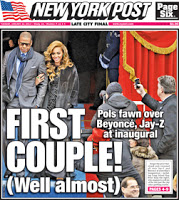
Maher may have been more on target than he knew.  The attendance of Beyoncé and Jay-Z at the inauguration provided a ready-made distraction for those who were looking for one and there were, indeed many, like Rupert Murdoch, owner of the media empire that includes Fox New and the New York Post, who would prefer that Obama’s message on the historic day not get through.  So, for example, the Post ran a full front page on its edition covering the inauguration that was nothing but a photo of  Beyoncé and Jay-Z with a tabloid-size headline proclaiming these two to be the real first couple.

What makes the distraction the celebrity couple was conveniently providing less funny and also makes the misguided fixation on Beyoncé lip syncing as `scandal’ less innocuous are the much more serious distractions that Beyoncé and Jay-Z provide, obstructing the messages Obama needs to get across.  No, I don’t refer to the fact that Beyoncé has been chastised for the promotion of sugary soda because it conflicts with Michelle Obama’s efforts to encourage healthy diets for American children as she seeks to combat the obesity epidemic.  There are other moral indicators and choices that concern me more, things that do greater damage to and greatly confuse the message Obama seeks to get out. . .

. . . Beyoncé's high-paid special performance for Libya’s Gaddafi family. .

 . . Jay-Z saying that he doesn’t understand what Occupy Wall Street is about while he himself buys into a system that perpetuates unfair privilege . .

. .    And yes, my concerns involve the moral laxity Bill Maher chided in his joke of people opening their mouths to give voice to words a disreputable organization has paid them to say. .  This extends to Jay-Z and Beyoncé, hiring out as fronts for a monopolisticly predatory real estate developer and public subsidy collector looking to neuter the rights of a community and the effectiveness of their community organizers mustering a defense.  (For more on all of this see: Tuesday, January 8, 2013, Tsk, Tsk: More Criticism of Beyoncé’s Moral Choices In a New York Times Op-Ed Piece.)