Showing posts with label Plutocracy. Show all posts

Tuesday, January 29, 2013

Tsk, Tsk: Criticism of Beyoncé’s Lip Syncing . . A Distraction From More Serious Issues And Moral Choices

President Barack Obama’s second inaugural speech last week had a lot in it that ought to have commanded serious attention, like the fact that he said, “We will respond to the threat of climate change” and his calls for equality with his alliterative allusions to “Seneca Falls, and Selma, and Stonewall.”  He spoke of protecting the young and future generations including those of Newtown.  There was his proclamation that a “rising middle class” is imperative and that the “patriots of 1776 did not fight to replace the tyranny of a king with the privileges of a few or the rule of a mob.” Significantly, he spoke out against believing that in America “freedom is reserved for the lucky, or happiness for the few” while asserting that the commitments Americans make to each other through “Medicare, and Medicaid, and Social Security” do not “make us a nation of takers” but strengthen and free us “to take the risks that make this country great.”

It’s unfortunate then that so many people want to come away just talking about whether Beyoncé lip-synced her singing of the National Anthem.  Admittedly, comment on the subject is hard to resist. . .  Right after Ms. Knowles concluded the soaring notes of her rendition Gwen Ifill, moderating PBS’s coverage, said: “As we have seen many, many times in the past, that is a tough song nail and Beyoncé managed to find a way to do it today.”

Yes, indeed, but little did Ms. Ifill know that the way that Beyoncé had managed to find to deliver her otherwise pitch perfect performance was for what was piped out to the national audience to be a prerecorded version.

With wealth of around $775 million Beyoncé and Jay-Z are the richest celebrity couple in the world, which adds to the feeling that they ought to really deliver when they perform (the way that Kelly Clarkson did when she performed “My Country, 'Tis of Thee” moments before Beyoncé performed.) 

As it turns out, even though the national audience only heard Beyoncé’s prerecorded version Beyoncé was probably not lip syncing in the truest sense but singing along live to the prerecorded tape people were hearing over the speakers.  That’s the verdict of a British sound engineer after listening to an alternative feed and he opines that her actual live performance “was every bit as good as the `safety’ pre-record – in fact it was so close that it’s hard to tell them apart” (See- and hear: 'She DID sing live': Now sound expert delivers verdict on the curious case of Beyoncé's national anthem... as new audio of her performance emerges, by Chris Johnson, 24 January 2013.)

People like Jon Stewart on the Daily Show have taken humorous advantage of the distraction of this faux scandal concerning Beyoncé’s performance ethics to make serious points.

One of the quips making the rounds gets expressed thus: “As if Beyoncé were the only person in Washington to move their lips and say nothing.”
Bill Maher opened his HBO program last week with a more pointedly appropriate variation on the above, telling the cheering audience that greeted his arrival on stage:
I know why you're happy this week: Obama got reinaugurated.  That was a big thing for liberals.  But I have to say, the Republicans were right . . . He's been in office less than a week now in the second term and already the administration's rocked by scandal . . .  Beyoncé lip syncing!

    * * * *

Let that be a lesson: If you are in Washington, D.C. and you open your mouth and another voice comes out it better be the NRA, an oil company, or a bank.
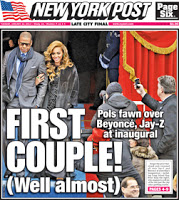
Maher may have been more on target than he knew.  The attendance of Beyoncé and Jay-Z at the inauguration provided a ready-made distraction for those who were looking for one and there were, indeed many, like Rupert Murdoch, owner of the media empire that includes Fox New and the New York Post, who would prefer that Obama’s message on the historic day not get through.  So, for example, the Post ran a full front page on its edition covering the inauguration that was nothing but a photo of  Beyoncé and Jay-Z with a tabloid-size headline proclaiming these two to be the real first couple.

What makes the distraction the celebrity couple was conveniently providing less funny and also makes the misguided fixation on Beyoncé lip syncing as `scandal’ less innocuous are the much more serious distractions that Beyoncé and Jay-Z provide, obstructing the messages Obama needs to get across.  No, I don’t refer to the fact that Beyoncé has been chastised for the promotion of sugary soda because it conflicts with Michelle Obama’s efforts to encourage healthy diets for American children as she seeks to combat the obesity epidemic.  There are other moral indicators and choices that concern me more, things that do greater damage to and greatly confuse the message Obama seeks to get out. . .

. . . Beyoncé's high-paid special performance for Libya’s Gaddafi family. .

 . . Jay-Z saying that he doesn’t understand what Occupy Wall Street is about while he himself buys into a system that perpetuates unfair privilege . .

. .    And yes, my concerns involve the moral laxity Bill Maher chided in his joke of people opening their mouths to give voice to words a disreputable organization has paid them to say. .  This extends to Jay-Z and Beyoncé, hiring out as fronts for a monopolisticly predatory real estate developer and public subsidy collector looking to neuter the rights of a community and the effectiveness of their community organizers mustering a defense.  (For more on all of this see: Tuesday, January 8, 2013, Tsk, Tsk: More Criticism of Beyoncé’s Moral Choices In a New York Times Op-Ed Piece.)

Wednesday, August 29, 2012

Mitt Romney Won’t Release His Tax Returns Because He Took His Wife’s Horseback Riding As a Medical Deduction? Why Romney’s Taxes Matter

Is the reason that Mitt Romney won’t release his tax returns because he took his wife’s dressage horseback riding as a medical deduction? . . .

. . . That would make sense because it would give “RomneyCare” a whole new meaning in a presidential campaign when everyone is supposed to be paying a lot of attention to the design of the national system we should have in place to pay for the public’s health care.

This is not to belittle the fact that Ann Romney has real health problems. .   she has multiple sclerosis, a serious disease. .   nor should anybody want to demean the significance of anyone else’s significant health issues.  But when so many people in the population faced with considerable health problems struggle to pay for even the minimum treatment they need there are basic questions to ask if and when Ms. Romney has relatively lavish options to attend to her personal health that are way beyond what is available to others, especially when the Romney/Ryan vision for a change to a capped-out voucherized Medicare involves everyone scrimping and saving and cutting back financially (except the insurance companies Romney/Ryan want to take over the program!).

Did the Romneys actually tax deduct Ann Romney dressage horseback riding?  Ms. Romney has “discussed the therapeutic benefits of horseback riding” and in June news reports had her doing so at the “Marion Therapeutic Riding Association in Ocala, Fla.”  (See: June 6, 2012, On horseback, Ann Romney talks about health struggle, by Chris Leyden.)  But the Romneys have released just one of their tax returns and are refusing to release any others so we don’t know and can only guess.  (The Romneys are not releasing more tax returns even after the vice-presidential vetting process was disclosed to have involved the required release to the Romney campaign of several years of tax returns.- Only two of Paul Ryan’s tax returns are being released to the public.  The less wealthy Ryan family paid  20% their adjusted gross income in 2011 and 15.9% in 2010.)

The political comedy troop “Capitol Steps” does a routine with a meaningful punch line where their faux Mitt Romney in their parody asks presidential debate audience members to submit their guess about why he is not releasing his tax returns so he can pick among the guesses for what he thinks might sound like the best explanation.  Consider this National Notice’s submission to that suggestion box collection of guesses!

In the only year for which the Romneys have released a tax return, it is shown that they did deduct $77,000 for one of their dressage horses.  So who knows what happened respecting dressage horse deductions in other years and whether some of them are medical?
 
Economist and New York Times columnist Paul Krugman has written a number of times about the importance of seeing Romneys tax returns to obtain critically important information.  In January he wrote about how Romney was doing the “Dance of the Seven Veils” maneuvering around the fact that he wasn’t going to release tax returns that would apparently raise issues that are deeper and more more awkward than the fact that Romney, a vastly wealthy man, is telling us that he pays only 13% of his income in taxes:
    . .  the larger question isn’t what Mitt Romney’s tax returns have to say about Mitt Romney; it’s what they have to say about U.S. tax policy. Is there a good reason why the rich should bear a startlingly light tax burden?  
(See: Taxes at the Top, by Paul Krugman, January 19, 2012.)

Krugman pointed out how knowing what Romney’s tax returns would disclose is central to the issues of the campaign:
Elections are, after all, in part about the perceived character of the candidates — and what a man does with his money is surely a major clue to his character.
and:
To the extent that Mr. Romney has a coherent policy agenda, it involves cutting tax rates on the very rich — which are already, as I said, down by about half since his father’s time. Surely a man advocating such policies has a special obligation to level with voters about the extent to which he would personally benefit from the policies he advocates.
(See: Mitt’s Gray Areas, by Paul Krugman, July 8, 2012 783.)

On the question of character, Krugman points out that when Romney’s father, George, ran for president 44 years ago he released twelve years worth of tax returns.  Those returns disclosed that because taxes on the rich were much higher in the `50s and `60s Romney paid much more in taxes (37%) than the 13% his son is now paying and that, as the senior Romney put it, he “seldom took advantage of loopholes to escape his tax obligations.”   What’s more, the senior Romney earned his money contributing value to the economy by running the American Motors automobile company making compact cars.

Exactly what the Romney son, Mitt, has been doing to build up his wealth certainly ought to be explained, and it's not just the question of why he parks his money in the Cayman Islands: We know far too little but according to Mitt Romney’s disclosure documents he has between $20.7 million and $101.6 million earning him tax-free income in his IRA.  Whether, the actual amount is closer to $20.7 million or $101.6 million (wouldn’t you like to know with a lot more specificity?) those multi-millions amount to a virtually impossible accomplishment because the Internal Revenue Code limits what can be contributed to an IRA to amounts that are relatively small by comparison ($2,000 and annual 401(k) retirement contributions at $30,000) and Romney had only about 15 years working at Bain Capital LLC. to make such annual contributions.  By rights, if you do the calculations, it ought not to have built up to even $1 million, let alone being so many multiples greater.  (See: The Secret Behind Romney’s Magical IRA, by William D. Cohan Jul 15, 2012 and Massive Romney IRA Still Sparks Unanswered Questions, by D.M. Levine, 07/17/2012.)

The reason that annual contributions to IRAs are limited by the federal tax code to somewhat moderate amounts is that IRAs are intended as a mechanism to provide a secure retirement for the general populace, not to be an instrument of abuse whereby those who are vastly wealthily can park their wealth to avoid paying taxes.  Mitt Romney must have found a way to circumvent the law’s intentions.

Since Romney isn’t releasing his secrets, what he did to build up what may be the single biggest IRA account in the country can only be guessed at.  It probably involved a degree of artificiality that, were the IRS guarding the chicken coop, the IRS probably ought not to have permitted.  If you read the above linked-to reporting, what is suspected is that Romney utilized his inside knowledge of the structuring of Bain transactions (where companies on Bain’s operating table were sliced and diced into all sorts of different  financial slivers, instruments and interest the average reader probably wouldn’t have patience to try to understand) in order to transfer what were relatively sure bets on truly huge financial pay-offs while valuing them for purposes of his IRA contribution as proportionately infinitesimal.

With Mitt Romney having by whatever trick or device tallied up a personal IRA that is at least in the tens of millions and with the Romneys taking tax deductions on the order of  $77,000 for dressage horses every year it's rather a challenge to believe Ann Romney's recent assurance in her speech at the Republican Convention that she and her husband understand and appreciate the economic challenges she describes as besetting the average American family:
    . . . that price at the pump you just can't believe, the grocery bills that just get bigger; all those things that used to be free, like school sports, are now one more bill to pay. It's all the little things that pile up to become big things. And the big things — the good jobs, the chance at college, that home you want to buy, just get harder. Everything has become harder.
This was part of Ms. Romney’s effort to encourage women (and she tried to be complete in naming all the variations: “moms of this nation — single, married, widowed — . . . mothers. . . wives. . .grandmothers. . big sisters . . . little sisters . .  daughters”) to view Romney as a potentially good provider if he is elected president.  One gathers that Ms. Romney’s point is that, if elected president, the man she “met at a dance many years ago” will spend less time looking for tax loopholes and tax deductions available only to the supremely wealthy and will spend more time considering the situation of the average Joes of the 99%.

Really? One indication on that score is the way the the Romneys interrupted their campaign (reportedly against campaign adviser advice) to rush off to attend the London Olympics (shoehorning in two ill-fated stops in Israel and Poland for cover) where Ms. Romney's horse was competing.  There Mr. Romney (who admittedly has Olympics in his resume) had to bend over backward to pretend that he didn't know anything about the "horse ballet" exploits (as dressage is sometimes called) of his wife's horse Rafalca and managed to undiplomatically offend his British hosts.

I don’t usually refer to the work of the ubiquitous Republican apologist David Brooks who, among other things, writes a regular opinion column for the New York Times: He is usually far too predictable about arguing that whatever position the Republicans have taken about things it is not necessarily entirely unreasonable when looked at a certain way.  He does that pretty much no matter how outrageous the Republicans get, rarely venturing any, even quiet, tut-tutting.  Something got into Mr. Brooks the week of the Republican Convention and he apparently couldn’t resist giving in to his sense of humor (I don’t think I’d previously picked up on the fact he had one) to write about the hilarity of the Republican chore at the convention of portraying the silver-spoon Romney biography as heroically relevant to the common man/woman/voter (a sampling to get you started before you click on to read the entire piece):       
Mitt Romney was born on March 12, 1947, in Ohio, Florida, Michigan, Virginia and several other swing states. He emerged, hair first, believing in America . . . . He was given the name Mitt, after the Roman god of mutual funds. . .

    * * * *

 . . . . He uttered his first words (“I like to fire people”) at age 14 months. . .  purchased his first nursery school at 24 months. The school, highly leveraged, went under, but Romney made 24 million Jujubes on the deal.
(See: The Real Romney, by David Brooks, August 27, 2012.)

Never did I think that I would find Brooks seeming to agree with fellow Times columnist Paul Krugman, but the truth behind the humorous bite of the Brooks piece is remarkably consonant with a more seriously scribed Krugman piece where Krugman says that the out-of-touch wealthy, “safely ensconced in a bubble of deference and flattery” look ridiculous “when they attribute the weakness of a $15 trillion economy to their own hurt feelings” which is causing them to refrain from job making.  (See: Pathos of the Plutocrat, by Paul Krugman, July 19, 2012.)

Wealthy upset is the cause of the nation’s current economic troubles?  What about the economic upset wealth run amok caused, the fact that it was the out-of-control banks, hedge funds and high finance insurance companies that wrecked the economy in the first place?  (See: Friday, August 17, 2012, The New York Times Starts Reporting That New York Government Officials Are Looking At Suing Barclays Bank- Leading to. . . ?).

Am I being the slightest bit unfair?  Just because Mitt Romney is substantially richer, does that  actually make the rest of us poorer?  Yes indeed, that question is answered at greater length here: Friday, December 23, 2011, Why Someone Else Being Wealthier Actually Makes Me Poorer: Debunking a Suspect Claim.  If nothing else, the fact that Romney and the Republicans are making it a priority to cut taxes for the wealthy (who control an ever-increasing percentage of the nations income and wealth) to historic new lows while eliminating social programs that those taxes have traditionally paid for means all the rest of us are hurt.  The Republicans, calling for cuts in social programs, set up a "deficit clock" at the convention hall in Tampa.  What they neglect to say is that the deficit being measured is a result of cutting taxes on the wealthy even in a time of war when sacrifices were called upon from others.

Friday, December 23, 2011

Why Someone Else Being Wealthier Actually Makes Me Poorer: Debunking a Suspect Claim

I found that the assertion stayed naggingly with me after I heard it expressed by one of the conservative talking heads appearing one night on Bill Maher’s Real Time HBO program: “Just because someone else is wealthier than I am doesn’t mean that it makes me poorer.”

I didn’t believe the statement when I heard it expressed but the way it seems to relinquish any envy gives it an attractive quality, making it sound admirably virtuous, as if it bespeaks a magnanimity of spirit even though it’s a statement wielded by the sort of spokespersons who also espouse such theories as “trickle down” economics. Somewhat inconsistently, “trickle down” economics proposes a world where another man’s accumulation of wealth can indeed be counted upon to affect your own but, optimistically, only for the better: Those who have less are expected to be satisfied by all the extra crumbs that will spill off the table with overflowing wealth. (The math behind this involves a prediction that the overall pie will always be bigger by more than the amount the wealthy themselves take.) These are the same sort of folk who now speak about the 1% Club as munificent “job creators.” Those espousing such theories can be counted upon to argue against measures such as a progressive income tax structure in order to to reduce the gap between the rich and the poor by having the wealthy pay higher income taxes.

“Just because someone else is richer doesn’t make me poorer”: Does this kind of statement really need debunking? Isn’t it just obviously wrong when you think about it? Maybe only to some and what might not be so obvious is just how many ways the statement is wrong. Let me count some ways:
1. Compensation to top executives in the United States is now paid at absurd multiples of other employees’ salaries. Ben and Jerry’s may no longer limit compensation of its highest paid employees to seven times that of entry level employees but the fact that it once did puts in perspective the kind of huge differentials now prevalent. Exact reliable figures about the ratio of top executive pay to bottom level employee pay or average employee pay level for given years is not easy to come by and the figures depend upon which group of companies one is selecting to derive one’s statistics, but whether one is looking at a ratio of 531 average employees’ salaries to1 highly compensated CEO’s, 525 or 263 to 1, 185 to 1, or 325-to-1 (the last ratio involving executives getting paid an average of $10.8 million each), each of those multiples represent corporate resources that could be redirected into hiring more employees or paying other lower-paid employees more. And isn’t it reasonable to expect that in the face of a more progressive income tax system we would likely see that kind of redistribution as the attraction of high salaries waned just as was the case when taxes were once more progressive?

2. Further, as focus shifts away from jobs being chased and held just for the sake of very high salaries mightn’t the quality of corporate management improve as a result? This is something we’d perhaps be more apt to believe if, along with Warren Buffett, we believe that executive compensation for U.S. executives is too often “ridiculously out of line with performance” and that a cooperation’s board’s ability to rein in such excessive compensation is a critical test of proper corporate governance. These then are two ways in which wealth lavished excessively on select individuals means the impoverishment others.

3. After another man is paid so many multiples more than his fellows the amount he is likely to invest should predictably be much greater than the rest of the populace and that investment will, in turn, spin off even more income. A fair amount of his wealth will probably be invested where so many of us inevitably think to invest: in stocks. Much of the nation’s wealth is owned through corporations. Ownership and control over a corporation is represented by its stock. The wealth of all of the nation’s investors intermingles in its ownership of the stock of those corporations but the intermingling is not equal in terms of ownership of the decision-making process because when it comes to corporate governance majority rules, the preferences of the minority must bend to the decisions of the majority. That majority is not added up in terms of stockholders as individuals; majority is counted up in terms of the majority of individual shares of stock. Which is to say the calculation involved is sheerly a measure of total wealth. As so much of the nation’s wealth is owned through corporations much of the nation’s policy is consequently set by the demands of those corporations but in the setting of such policy the voice of any minority ownership is lost as the corporate governance structure acts as a lens to focus the corporation’s influence behind the interests of aggregating wealth, much like a magnifying glass can bend the diffuse rays of the sun to focus on one concentrated incinerating point. Maybe I want my local environment kept clean and pure but maybe the corporations don’t, and maybe the wealthy will fly away to vacation in remote spots beyond my means where devastations to the environment will matter less to them.

4. When we think of influencing policy in the United States we think about appealing to our politicians and electing those we think will represent our interests, but every politician thinks of him or herself as having two constituencies: a.) Those individuals capable of voting for them, and b.) Their money constituency. The first is a finite constituency tied to a locality. In the United States every individual must decide where he will vote and there he will get to vote only once in each election. The monied constituency is free to cross lines. Those wealthy enough can support candidates anywhere no matter whether they live or vote where a candidate is running. They can even support candidates running against each other in the same election, and do. The amount of support supplied this way is limited only by one’s wealth and the will to deploy it. In the United States political spending in the form of contributions to political candidates is almost entirely the provenance of the very wealthy. Most of the money for the nation's political campaigns comes from .5% of the population,which means that it is really the .5% vs. the 99.5% that Occupy Wall Street ought to be talking about and 1 percent of the 1 percent account for almost a quarter of all individual campaign contributions to federal political campaigns in 2010. That means we have a government where it is going to be very difficult for ordinary citizens to get the attention of their political representatives because those representatives will spend most of their time preoccupied thinking about the donating elite. Unequal access to those entrusted with governing the nation leads, quite justifiably, to distrust of the system by those without access.

5. One reason that distrust of the system may now be very sensibly coming to the fore is that, as argued by Glenn Greenwald, the author of “With Liberty and Justice for Some: How the Law Is Used to Destroy Equality and Protect the Powerful,” we have seen a two-tier justice system emerge, one for the nation’s uppermost class, another for the less politically powerful. Normatively, the idea that the same rules apply to all ought to supply a check and balance against draconian abuses in the legal system and against violations of the law. With a two-tier system liberties are no longer protected by this check and balance. So yes, when others become a lot wealthier than the rest of us we poorer souls all become still poorer because even our life and liberty are put in jeopardy.

6. Others being wealthier also makes us poorer when we are competing in the market for the same limited resources. This is really classic supply and demand economics. More money chasing a limited supply drives prices up. Since real estate is unique and can’t be duplicated it is very easy to see how the rules apply. In 2004 when apartment prices in New York were rapidly rising the New York Times ran an article about “gazumping” which, technically, is the acceptance of higher offer from a different buyer after a handshake deal on a lower apartment price was reached. With the market awash in new cash, offers significantly trumping already accepted offers for which contracts weren't yet executed were becoming commonplace. It created a lot of pressure to close deals rapidly. A “gazumping” buyer can be particularly effective in persuading a seller to accept an offer (in the bidding practice that is considered less than entirely ethical) if they offer cash and a substantial deferential in price. Sellers may appreciate the higher prices the wealthy pay but say, for instance, you have a property that has been in a family for many years: Members of the extended family who want to buy it and keep it in the extended family (essentially maintain the status quo) may be “gazumped” out of their opportunity to do so by those who have become disproportionally wealthy. Another example involving real estate would be a neighborhood townhouse providing homes to perhaps nine renting families which is then purchased by a bet-winning hedge fund entrepreneur who, with his newly minted wealth intends to occupy the entire building after he evicts all the long-term tenants. Those tenants will have to move elsewhere. Shifting wealth will subtract from their other choices and the prices they will pay will accordingly be higher. These examples involve real estate but the same rules apply whenever there is competition for commodities that are limited.

7. Others having wealth substantially exceeding my own makes life more expensive in other ways. Sometimes the cost of living gets established as a community package. Say I live in co-op or condominium building where the expense of maintenance and operation are handled communally. If everyone in the building has resources similar to mine we are all apt to have similar notions about the value of certain expenditures and the need to make careful resource-conserving choices. But if others in the building become far wealthier than I am then they may want to hire extra doormen and porters, multiplying expenses. They may also care less about close oversight of the the wisdom with which each community dollar is spent. They may be more inclined to delegate such oversight to hired professionals at extra expense. In their view the lobby might need to be grander. The wintertime heat in the building might be ratcheted up profligately allowing windows to be flung open. The building may become unaffordable to the less affluent but because the expenditures are communally undertaken and enforced those expenses must be paid by all who stay. Those who need to move as a result will bear an extra expense but those who don’t, won’t.

8. The community-determined expenses discussed above which are enforced are presented conceptually with the example of a residential co-op or condo, but the very same sort of situation can occur when government in a locality decides to provide a higher level of more expensive services, better roads, more frequent trash pick-ups, a more ostentatious Town Hall, etc. Or it can work similarly but in reverse: As an area fills with wealthier residents there may be fewer among them who feel the need for the services of a good public library open at convenient hours throughout the week. As a result these services may be cut back.

9. Besides communally undertaken and enforced expenses there are expenses associated with living alongside wealthier people that are not enforced but nevertheless hard to avoid. Those with fewer resources appreciate some of the changes that come with a gentrifying neighborhood (renovations, cleanliness, policing may improve and some new stores may be appreciated) but one of the complaints such residents often have is that many of the stores selling merchandise at price points geared to their own incomes disappear and are replaced by stores selling merchandise at price points they can’t afford. A Starbucks may have a certain novel cachet but the Starbucks coffee can be a lot more expensive than the alternatives.

10. Looking for a new home one might also find one’s choices of apartments circumscribed by the wealth and more affluent life style of others when one encounters apartments that are available only if one pays unaffordable “amenity fees.” The amenity fees may boost the cost of renting more for those looking to save money by doubling up when they are required to be paid on a per person basis. Developers have been packing new New York City buildings with amenities like swimming pools, party and entertainment rooms, screening rooms, roof decks, etc. - There is no free lunch (although amenities sometimes include ostensibly-free regularly-served breakfasts) so these would be paid for in increased prices somehow but now developers make a practice of charging overtly for these amenities by required fees imposed in addition to the rent.

11. The very best schools, particularly colleges, are also likely to exceed the reach of the less wealthy for a variety of cumulative reasons: a.) tuition b.) higher SAT scores by virtue of hired tutors and prep c.) preference for legacy admissions based on prior family member attendance d.) Attendance at better feeder schools, and e.) donations from the family to the school. Whether or not one succeeds in sending one’s children to the nation’s select set of very top schools would not be such an significant issue (many schools are very good and more than sufficient for providing excellent educations) were it not for the fact that attendance and socializing at premier schools significantly eases the entry of the next generation into a privileged club whereby they can expect better opportunities in terms of earning wealth. Ultimately it becomes a self-perpetuating system.
The above list can no doubt easily be expanded. I invite readers to suggest additions by commenting on this post. I know the list is not all-inclusive.

I originally thought to write this article months ago back when I first mused about what had been said on Bill Maher’s show. Since that time there was an influential article in the May 2011 edition of Vanity Fair by Joseph E. Stiglitz that makes similar and related points even if its theme is not exactly the same. On point Stiglitz makes that could be added to the above list is that the nation’s decisions with respect to war are affected when there is a class wealthy enough not to send any of its children to war. Surely we are poorer when another disinvolved individual makes a decision to send our children to war. I strongly suggest that if you have appreciated this National Notice article and haven’t yet read Mr. Stiglitz’s, you read it: Of the 1%, by the 1%, for the 1%.

A final point to mention: After acknowledging that another man’s wealth can, indeed, make me poorer in all the ways mentioned, there is another economic truism to remember. . . The value of a dollar is greater to a poor person than it is to a rich person. Ergo, when a wealthy man’s wealth makes a less wealthy man poorer, the significance in the shift is greater to the poorer individual. To the extent that the shift reflects an injustice, that injustice is consequently greater.

Wednesday, December 21, 2011

Republican Party Plutocracy At Work: The Big Money Wants Romney Over Gingrich or Ron Paul- Steering the Selection of Candidates

I am not inclining to vote for any Republican candidate in the next presidential election. It is not that I couldn’t ever bring myself to vote for a candidate that represented proper Republican principles, at least as I once understood those principles to be, but what we are getting out of the national Republic party is just so absurdly contorted. . . Why even go into it?

But that doesn’t stop me from wondering at the way that the national candidates are selected, and most specifically the fixated way that big money will always keep steering toward what it wants: In this election the big money wants candidate Romney.

The Republican primary race has been a fascinating roller coaster ride as potential candidates emerge, surge and are then purged when they can’t stand the light of day. Then as front runners in the race (focusing on the important first state of Iowa) we recently got the candidate who was cavalierly dismissed by the pundits as never having had a serious chance (Ron Paul) and the first candidate in the race who first demonstrated how the emerge, surge and purge cycle worked (Newt Gingrich). Gingrich, as a result of what we are about to discuss has dropped in the Iowa polls and also slide in the national polls.

From the sidelines I can certainly see what any electorate might like better about Ron Paul or Newt Gingrich.

Ron Paul has been resolutely courageous in his willingness to say what he apparently believes about what’s wrong with wars, a foreign policy wastefully bending toward imperialism, and his libertarian precepts about limiting governments interventions. I would even endorse much of what he has to say if it were properly tempered.

While ultimately very scary, Newt Gingrich’s relentless energy has an attraction and the roguish self-interest of his pursuits has a rascally charm. It’s hard not to grudgingly admire someone who can cross all sorts of lines when it comes to principle (for instance, what ought to be the legitimate goals of charities) and thereby quickly amass a personal fortune of $50 million Beltway dollars by selling, to corporations subscribing for access, his ability to schmooze.

Ron Paul and Newt Gingrich as comprehensible individuals each supply a more emotionally satisfying narrative than Mitt Romney’s dutiful shape-shifting which registers as mechanically robotic and programed, which it is. Conventional wisdom says that Romney is a better choice for a candidate likely to defeat Obama. While making him less recognizable as a human his malleability also makes him less threatening in other ways: He is less threatening to electorates because, on the outside, he conforms himself to the latest polls and fashionable view affecting whatever race he is in (a familiar trait in politicians in general, and one not necessarily completely unhealthy for the nation’s governance) and, on the inside, Romney is no doubt ready to mindfully hew to instructions from the powers-that-be (another not uncommon trait amongst politicians who are all likely to be cognizant of their monied constituency).

What’s fascinating in this election cycle is the way in which Romney’s steady attraction for the 1% money providers diverges from the affection the general populace of the Republican party have for him. As far back as August I’ve listened to people telling me that Romney’s appointment as the Republican nominee was a certitude. Mostly these people have been those who track and predict the future based on where the big money is going and I guess there was never any significant disagreement amongst the big money contributors as to which candidate they supported this cycle. But if Romney wins this time there will be some necessary explaining to do within the Republican party as to whether everyone in the party has an equal voice and vote or whether it is simply a top-down plutocracy. Big money’s sharp elbows are more apparent than usual this season.

As we get down to the short strokes of the primary season with Romney running third in various recent polls and Gingrich having experienced a surge that put him well ahead, big money has pulled out all the stops to support Romney and we are beginning to see the effects.

According to a December 19th Associated Press story more than $1 million has been spent in negative advertising attacking Gingrich in Iowa: Attacks Hurt Gingrich In Iowa, No Letup Pre-Caucus.

Much of the money is being spent by a Super PAC called “Restore Our Future” supporting Romney. As result of the Supreme Court’s Citizens United case such spending is unstoppable and it is not currently possible to know who are all the individuals and corporations funding the Super PAC. In theory, although that Super PAC is run by political operatives who used to work for Romney, Romney can’t communicate or coordinate with the PAC or the people running it to, for instance, ask that they dial down the negativity of the attacks. Gingrich says that this theoretical inability is “baloney.” It will be interesting to see what Gingrich says about such conceptual niceties if he ultimately becomes the Republican nominee. (See: Romney, Gingrich Spar Over Negative Super PAC Ads, by Kathy Lohr, December 21, 2011.)

That the monied establishment will protect itself and go after what it wants is self-evident. It moves in less than mysterious ways. This week’s New York Times has in it at least two more stories that are essentially about how clearly the Republican monied establishment wants Mitt Romney as its nominee: One is again about how well-funded attacks are being mounted against Newt Gingrich and the other is about how past writings appearing in Ron Paul’s newsletters include bigoted statements.

This problem of big money steering the selection of candidates is not just a Republican party issue or a problem that presents itself only on the national level. I just finished writing about how similar problems are present in the race to select nominees for mayor in New York, which in NYC is a problem that clearly affects the Democrats’ primary process ( In New York City the big money problem is headlined by the real estate industry): Tuesday, December 20, 2011, John Liu And the Mayoral Race: We Are Confronted by A Misfortune. Can Misfortune Be Turned Aside?

A partial window into what Gingrich is up against in terms of how big money is working for Romney is provided in a December 21, 2011 CNN story:
According to an analysis of disclosure forms from Restore Our Future conducted by the nonpartisan government watchdog Center for Responsive Politics, the pro-Romney super PAC has spent $430,380 on ads in Iowa. That's more than the $325,770 spent by the Romney campaign. Combined, they are outspending Gingrich in Iowa by more than seven to one.

Bain employees have given $1.25 million to Restore Our Future. Contrast that to the $84,500 contributed by Bain employees directly to the Romney campaign.
(See: Pro-Romney super PAC slams Gingrich, by Jim Acosta, CNN Political Correspondent.)

Outspending Gingrich “by more than seven to one”? And look at the amount of money coming just from Romney's former investment firm, Bain Capital.