Showing posts with label Bill Maher. Show all posts

Thursday, April 1, 2021

PBS And The Muppets To Partner With The Wall Street Journal And HBO To Bring More Content To The Public With The Launch Of Its PBS “Passport Two” Service

Bill Maher interviewed Elmo the Muppet about the new Passport Two service partnership, PBS, HBO, the Muppets and the Wall Street Journal

Something new is coming!  A more better version of Public Broadcasting in the form of PBS’s new “Passport Two” access.

It’s been six years since PBS and all its member stations launched its “freemium” Passport service, a new membership streaming service in order to do a better job at, and bring more of its Public Broadcasting Station content to the public by providing video-on-demand to members of the public paying a subscriber’s fee.  (See: PBS Passport serves up on-demand content for public TV’s members, by Jill Goldsmith, Contributing Editor,  December 15, 2015.)

Also, at that time, in a parallel move, PBS’s Muppets inked another “freemium” deal with HBO to help bring more and better Muppet content to public broadcasting.  (See: Sesame Street Is Moving To HBO In 5-Year Deal That Will Give PBS Free Episodes, by Lynn Elber, August 13, 2015)–   Point of fact- It’s actually not correct to say it’s “PBS’s Muppets”: Though long closely associated with PBS and although Big Bird testified before Congress to protect PBS funding, PBS having been the network through which the Muppets became universally identified as the children educating, family friendly and very amusing puppets that they are, PBS does not actually own the Muppets.– The deal inked with HBO allowed the subscribers of HBO’s premium services to see newly made Muppet episodes first and then let HBO pass the episodes along for rerun on PBS air after a nine-month exclusivity window.  (See: Sesame Street's move to HBO, explained, by Emily VanDerWerff, January 16, 2016)

With the launch of its original Passport service in 2015, PBS leapt into “the age of on-demand viewing” and aimed:

to deliver a one-two punch that will dazzle station donors with significant upgrades to their digital viewing experiences. Executives also hope the new service will entice younger viewers to watch more public TV programs and become members.
Now, with new partnerships, and a pivotal partnership with the Wall Street Journal, PBS and the Muppets collaborating together will be launching their new Passport Two service to deliver more of that “one-two punch.”  It’s obviously important since digital on-demand streaming is the obvious future, the destiny that is fast replacing what used to be watched as regular television.  The freemium availability of extensive PBS content only to those who are donating as subscribers is an obvious update of traditional station contributor perks: As was noted, in 2015 when Passport was launched, “an ecstatic Daniel Greenberg, chief digital officer at New York City’s WNET, a station that piloted Passport” said that this freemium availability of the extensive PBS content only available to viewers who donate should be seen as “a contemporary version of the tote bag.”


With the help and involvement of the Wall Street Journal PBS and the Muppets will be able to produce much higher quality, better informed, and better sourced content.  Among the offerings will be upgraded nightly news programs and a regular new stock market program on the days the stock market is open.  Passport Two subscribers will be able to see the news programs live and on demand anytime thereafter.  Station contributors who continue as regular Passport station members will be able to see the news the next morning after a twelve-hour window.  News programs will be available on the air for any and all members of the public twenty-four hours after origination.  During elections, Passport Two will adhere to a generous practice now already followed by the Wall Street Journal: News content about the elections and providing people with insight and information about how they should vote will be open and supplied to all immediately.

The partnership with the Wall Street Journal is expected to bring in many new members and high donation contributors, luring them in from the Wall Street Journal’s reader base and from Wall Street and financial industry in general.  To make sure that Passport Two gets a good kick off in this regard, anyone who has paid steadily to get behind the Wall Street Journal’s paywall over the past two years will automatically be gifted a year and half of Passport Two access.  This will enure that insider conversation gets Passport Two talked about and paid attention to by those who swing power.                 

Passport Two will most times go by the simple, sweet, short name of “Passport Two,” but various times and in the smaller print on the logo for the service it will be more fully inclusive of its entire official name: “Passport Two- PBS/WSJ.”   Mr. P. Rite Gold of the Wall Street Journal said that the initials “WSJ” should implicitly be understood to represent the Wall Street Journal and its involvement, but that they would also, in the context of Passport Two, be promoting “WSJ” to mean “Wellness and Social Justice,” a focal mission of the service.

Passport Two logo- "WSJ"= "Wall Street Journal" and "Wellness and Social Justice"


Concept and design plans for the Passport Two service were developed with seed money from the Wallace and Pace Summer Foundation.  Wally Summer Jr, who now heads that foundation said that denizens of Wall Street would definitely understand the intended Passport Two set up without any problem.  Summer said that on Wall Street, where everyone is welcome to invest, the value of timely information and the ability to act on it quickly is well understood.  That was why, he said, Wall Street firms were willing to pay exorbitantly for computers with downtown Manhattan locations whose connection would be micro-seconds closer to the Wall Street stock exchange in order to be able to execute trades faster.

How do Sesame Street and the Muppets benefit from the new Passport Two partnerships?  To answer that question, Elmo went on HBO’s Real Time with Bill Maher to engage in a charming interview with Bill Maher about what Passport Two will mean for the future of educating and communicating with kids.

Elmo explained to Maher that some of the new Muppet Passport Two productions will slant upwards to start taking in a somewhat maturing juvenile audience that’s more capable of absorbing the kind of content that Wall Street Journal has extraordinary mastery of.  To this end, Sesame Street’s Muppets world will introduce a new character, Alfalfa, whose most distinguishing  characteristic will be his funny pubescent Muppet voice crack. (The Muppets recently acquired the rights of the Hal Roach Studio “Our Gang,” “Little Rascal” films from ViacomCBS and Sonar Entertainment.  That means the Little Rascals are now also indirectly owned by Disney, which acquired the Muppets in February of 2004.  Muppeteer Jim Henson, their creator, died May of 1990.)

Elmo told Maher that, echoing a little of the approach of the defunct My Weekly Reader of the days of yore, new Muppet shorts would be produced to make juveniles aware of, and conversant with, current world events and educate them about civics issues.  Elmo said that a segment was in the works titled, “Why We Should Go To War With Iran” and there was a related short feature involving a cartoon yellow submarine titled “How We Can Go To War With Iran.”  Several editors from the WSJ editorial page are volunteering their time to contribute ideas.  One short segment, focused on civics, completed with the help of the editors is already complete: “Why A Socialist Venezuela Threatens American Values.”   
 

In his interview Elmo told Bill Maher about the cartoon segment using a submarine to teach about relationships with Iran

Chuckling, Maher responded, “You Tickle me, Elmo,” an obvious indication that Maher’s Covid era challenged writers are not up to producing their best material right now.  Contributing, statements for HBO to a press release announcing Passport Two, Maher said, “HBO’s willingness to join with the Muppets, the Wall Street Journal and PBS provides a firm answer, a resounding negative answer to the question (See: Will AT&T Be Able to Handle HBO? By John Koblin, June 14, 2018) of whether ATT’s 2018 acquisition of HBO and Time Warner would result in detrimental changes to HBO.

Maher’s press release statements asserted that with the media corporation “Game of Thrones” style wars competing for complete content dominance, ATT had been anonpassive corporate parent insisting that HBO must get bigger and broader.” Thus, “yes,” he said, with the acquisition “there have been changes” and “HBO has been developing less expensive, shorter length content suitable for the modern era of today’s challenged attention spans,” but that “those changes have all been good.”

PBS says that it is not the only charity participating in the Passport Two paywall project, that PBS’s own participation had induced additional partners to be included, particularly an expansion of HBO’s recent partnerships with libraries around the country that includes NYPL, the New York Public Library, and the Brooklyn Public Library.  (See: New York Public Library and HBO Partner, by Gary Price on May 29, 2018 and Brooklyn Public Library Partners With HBO To Promote HBO Subscription Content Offering “My Brilliant Friend-  “The Blue Fairy”, April, 2020)      

Explaining the Passport Two participation partnership to the NYPL trustees, NYPL president Tony Marx said “HBO is providing some great video talent” and it is providing that “great video talent” just when it’s going to be ever more important for the internet streaming and internet digital availability that, like Covid, is ushering us away from books and physical libraries.  Brooklyn Public Library spokesperson Les Izmur, said the BPL heartily agreed.

The new CEO of HBO, Constance Ailes (daughter of Roger who died in May of 2017), who was recently hired by HBO president John K. Billock to replace former CEO Richard Plepler, says HBO is jubilant about its partnering with the libraries:  “The libraries are repositories of so many stories no longer subject to copyright that, through creative retelling, we can make our own so that Passport Two will be an ever more essential part of life.”

Wally Summer of the Wallace and Pace Summer Foundation said that partnerships like these are so important to ensure that PBS will continue to be commercial free.  He noted that these partnerships were even more fruitful in that regard in that Disney, as a proud nonpassive corporate parent was pumping even more money into the Passport Two partnerships than the Muppet episodes were costing.”  In recognition of this, PBS will run sponsorship acknowledgment spots thanking Disney with brief clips from “The Mandalorian,” “Black Panther,” “Hamilton,” and “Avengers: Infinity War,” referencing Disney’s new Disney+ steaming service.

Passport Two will launch at an initial monthly fee of just $89.  However, in a public health and cross-cultural event supporting move, the Passport Two will promote `Passport’ awareness in general by initially offering Passport Two for the reduced cost of $29 monthly for those who have obtained Covid Passports, the proof that concert and cultural event goers are going to be getting that they have been double vaccinated in order to allow then be able to resume normal cultural activities like attending the Broadway Theater when it reopens.

Not all of PBS’s content will be run exclusively behind the Passport Two paywall for prescribed windows of time: PBS’s “Frontline,” regularly a joint venture with the New York Times will continue, as always, to be available to the public from the first date of publication.  Although it will continue to be free and available as before, it will now be available through the Passport Two apps as an enticement for Passport Two membership.  The New York Times, currently uses the freemium model of allowing a certain number of articles to be read free each month, after which a subscription to the Times is needed to be able to read more.  In contradistinction, the Times/PBS “Frontline” production however has always been entirely free, permanently posted on the internet except for one episode about Israel and the Palestinians in the Gaza Strip.

“Frontline” producers said that “Frontline’s” messages about how divided the American public is, making it impossible for our country to agree upon or effectively address issues, together with Frontline’s subtle appeals to the PBS intelligentsia in favor of war and interventionism were too valuable and important to put behind a paywall.  Times spokesperson Mimidae Passerine said that for the New Times to continue to lead the national dialogue, signaling and blessing the important narratives with what is referred to as The Times Effect,” it was the kind of propaganda that needed to get out immediately and unimpeded.

The Passport Two service launches today, the first day of April, April 1st.


Tuesday, October 17, 2017

Two Guests On Democracy Now, Andrew Cockburn and Masha Gessen, Speaking On Subjects 9/11 Both Seem To Invite Listeners To Read Between The Lines: What Are They Saying Here?

Andrew Cockburn and Masha Gessen on Democracy Now
Two recent guests of Democracy Now, Andrew Cockburn on September 13th and Masha Gessen on October 5th, both seemed to be inviting viewers or listeners to the program to `read between the lines” and hear something more than what they were actually saying when they spoke on 9/11 topics.  Can one “read between the lines' with a program that one “watches” or “listens to”?  Well in any event the question is whether they intended their audience to hear something more than just what they said. . .

. . And if they did, what were they saying while not actually saying it?

Andrew Cockburn was on Democracy Now to explain a lawsuit making progress against the Saudi Arabian government based on a growing cornucopia of evidence that people in the Saudi government were clearly involved in supporting the men identified as the 9/11 hijackers.  During his interview Mr. Cockburn (or former Senator Bob Graham via an inserted clip) made a number of fascinating points.

To Wit:
    •    The Bush administration, people like Vice President Dick Cheney and Secretary of Defense Donald Rumsfeld, had a “concocted story” about what actually happened on 9/11.
    •    The Bush administration did not want the public to figure out that the identified hijackers could not have done it alone, that only with support of the sort of resources supplied by a government (a nation-state) could the 9/11 plot have been carried out.
    •    The Bush administration did not want the American public to figure out the extent that Saudi Arabia was involved in the plot.
    •    The Bush administration wanted instead to pin the plot elsewhere, particularly on Iraq against which it wanted to wage war.
    •    The torturing of detainees in Guantánamo was for the purpose coercing false confessions and false information to help buttress the concocted story.
    •    Saudi Arabia has a close and symbiotic relationship that runs very, very deep with the U.S. defense industry and military-industrial complex that involves a huge amount of expensive contracted for armaments and even personal relationships.
    •    And ditto, Saudi Arabia also has such a relationship with the oil companies.
    •    A critical lead in discovering much more about what really happened was, as an investigator for the House and Senate Intelligence Committees investigating the attacks noticed, that one of the hijackers had been in contact with an FBI informant.
    •    The then-head of the FBI, Robert Mueller (now investigating allegations about Donald Trump), strenuously attempted to stop that investigator from doing what he needed to do (going to San Diego) to discover most of what we now know about the Saudi connection to 9/11.
    •    A Mr. al-Bayoumi, a Saudi agent, at least according who everyone in the FBI, was in close contact with the hijackers (who was basically their case officer, it seemed”), found them a place to live in San Diego, opened a bank account for them, helped them, introduced them to people who helped them get flying lessons, helped them to get driver’s licenses, and more.
    •    Mr. Bayoumi himself worked for a company owned by the Saudi Ministry of Defense, but never showed up to work.
    •    There were checks from the Saudi Embassy in Washington that went in a pretty straightforward (if indirect) procedure to the hijacker, or to Mr. Bayoumi for the purposes of looking after the hijackers.
Here are the parts of the interview transcript covering the above.
Democracy Now On Lawsuit About Who Was Responsible For 9/11

FORMER SENATOR BOB GRAHAM:  They even had a concocted story . .  My feeling is that what happened is they wanted to go to war with Iraq, had wanted to, particularly people like Cheney and Rumsfeld, and it was embarrassing to find out that the information that was becoming available seemed to more point to Saudi Arabia as having been the country that aided the 9/11, rather than Iraq. And so, the response to that is, let's suppress the information about Saudi Arabia's involvement . . as we push hard to get authorization for war in Iraq.

ANDREW COCKBURN: . . . there's one thing that the Bush administration and Senator Graham agreed on, which was that the-for the hijacking, for the 9/11 operation to succeed, they had to have had the support of-the structured support of a nation-state, I mean, the elaborate-in terms of money, in terms of contacts, in terms of-you know, these were a bunch of, basically, sort of hicks, who-most of them, who arrived in this country, didn't speak English, didn't know people. And they were all taken care of and found places to live and given money and, you know, steered to flying lessons. You know, it was a very sophisticated or well-organized operation. And that had to have been-in Graham's view, and, it seems, in mine, too, had to have been done by a state. Now, the Bush administration tried to say it was Iraq. In fact, they so wanted it to be Iraq, or wanted people to believe it was Iraq, that prisoners-interrogators at Guantánamo were under instructions to torture detainees in Guantánamo into admitting, falsely, this link between Iraq and the 9/11 hijackings.

* * * *
. . . the relationship with Saudi Arabia . .  runs very, very deep . . . the huge financial benefits that flow at least to the U.S. defense industry, the U.S. military-industrial complex, in terms of arms contracts, consultancy contracts for retired general officers. You know, there's just a very close sort of symbiotic relationship between the two. The whole relationship of the oil companies to Saudi Arabia . .

* * * *

[Michael] Jacobson was an investigator on the . . .  the joint inquiry by the House and Senate Intelligence Committees . set up right after the attacks . .  noticed an odd discrepancy, an odd mention in FBI files here in Washington, that seemed to say—that said that one of the hijackers had been in contact with an FBI informant. And he thought, "This is quite interesting." And he wanted—he put in to go to San Diego. This is a hijacker, sorry, I should say, who had been living in San Diego. He pushed to go to San Diego to look into the files in the local FBI office. Interestingly, the then-head of the FBI, Mr. Mueller, Robert Mueller, now investigating the Trump—allegations about Donald Trump, pushed—moved heaven and earth to stop Jacobson going to San Diego. Nevertheless, the committee insisted he do so. And he went there and found most of what we know about the Saudi connection.

He found that in the files they had—there was plenty of information about a Saudi agent, Mr. al-Bayoumi, who everyone in the FBI, certainly, out there believed was a Saudi agent, who had been in close contact with the hijackers, who had found them a place to live in San Diego, had opened a bank account for them, had helped them—well, introduced them to people who helped them get flying lessons, helped them to get driver’s licenses—had basically been their case officer, it seemed. This was all turned up in—I mean, I could go on. You know, there’s other people. There were checks that went from the Saudi Embassy in Washington that went, more or less—I mean, indirectly, but in a pretty straightforward procedure—to the hijacker, or to Mr. Bayoumi, for looking after the hijackers. Mr. Bayoumi himself worked for a company owned by the Saudi Ministry of Defense, but never showed up to work.
Now on to the pertinent part of the other Democracy Now interview with award-winning author, journalist Masha Gessen, author of "The Future is History: How Totalitarianism Reclaimed Russia."  Ms. Gessen has gained attention telling people that in our new political landscape we all have to develop our talent for listening through a "cacophony of lies."

The overall interview was wide ranging but at one point Democracy Now’s Nermee Shaikh asked Ms. Gessen what she thought the effects of 9/11 were on the U.S. government.

Responding, Ms. Gessen made these points:
    •    That 9/11 was our “Reichstag fire.”
    •    The Reichstag fire in Germany was used by Hitler in 1933/1934 who had just been appointed chancellor as a “pretext for restricting political freedoms” while the government claiming “extraordinary power.”
    •    That in Germany this was done pursuant to what in 1934 Germany was called a “a state of exception,” and in the U.S. after 9/11 was “state of emergency that went into effect three days after September 11th has never been lifted.”
    •    That the War Powers Act passed with one dissenting vote three days after September 11th, continues to be in effect and has been used by President Obama and now by President Trump.
    •    We have a now 16-year run of an increasing concentration of power in the executive branch (including military power and surveillance) from George W. Bush, through Obama and now on to Trump.
    •    This chain of events created the possibility a politician like Trump able to get elected in this country running for “autocrat.”
When Ms. Gessen referred to the example of Gerrmany’s  “Reichstag fire” (actually 1933)  as a  “pretext” for Hitler’s government to limit personal freedoms and arrogate massively greater power to Hitler she did not directly allude to the fact that, although it is still debated, there is a general consensus that the “Reichstag fire” was quite likely an inside job, a false flag operation carried out by the Nazis themselves for the purpose of gaining the pretext they then seized upon.  (Various German courts acted to posthumously overturn the conviction of Marinus van der Lubbe the one man, a possibly mentally deficient drifter, accused and convicted and quickly executed by the Nazi's and in 2008 he was posthumously pardoned.)

Ms. Gessen did, however, refer to talk “early on in the Trump presidency” of prospective future terrorist attacks that were characterized as “inevitable” and sure to be opportunistically seized upon by the Trump administration for the pretext of consolidating power.  That talks sounds almost like, even if it is not exactly, a warning of a concern respecting a possibly false flag in nature.  Ms. Gessen allowed that she thinks this “trope has sort of faded a little bit.”  Indeed, in November right after the election, Bill Maher on his HBO program specifically referred to the notorious German Reichstag fire as a false flag operation launched by Hitler himself and asked his audience and panel “Don't you think that they would have that in their mind?” He said this while suggesting that Trump and conceivable Trump administration officials like “Christie and Guiliani” would be less constrained by the “rule of law” than Bush, Cheney and Rumsfeld.  Where can one find other instances of this “trope” before it "faded"?: Not sure.

Here are the parts of the interview transcript covering the second set of bullet points above.
On Democracy Now: Journalist Masha Gessen on Effects of 9/11

From interview of award-winning author, journalist Masha Gessen, author of The Future is History: How Totalitarianism Reclaimed Russia.
NERMEEN SHAIKH:     Now, in one of your pieces, you talked about the effects-I mean, the kind of looking at the longer view-the effects of 9/11 and the concentration of power in the executive branch. Can you say what you think some of the historical-although not that long ago-reasons are that Trump was elected?

MASHA GESSEN: So, that was a piece that I wrote when I was asked to write about the looming Reichstag fire, if you remember. I think this trope has sort of faded a little bit. But early on in the Trump presidency, a lot of people were saying, "Oh, he's going to use an event to consolidate power, to create a state of exception, right? And that event is going to be like a terrorist attack. And, of course, you know, the terrorist attack is inevitable. It's just a question of how Trump is going to use it."

    My argument is basically that our Reichstag fire-and the Reichstag fire, as I'm sure you know, is, in 1934, the Reichstag, the parliament building in Berlin, burned, and Hitler, who had just recently been appointed chancellor, used it as a pretext for restricting political freedoms in really profound ways, in ways that-to create a state of exception, what his favorite legal theorist, Carl Schmitt, called a state of exception, which is when the sovereign claims extraordinary power.

    Well, I think that that has all happened in this country, and it happened in the wake of September 11th. The state of emergency that went into effect three days after September 11th has never been lifted. It was renewed by President Obama every September for seven years of his presidency, the seven Septembers that he was president. We continue to be in the state of emergency. The War Powers Act passed with one dissenting vote three days after September 11th, continues to be in effect and has been used by President Obama and now by President Trump. And there's also been a 16-year run of concentrating-increasing concentration of power in the executive branch-under George W. Bush, basically, in the interest of shoring up more military and surveillance power; under President Obama, for some of the same and some other reasons, having to do with a Congress that was intent on paralyzing him. But basically, I think that chain of events did a lot to create the possibility of Trump, to create the very possibility of a politician who could run for autocrat in this country and get elected.
The question is worth asking again: Watching these episodes of Democracy Now does it seem that things are being almost said with people not completely willing to say them?  As if saying certain things is proscribed?

And what is being said?  . . .  Well if the game is for these Democracy Now guests to beat around the bush and ultimately not say something, we are not going to ruin the game and say it for them here.

Friday, November 18, 2016

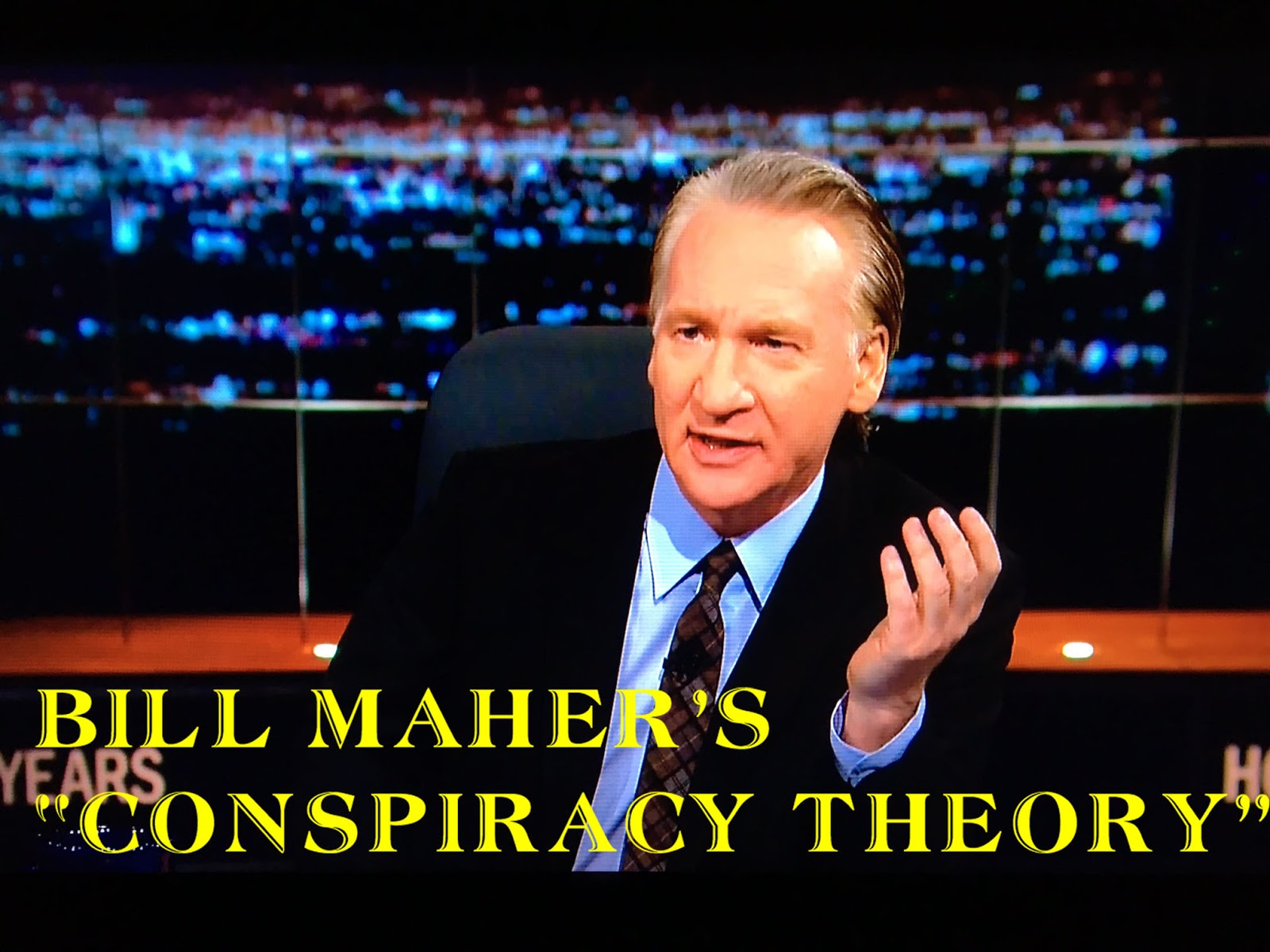
Bill Maher’s Conspiracy Theory- His Opinions About 9/11 Strongly Expressed, He Makes An Accusation of US Government Implementation of “False Flag” Attack On American Public- Weird?

With an election result that few except Michael Moore apparently expected there are quite a few people who may be in a weird place these days, but Bill Maher seemed to be coming from a rather weird place before the election.  He offered his viewers a conspiracy theory.

On his last Real Time With Bill Maher show broadcast before the election, Friday, November 4 (Season 14, Episode 37- It's the episode where Maher finally attains his long sought goal of interviewing President Obama), Maher spoke about a “slow moving right wing coup” telling us that: “This could fucking happen in this country.”

He wasn’t just speaking of the possible materialization of the election outcome prophesied by Michael Moore.  It went beyond.

Worriedly mentioning the recent rash of media reports about the `politicization' of the FBI, Maher said: “And of course in security law enforcement agencies it's usually right wing folks. The difference between fascism- And I know that's a strong word- that's what it is - and what we have enjoyed in this country for 240 years is that those types are under the rule of law. If Trump gets elected they're not: they ARE the rule of law.”

In criticizing the complacency of David Frum, one of the guests on his panel that night, he spoke about “old thinking”:
“Thinking in terms of someone who gets elected and is going to abide by the rule of law. That's not what these people will do. The reason why I use the word `fascism' is because of the cult of personality with the dictator, and they don't care about rule of law. It's going to be Donald Trump president, Chris Christie attorney general of the United States, and he's never been a vengeful guy-we know that from Bridgegate - and Rudy Giuliani the head of the FBI. You want to live in that country?”
Bill Maher then went so far as to suggest to his audience that, with the rule of law departed from by these individuals, we'd see our U.S. Government mount a false flag attack on our own county to seize even more power (he brought up the notorious German Reichstag fire after Hitler's election).

He said: “You know that Hitler was elected, And three months after he was elected, What did he do? He burned the Reichstag to create an `emergency' where he needed more powers. Don't you think that they would have that in their mind?”

FASCINATING: Bill Maher's “conspiracy theory” duplicates almost exactly the 9/11 “conspiracy theories” of others that Maher has vehemently castigated,* the only real difference being that Bill Maher is positing his conspiracy in the future and that he thinks that Bush, Cheney and Rumsfeld were characters more constrained by the “rule of law” than Trump, Christie and Guiliani would be.
 (* On  September 14, 2007 in the New Rules segment of his show Maher made fun of “crazy people” who thought the government brought down the two Twin Towers in a controlled explosion.  This was followed up, October 24, 2007, with the widely reported incident where Maher got tough with and insulted six heckling 9/11 Truther activist protestors who had infiltrated his audience and interrupted his show, shouting things like the question: “What about Building 7 " -i.e. the third tower that went down much later that day in a similar-looking fast and total collapse. The heckling incident does not appear to have been a faked one to make Maher look tough, because more about it, including the names of the protesters, and an interview, are available.  In 2011 Maher criticized those doubting that Osama Bin Laden was responsible for the attack.)
Interestingly weird on Bill Maher’s part. . . And, in another weirdness, just a few programs before this accusation against a possible incoming Trump administration he suggested (clip available) that because the people of the USA are “stupid” (and we face apocalypse) that a despotic elite should simply anoint technocrat Hillary Rodam Clinton as president. Merely another comicly based fantasy on his part?

On the show where Maher posited a “false flag” operation by the incoming Trump administration, he off-handedly quipped how, the election pending, the show could even be his very last.  Such speculation is not far-fetched.  Maher’s previous show, “Politically Incorrect” was canceled by ABC because in September of 2001 he controversially contradicted statements of President George W. Bush after the World Trade Center was destroyed.

Bush said (with the House of Representatives and Senate following suit to back him) that the World Trade Center had been destroyed by hijackers who were `cowards’ and “cowardly.”  Maher said that choosing to be in an “airplane when it hits the building, say what you want about it, . .   not cowardly.”  When the subject is `courage’ vs. `cowardice,’ not the despicability of attacks undertaken with the knowldge thousands of civilians will be killed, that seems correct: If you believe hijackers got on airplanes intending that they die by slamming into buildings it is hard to call them cowards.

Maher suggested something else even more controversial that, by comparison, it was “cowardly for the United States to launch cruise missiles on targets thousands of miles away,” a remark that, would today assuredly be updated to refer to overseas drone attacks conducted by operators not physically in any jeopardy as they remain in the United States.

What happened to Mr. Maher and his “Politically Incorrect” after 9/11?. .

Ari Fleischer, the White House press secretary, denounced Mr. Maher, saying the nation was in a time when people have to watch what they say and watch what they do.”  Mr. Maher lost his sponsors and his show was promptly off the air.

Last week, the week after the election, was Maher's last show of the season.  His conspiracy theory was out-of-sight and he was speaking more mildly of being in "uncharted waters."  His next show: He expects the first show of his next season will broadcast in January on Inauguration DayHere's expecting. . . . what?

Tuesday, January 29, 2013

Tsk, Tsk: Criticism of Beyoncé’s Lip Syncing . . A Distraction From More Serious Issues And Moral Choices

President Barack Obama’s second inaugural speech last week had a lot in it that ought to have commanded serious attention, like the fact that he said, “We will respond to the threat of climate change” and his calls for equality with his alliterative allusions to “Seneca Falls, and Selma, and Stonewall.”  He spoke of protecting the young and future generations including those of Newtown.  There was his proclamation that a “rising middle class” is imperative and that the “patriots of 1776 did not fight to replace the tyranny of a king with the privileges of a few or the rule of a mob.” Significantly, he spoke out against believing that in America “freedom is reserved for the lucky, or happiness for the few” while asserting that the commitments Americans make to each other through “Medicare, and Medicaid, and Social Security” do not “make us a nation of takers” but strengthen and free us “to take the risks that make this country great.”

It’s unfortunate then that so many people want to come away just talking about whether Beyoncé lip-synced her singing of the National Anthem.  Admittedly, comment on the subject is hard to resist. . .  Right after Ms. Knowles concluded the soaring notes of her rendition Gwen Ifill, moderating PBS’s coverage, said: “As we have seen many, many times in the past, that is a tough song nail and Beyoncé managed to find a way to do it today.”

Yes, indeed, but little did Ms. Ifill know that the way that Beyoncé had managed to find to deliver her otherwise pitch perfect performance was for what was piped out to the national audience to be a prerecorded version.

With wealth of around $775 million Beyoncé and Jay-Z are the richest celebrity couple in the world, which adds to the feeling that they ought to really deliver when they perform (the way that Kelly Clarkson did when she performed “My Country, 'Tis of Thee” moments before Beyoncé performed.) 

As it turns out, even though the national audience only heard Beyoncé’s prerecorded version Beyoncé was probably not lip syncing in the truest sense but singing along live to the prerecorded tape people were hearing over the speakers.  That’s the verdict of a British sound engineer after listening to an alternative feed and he opines that her actual live performance “was every bit as good as the `safety’ pre-record – in fact it was so close that it’s hard to tell them apart” (See- and hear: 'She DID sing live': Now sound expert delivers verdict on the curious case of Beyoncé's national anthem... as new audio of her performance emerges, by Chris Johnson, 24 January 2013.)

People like Jon Stewart on the Daily Show have taken humorous advantage of the distraction of this faux scandal concerning Beyoncé’s performance ethics to make serious points.

One of the quips making the rounds gets expressed thus: “As if Beyoncé were the only person in Washington to move their lips and say nothing.”
Bill Maher opened his HBO program last week with a more pointedly appropriate variation on the above, telling the cheering audience that greeted his arrival on stage:
I know why you're happy this week: Obama got reinaugurated.  That was a big thing for liberals.  But I have to say, the Republicans were right . . . He's been in office less than a week now in the second term and already the administration's rocked by scandal . . .  Beyoncé lip syncing!

    * * * *

Let that be a lesson: If you are in Washington, D.C. and you open your mouth and another voice comes out it better be the NRA, an oil company, or a bank.
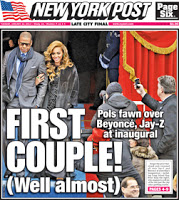
Maher may have been more on target than he knew.  The attendance of Beyoncé and Jay-Z at the inauguration provided a ready-made distraction for those who were looking for one and there were, indeed many, like Rupert Murdoch, owner of the media empire that includes Fox New and the New York Post, who would prefer that Obama’s message on the historic day not get through.  So, for example, the Post ran a full front page on its edition covering the inauguration that was nothing but a photo of  Beyoncé and Jay-Z with a tabloid-size headline proclaiming these two to be the real first couple.

What makes the distraction the celebrity couple was conveniently providing less funny and also makes the misguided fixation on Beyoncé lip syncing as `scandal’ less innocuous are the much more serious distractions that Beyoncé and Jay-Z provide, obstructing the messages Obama needs to get across.  No, I don’t refer to the fact that Beyoncé has been chastised for the promotion of sugary soda because it conflicts with Michelle Obama’s efforts to encourage healthy diets for American children as she seeks to combat the obesity epidemic.  There are other moral indicators and choices that concern me more, things that do greater damage to and greatly confuse the message Obama seeks to get out. . .

. . . Beyoncé's high-paid special performance for Libya’s Gaddafi family. .

 . . Jay-Z saying that he doesn’t understand what Occupy Wall Street is about while he himself buys into a system that perpetuates unfair privilege . .

. .    And yes, my concerns involve the moral laxity Bill Maher chided in his joke of people opening their mouths to give voice to words a disreputable organization has paid them to say. .  This extends to Jay-Z and Beyoncé, hiring out as fronts for a monopolisticly predatory real estate developer and public subsidy collector looking to neuter the rights of a community and the effectiveness of their community organizers mustering a defense.  (For more on all of this see: Tuesday, January 8, 2013, Tsk, Tsk: More Criticism of Beyoncé’s Moral Choices In a New York Times Op-Ed Piece.)

Friday, December 23, 2011

Why Someone Else Being Wealthier Actually Makes Me Poorer: Debunking a Suspect Claim

I found that the assertion stayed naggingly with me after I heard it expressed by one of the conservative talking heads appearing one night on Bill Maher’s Real Time HBO program: “Just because someone else is wealthier than I am doesn’t mean that it makes me poorer.”

I didn’t believe the statement when I heard it expressed but the way it seems to relinquish any envy gives it an attractive quality, making it sound admirably virtuous, as if it bespeaks a magnanimity of spirit even though it’s a statement wielded by the sort of spokespersons who also espouse such theories as “trickle down” economics. Somewhat inconsistently, “trickle down” economics proposes a world where another man’s accumulation of wealth can indeed be counted upon to affect your own but, optimistically, only for the better: Those who have less are expected to be satisfied by all the extra crumbs that will spill off the table with overflowing wealth. (The math behind this involves a prediction that the overall pie will always be bigger by more than the amount the wealthy themselves take.) These are the same sort of folk who now speak about the 1% Club as munificent “job creators.” Those espousing such theories can be counted upon to argue against measures such as a progressive income tax structure in order to to reduce the gap between the rich and the poor by having the wealthy pay higher income taxes.

“Just because someone else is richer doesn’t make me poorer”: Does this kind of statement really need debunking? Isn’t it just obviously wrong when you think about it? Maybe only to some and what might not be so obvious is just how many ways the statement is wrong. Let me count some ways:
1. Compensation to top executives in the United States is now paid at absurd multiples of other employees’ salaries. Ben and Jerry’s may no longer limit compensation of its highest paid employees to seven times that of entry level employees but the fact that it once did puts in perspective the kind of huge differentials now prevalent. Exact reliable figures about the ratio of top executive pay to bottom level employee pay or average employee pay level for given years is not easy to come by and the figures depend upon which group of companies one is selecting to derive one’s statistics, but whether one is looking at a ratio of 531 average employees’ salaries to1 highly compensated CEO’s, 525 or 263 to 1, 185 to 1, or 325-to-1 (the last ratio involving executives getting paid an average of $10.8 million each), each of those multiples represent corporate resources that could be redirected into hiring more employees or paying other lower-paid employees more. And isn’t it reasonable to expect that in the face of a more progressive income tax system we would likely see that kind of redistribution as the attraction of high salaries waned just as was the case when taxes were once more progressive?

2. Further, as focus shifts away from jobs being chased and held just for the sake of very high salaries mightn’t the quality of corporate management improve as a result? This is something we’d perhaps be more apt to believe if, along with Warren Buffett, we believe that executive compensation for U.S. executives is too often “ridiculously out of line with performance” and that a cooperation’s board’s ability to rein in such excessive compensation is a critical test of proper corporate governance. These then are two ways in which wealth lavished excessively on select individuals means the impoverishment others.

3. After another man is paid so many multiples more than his fellows the amount he is likely to invest should predictably be much greater than the rest of the populace and that investment will, in turn, spin off even more income. A fair amount of his wealth will probably be invested where so many of us inevitably think to invest: in stocks. Much of the nation’s wealth is owned through corporations. Ownership and control over a corporation is represented by its stock. The wealth of all of the nation’s investors intermingles in its ownership of the stock of those corporations but the intermingling is not equal in terms of ownership of the decision-making process because when it comes to corporate governance majority rules, the preferences of the minority must bend to the decisions of the majority. That majority is not added up in terms of stockholders as individuals; majority is counted up in terms of the majority of individual shares of stock. Which is to say the calculation involved is sheerly a measure of total wealth. As so much of the nation’s wealth is owned through corporations much of the nation’s policy is consequently set by the demands of those corporations but in the setting of such policy the voice of any minority ownership is lost as the corporate governance structure acts as a lens to focus the corporation’s influence behind the interests of aggregating wealth, much like a magnifying glass can bend the diffuse rays of the sun to focus on one concentrated incinerating point. Maybe I want my local environment kept clean and pure but maybe the corporations don’t, and maybe the wealthy will fly away to vacation in remote spots beyond my means where devastations to the environment will matter less to them.

4. When we think of influencing policy in the United States we think about appealing to our politicians and electing those we think will represent our interests, but every politician thinks of him or herself as having two constituencies: a.) Those individuals capable of voting for them, and b.) Their money constituency. The first is a finite constituency tied to a locality. In the United States every individual must decide where he will vote and there he will get to vote only once in each election. The monied constituency is free to cross lines. Those wealthy enough can support candidates anywhere no matter whether they live or vote where a candidate is running. They can even support candidates running against each other in the same election, and do. The amount of support supplied this way is limited only by one’s wealth and the will to deploy it. In the United States political spending in the form of contributions to political candidates is almost entirely the provenance of the very wealthy. Most of the money for the nation's political campaigns comes from .5% of the population,which means that it is really the .5% vs. the 99.5% that Occupy Wall Street ought to be talking about and 1 percent of the 1 percent account for almost a quarter of all individual campaign contributions to federal political campaigns in 2010. That means we have a government where it is going to be very difficult for ordinary citizens to get the attention of their political representatives because those representatives will spend most of their time preoccupied thinking about the donating elite. Unequal access to those entrusted with governing the nation leads, quite justifiably, to distrust of the system by those without access.

5. One reason that distrust of the system may now be very sensibly coming to the fore is that, as argued by Glenn Greenwald, the author of “With Liberty and Justice for Some: How the Law Is Used to Destroy Equality and Protect the Powerful,” we have seen a two-tier justice system emerge, one for the nation’s uppermost class, another for the less politically powerful. Normatively, the idea that the same rules apply to all ought to supply a check and balance against draconian abuses in the legal system and against violations of the law. With a two-tier system liberties are no longer protected by this check and balance. So yes, when others become a lot wealthier than the rest of us we poorer souls all become still poorer because even our life and liberty are put in jeopardy.

6. Others being wealthier also makes us poorer when we are competing in the market for the same limited resources. This is really classic supply and demand economics. More money chasing a limited supply drives prices up. Since real estate is unique and can’t be duplicated it is very easy to see how the rules apply. In 2004 when apartment prices in New York were rapidly rising the New York Times ran an article about “gazumping” which, technically, is the acceptance of higher offer from a different buyer after a handshake deal on a lower apartment price was reached. With the market awash in new cash, offers significantly trumping already accepted offers for which contracts weren't yet executed were becoming commonplace. It created a lot of pressure to close deals rapidly. A “gazumping” buyer can be particularly effective in persuading a seller to accept an offer (in the bidding practice that is considered less than entirely ethical) if they offer cash and a substantial deferential in price. Sellers may appreciate the higher prices the wealthy pay but say, for instance, you have a property that has been in a family for many years: Members of the extended family who want to buy it and keep it in the extended family (essentially maintain the status quo) may be “gazumped” out of their opportunity to do so by those who have become disproportionally wealthy. Another example involving real estate would be a neighborhood townhouse providing homes to perhaps nine renting families which is then purchased by a bet-winning hedge fund entrepreneur who, with his newly minted wealth intends to occupy the entire building after he evicts all the long-term tenants. Those tenants will have to move elsewhere. Shifting wealth will subtract from their other choices and the prices they will pay will accordingly be higher. These examples involve real estate but the same rules apply whenever there is competition for commodities that are limited.

7. Others having wealth substantially exceeding my own makes life more expensive in other ways. Sometimes the cost of living gets established as a community package. Say I live in co-op or condominium building where the expense of maintenance and operation are handled communally. If everyone in the building has resources similar to mine we are all apt to have similar notions about the value of certain expenditures and the need to make careful resource-conserving choices. But if others in the building become far wealthier than I am then they may want to hire extra doormen and porters, multiplying expenses. They may also care less about close oversight of the the wisdom with which each community dollar is spent. They may be more inclined to delegate such oversight to hired professionals at extra expense. In their view the lobby might need to be grander. The wintertime heat in the building might be ratcheted up profligately allowing windows to be flung open. The building may become unaffordable to the less affluent but because the expenditures are communally undertaken and enforced those expenses must be paid by all who stay. Those who need to move as a result will bear an extra expense but those who don’t, won’t.

8. The community-determined expenses discussed above which are enforced are presented conceptually with the example of a residential co-op or condo, but the very same sort of situation can occur when government in a locality decides to provide a higher level of more expensive services, better roads, more frequent trash pick-ups, a more ostentatious Town Hall, etc. Or it can work similarly but in reverse: As an area fills with wealthier residents there may be fewer among them who feel the need for the services of a good public library open at convenient hours throughout the week. As a result these services may be cut back.

9. Besides communally undertaken and enforced expenses there are expenses associated with living alongside wealthier people that are not enforced but nevertheless hard to avoid. Those with fewer resources appreciate some of the changes that come with a gentrifying neighborhood (renovations, cleanliness, policing may improve and some new stores may be appreciated) but one of the complaints such residents often have is that many of the stores selling merchandise at price points geared to their own incomes disappear and are replaced by stores selling merchandise at price points they can’t afford. A Starbucks may have a certain novel cachet but the Starbucks coffee can be a lot more expensive than the alternatives.

10. Looking for a new home one might also find one’s choices of apartments circumscribed by the wealth and more affluent life style of others when one encounters apartments that are available only if one pays unaffordable “amenity fees.” The amenity fees may boost the cost of renting more for those looking to save money by doubling up when they are required to be paid on a per person basis. Developers have been packing new New York City buildings with amenities like swimming pools, party and entertainment rooms, screening rooms, roof decks, etc. - There is no free lunch (although amenities sometimes include ostensibly-free regularly-served breakfasts) so these would be paid for in increased prices somehow but now developers make a practice of charging overtly for these amenities by required fees imposed in addition to the rent.

11. The very best schools, particularly colleges, are also likely to exceed the reach of the less wealthy for a variety of cumulative reasons: a.) tuition b.) higher SAT scores by virtue of hired tutors and prep c.) preference for legacy admissions based on prior family member attendance d.) Attendance at better feeder schools, and e.) donations from the family to the school. Whether or not one succeeds in sending one’s children to the nation’s select set of very top schools would not be such an significant issue (many schools are very good and more than sufficient for providing excellent educations) were it not for the fact that attendance and socializing at premier schools significantly eases the entry of the next generation into a privileged club whereby they can expect better opportunities in terms of earning wealth. Ultimately it becomes a self-perpetuating system.
The above list can no doubt easily be expanded. I invite readers to suggest additions by commenting on this post. I know the list is not all-inclusive.

I originally thought to write this article months ago back when I first mused about what had been said on Bill Maher’s show. Since that time there was an influential article in the May 2011 edition of Vanity Fair by Joseph E. Stiglitz that makes similar and related points even if its theme is not exactly the same. On point Stiglitz makes that could be added to the above list is that the nation’s decisions with respect to war are affected when there is a class wealthy enough not to send any of its children to war. Surely we are poorer when another disinvolved individual makes a decision to send our children to war. I strongly suggest that if you have appreciated this National Notice article and haven’t yet read Mr. Stiglitz’s, you read it: Of the 1%, by the 1%, for the 1%.

A final point to mention: After acknowledging that another man’s wealth can, indeed, make me poorer in all the ways mentioned, there is another economic truism to remember. . . The value of a dollar is greater to a poor person than it is to a rich person. Ergo, when a wealthy man’s wealth makes a less wealthy man poorer, the significance in the shift is greater to the poorer individual. To the extent that the shift reflects an injustice, that injustice is consequently greater.

Wednesday, November 9, 2011

Bill Maher Reiterates Theme of Plutocrats Favored By Unlevel Playing Field of "Lobbyists & Suits": Glenn Greenwald Dittos Advantaging Rules For Elite

Regarding the above headline, Maher didn’t say “plutocrats”; first he said the “right wing” and a week later he said “Republicans” but each time he was clearly referring to the 1% Club, that elite group that is specially advantaged by rules by which they want the rest of us to play, rules setting up contests they expect always to win, because as Maher says, those contests are played with “lobbyists and suits” and they have all of the “lobbyists and suits” on THEIR side.

As Rachel Maddow observed, this means the elite can ignore the 99%.

(Bill Maher, above, on the first show where he commented on futility of the plutocratically-preferred processes.)

The first time Maher ventured this thesis to explain way the 1% Club so desperately objects to the rule-changing presence of the Occupy Wall Street 99 percenters in the streets, I wrote about it in National Notice, including exactly what Maher said: Wednesday, October 26, 2011, Bill Maher: Right Wing, Wanting It THEIR Way, Yearns To Get Occupy Wall Street On THEIR Unlevel Playing Field of Lobbyists and Suits.

One week later, on his next “Real Time” edition, Maher returned to the topic of how the 1% Club craves rules that render futile for the rest of us the forms of participatory democracy into which we are conventionally channeled. I wrote about his doing so in one of two Noticing New York articles that translated how Maher’s thesis applies to the futility of public hearings in New York City for big real estate projects when those projects are handing out enormous benefit at the expense of the public to politically connected developers through heavy use of of subsidies and frequent abuse of eminent domain. (See: Wednesday, November 2, 2011, Big Politically-Connected Real Estate Projects: Ignoring The Public Majority With Futile “Participatory Democracy” Hearing Process? and Tuesday, November 8, 2011, Public Hearings For Big Real Estate Projects: Refining Your Sense of the Absurd.)

In the first of those two Noticing New York articles (linked above) I covered Maher's updating remarks about his thesis from that second show:
My point I was trying to make last week is that the Republicans don’t want them in the streets, the people, because they would like them to fight the way THEY fight, with lobbyists, where they will lose.

* * * *

When the original Red Coats. . . didn’t like it when George Washington and his troops were fighting behind trees, you know, not fighting in a straight line with red coats where they can be SHOT– It’s the same thing with these people. They’re not fighting FAIR in the way they will LOSE by going to Washington and getting a lobbyist: They’re in the streets! It’s the same way you guys are all saying about Obama, “Oh, he’s out campaigning. He’s not governing!” Yeah, he’s not sitting in Washington giving you guys bills that you’ll crumple up and throw away. He’s taking his case to the people. Is there something wrong if you are not winning with one tactic . . . . Is it so wrong to try the other tactic where you might be able to WIN?
(Above, Maher the seconds Friday night with Ron Christie reacting to his remarks.)

In that same Noticing New York piece I mentioned the very similar sentiments expressed by Chris Hedges when he was discussing Occupy Wall Street on an edition (October 24) of Charlie Rose where he and Amy Goodman were guests. (A link to the video of that discussion is available on the Noticing New York post) Hedges, described a world where it “doesn’t matter what the citizens think,” where what Goldman Sachs wants, Goldman Sachs gets because, as a practical matter: “There is no way to vote against the interest of Goldman Sachs.” Maybe you can vote as a technical matter but if you do “vote against the interest of Goldman Sachs” your vote will simply be ignored because, as Bill Maher might analyze it, your vote doesn’t count in a system where “the other side has all the lobbyists and all the suits.”

In the second of those two Noticing New York articles where I wrote about public process and big real estate projects in New York discussing the absence of the rule of law for the elite, spurred me to bring up Glenn Greenwald’s thinking:
There is a theory, a rather frightening one, that there is now a club, a political and financial class, that is above the law. I heard this theory propounded by Glenn Greenwald, the author of “With Liberty and Justice for Some: How the Law Is Used to Destroy Equality and Protect the Powerful” on a Leonard Lopate show segment yesterday.
Mr. Greenwald theorizes that we have been on a downward slope since the pardon of Richard Nixon and that there is now a elite club that expects to behave with impunity. He was utterly too convincing in the case he made. I hope it’s not true.

Here is a link and WNYC summary of the segment and you may click below to listen to it:
Glenn Greenwald on Our Justice System
Monday, November 07, 2011

Glenn Greenwald argues that, over the past four decades, the principle of equality before the law has been replaced with a two-tiered system of justice—the country's political and financial class is virtually immune from prosecution, while the politically powerless are imprisoned with greater ease and in greater numbers than in any other country in the world. With Liberty and Justice for Some reveals the mechanisms that have come to shield the elite from accountability. He shows how the media, both political parties, and the courts have abetted a process that has produced torture, war crimes, domestic spying, and financial fraud.


Maybe Mr. Greenwald should appear as a guest on one of Bill Maher’s upcoming shows. It sounds like there is a lot they could flesh out on the topic of the tailoring or rules specially benefit the 1% Club and equipping them with impunity at the expense of the rest of us.

Is it just fringe thinkers who believe this kind of special rules inequality has gotten entirely out of hand? My thoughts were picked up by a post on Norman Oder’s Atlantic Yards Report site comparing this to hot-off-the presses editorial in the Wall Street Journal. Said the Wall Street Journal in its editorial:
As important as this economic damage is [from corporate welfare/crony capitalism] the corrosive effect that corporate welfare has on public trust in government. Americans understand that powerful government invariably favors the powerful, who have the means and access to massage Congress and the bureaucracy that average citizens do not. This really is aid to the 1% paid by the other 99%.
(See: Tuesday, November 08, 2011, Catching up: WSJ on corporate welfare, Noticing New York on the connection between public hearings and the lack of public trust.)

The Journal’s editorial headlined “The Corporate Welfare State: A cause to unite the tea party and the Occupy Wall Street crowd” and beginning:
The Occupy Wall Street protesters aren't good at articulating what they want, but one of their demands is "end corporate welfare." Well, welcome aboard. Some of us have been fighting crony capitalism for decades, and it's good to have new allies if liberals have awakened to the dangers of the corporate welfare state.

Corporate welfare is the offer of special favors—cash grants, loans, guarantees, bailouts and special tax breaks—to specific industries or firms.
. . . You’ll have to be a paying Journal subscriber to read more. . . Sounds a lot like National Notice, Noticing New York (and NPR) as written here:
Monday, October 24, 2011
On NPR, Echo of Coinciding Principles Noticed: What the Tea Party and Occupy Wall Street Ought To Agree On

and here:

Tuesday, October 25, 2011
Opposition To Crony Capitalism As Uniting Cause: Resource-Grabbing Mega-Monopolies (Like Atlantic Yards) As Catalyst For Great Recessions/Depressions
When the “Wall Street Journal” begins to sound like the Occupy Wall Street Journal maybe Occupy Wall Street is having and effect.

Wednesday, October 26, 2011

Bill Maher: Right Wing, Wanting It THEIR Way, Yearns To Get Occupy Wall Street On THEIR Unlevel Playing Field of Lobbyists and Suits

(Above, Bill Maher on his show this week making the statement talked about below.)

Messages Needing To Break Through: Private Companies Keeping Public’s Solutions Off the Table

Right near the end of this week’s episode of Real Time with Bill Maher, at about the 45 minute mark, Rachel Maddow was talking about how there was no mystery to the fact that “so many common sense solutions, not very partisan solutions” to America’s problems were “off the table” because one or another “big business wants them off the table” “precluding these serious issues from getting traction.” (Crony capitalism ?)

Thomas Friedman, who in the discussion had just identified a set of issues such as a possible carbon tax (i.e. fossil fuels tax) that are vexingly “off the table” thereupon asked how “we the people” can, “leverage our energy to take these people on,” saying with exasperation that this was what he was “hungry for” right now.

That’s when Maher ventured his insight that the right wing wants Occupy Wall Street to resort to more routine and conventional forms of opposition because, if they do, those with the money will have them outgunned so that the Occupy Wall Street crowd will lose. Maher’s words:
When I see these Occupy Wall Street folks and I hear the right wing say `Humph, these people down there with their dirty, filthy. . pissing in the street’ and, you know all this stuff. It’s like, you know what?: They want them, to do it THEIR WAY. They don’t want them in the streets. They’re saying `come inside, put on a suit and get a lobbyist instead, because that way, `we know you’ll lose.’ . . .

. . . This is the only other way to get power when the other side has all the lobbyists and all the suits.
Maddow, commenting on what makes street demonstrations effective, said that demonstrations were designed to be “inconvenient” and “in the way” so they won’t be ignored.

Touré (the MSNBC correspondent and one-name author of “Who's Afraid of Post-Blackness?”) commented that inconvenience to the protesters themselves was also key because by expressing the “depth of their commitment” it gave their actions power.

Apparently concurring, Maher said about the value of the particularity of this Freedom of Assembly tactic that:
The only thing that impresses the other side is willingness to stay in the street.
With Privatization Public Expression Becomes an Option “Off the Table”

These observations accord with the key points of a Noticing New York article I posted this week about Occupy Wall Street’s free speech and how it had been effective in breaking through with its message by physically occupying the Zucotti Park space. I quoted Michael Kimmelman, the new architecture critic of The New York Times, that, “we tend to underestimate the political power of physical places” and that the power of various media aside, “nothing replaces people taking to the streets.”

I further noted that as Occupy Wall Street has been achieving surprising success in transmitting its message to a receptive public Mayor Bloomberg has reacted by redefining what he originally described as free speech as something that he no longer wants qualified as such, or to accept. It seems that pro-Wall Street Bloomberg, much as Bill Maher aptly described, would like Occupy Wall Street compelled to communicate more conventionally, on more Bloombergian terms, in which case it is doubtful its message would be getting through as effectively.

Bloomberg already has formidable potential tools at his command to bring about what he wants in terms of breaking up a ‘real estate’ insurrection: His live-in girlfriend is on the board of the private company that owns the `public’ space of Zucotti Park, and Bloomberg is very entwined with the developers of the Real Estate Board of New York who are now seeking to change the law retroactively to evict the OWS protesters.

All of this is especially important, because meaningful free speech, the ability to actually break through with a message is being increasingly threatened with new, historically unfamiliar constraints. Free speech is threatened by an escalating privatization of that which used always to be public. As I wrote, privatization of the streets and parks (real estate) is coming up as an issue right now with Occupy Wall Street but there is also the broader background issue of privatization of the basic elements and channels of speech, via unprecedented restrictions imposed by copyright and through ownership of monopoly media and airwaves. We are even having to fend off pending schemes to privatize ownership of the Internet. And the implications of such privatization for political expression are all the more bleak considering the way in which the nation’s wealth and resources are being ever increasingly skewed to the wealthy.

People publicly “taking to the streets,” is a great leveler to get popularly supported messages through. But when you take on the plutocrats, as Bill Maher suggests, those plutocrats are going to try to convince you to do so on their home playing field, an unlevel one, where you will lose because they have “all the lobbyists and all the suits.” In a world where everything is rapidly being privatized you need “lobbyists” and “suits” to express yourself, unless you resort to “taking the streets.” But, in New York City, that option too is fast being precluded to by the privatizing of previously public space: streets, sidewalks and parks. If Bloomberg and the New York City real estate oligarchs have it their way it may soon be that to demonstrate in what used to be public space you will need your own private army of lobbyists and suits.

I said a lot more about this in my Noticing New York article on the subject: Saturday, October 22, 2011, Occupy Wall Street and the Banks- Messages From Bonnie & Clyde, “They’ve Got Too Much Money”: Ownership of the Public Forum by the Wealthy?

If you read it you will also gain an appreciation (also explained here) for why the picture below depicts Mayor Bloomberg’s dogs, Bonnie and Clyde, joining the Occupy Wall Street protesters.